QUESTION IMAGE
Question
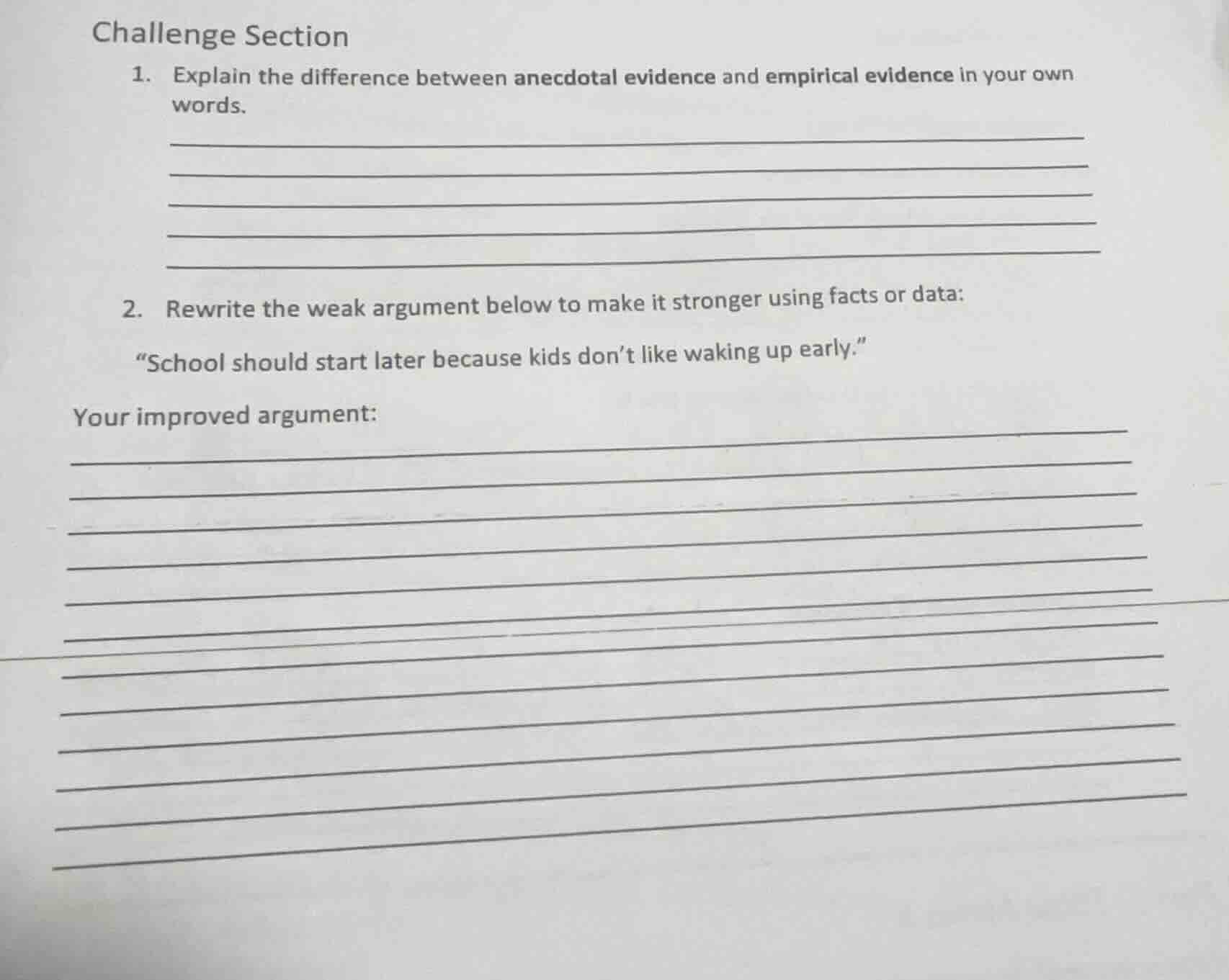
challenge section
- explain the difference between anecdotal evidence and empirical evidence in your own words.
- rewrite the weak argument below to make it stronger using facts or data:
\t\school should start later because kids don’t like waking up early.\
your improved argument:
Question 1
Anecdotal evidence is based on personal stories, individual experiences, or isolated incidents. It's often subjective and lacks systematic verification. For example, saying "My friend got better from a cold by drinking herbal tea" is anecdotal. Empirical evidence, on the other hand, is obtained through systematic observation, experimentation, or research, often involving data collection and analysis. It's more objective and reliable, like a study showing that a certain medication cures a disease in 80% of patients after clinical trials.
The original argument is weak as it's based on personal preference. To strengthen it, we can use empirical evidence related to student performance, sleep needs, or health. For example, research shows that teenagers need 8 - 10 hours of sleep, and starting school later (e.g., from 7:30 am to 8:30 am) has led to a 20% increase in test scores in some districts.

Snap & solve any problem in the app
Get step-by-step solutions on Sovi AI
Photo-based solutions with guided steps
Explore more problems and detailed explanations
Anecdotal evidence is personal, story - based, and less reliable (e.g., a single person’s experience). Empirical evidence is from systematic research/observation, objective, and more reliable (e.g., a study with data).