QUESTION IMAGE
Question
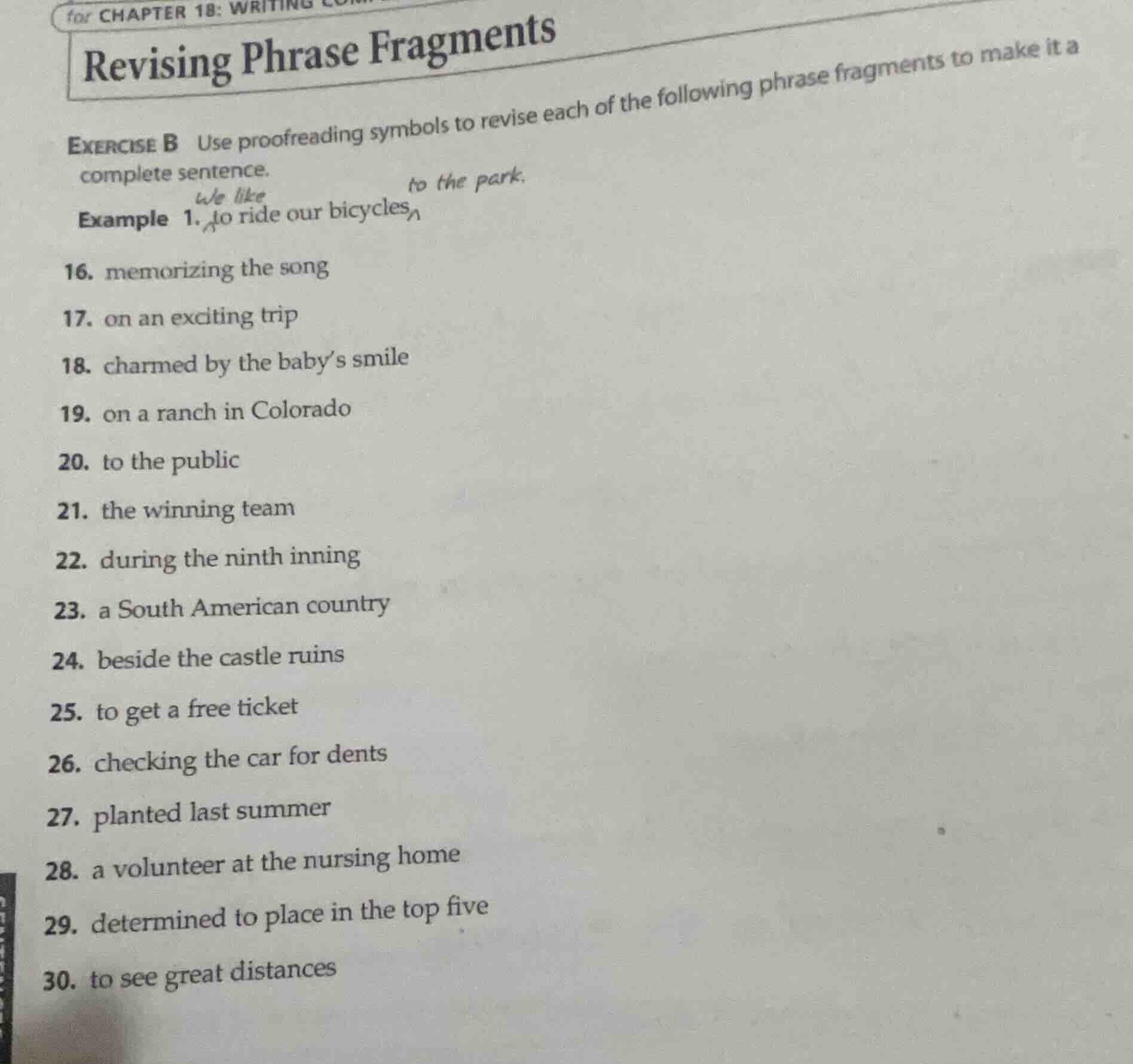
for chapter 18: writing
revising phrase fragments
exercise b use proofreading symbols to revise each of the following phrase fragments to make it a
complete sentence.
example 1. ∧we like to ride our bicycles∧ to the park.
- memorizing the song
- on an exciting trip
- charmed by the baby’s smile
- on a ranch in colorado
- to the public
- the winning team
- during the ninth inning
- a south american country
- beside the castle ruins
- to get a free ticket
- checking the car for dents
- planted last summer
- a volunteer at the nursing home
- determined to place in the top five
- to see great distances
To solve this, we need to turn each phrase fragment into a complete sentence by adding a subject and a predicate (or appropriate context). Let's take one example, say number 16: "memorizing the song".
Step 1: Identify the fragment type
"Memorizing the song" is a gerund phrase (verb - ing as a noun). We need to add a subject and a verb (or a complete predicate) to make it a sentence.
Step 2: Add a subject and predicate
We can add a subject like "She" and a predicate like "is memorizing the song" to make it a complete sentence: "She is memorizing the song."
Let's do another one, number 17: "on an exciting trip".
Step 1: Fragment type
This is a prepositional phrase. We need a subject and a verb to complete it.
Step 2: Add subject and verb
Add a subject like "We" and a verb phrase like "went" to make: "We went on an exciting trip."
For number 18: "charmed by the baby’s smile".
Step 1: Fragment type
This is a participial phrase (past participle). We need a subject.
Step 2: Add a subject
Add a subject like "I was" to make: "I was charmed by the baby’s smile."
We can follow this pattern for all the fragments:
- Identify the type of phrase (gerund, prepositional, participial, infinitive, noun phrase, etc.).
- Add the necessary components (subject, verb, or context) to form a complete sentence with a subject and a predicate.
Example Solutions for All:
- Memorizing the song → She is memorizing the song.
- On an exciting trip → We went on an exciting trip.
- Charmed by the baby’s smile → I was charmed by the baby’s smile.
- On a ranch in Colorado → He lives on a ranch in Colorado.
- To the public → The exhibit is open to the public.
- The winning team → The winning team celebrated.
- During the ninth inning → A home run was hit during the ninth inning.
- A South American country → Peru is a South American country.
- Beside the castle ruins → We picnicked beside the castle ruins.
- To get a free ticket → He stood in line to get a free ticket.
- Checking the car for dents → She is checking the car for dents.
- Planted last summer → The flowers planted last summer bloomed.
- A volunteer at the nursing home → She is a volunteer at the nursing home.
- Determined to place in the top five → He is determined to place in the top five.
- To see great distances → Eagles use their eyes to see great distances.
Each of these steps involves recognizing the phrase structure of the fragment and then adding the necessary elements (subject, verb, or context) to create a complete sentence with a subject and a predicate (a group of words that expresses a complete thought).

Snap & solve any problem in the app
Get step-by-step solutions on Sovi AI
Photo-based solutions with guided steps
Explore more problems and detailed explanations
To solve this, we need to turn each phrase fragment into a complete sentence by adding a subject and a predicate (or appropriate context). Let's take one example, say number 16: "memorizing the song".
Step 1: Identify the fragment type
"Memorizing the song" is a gerund phrase (verb - ing as a noun). We need to add a subject and a verb (or a complete predicate) to make it a sentence.
Step 2: Add a subject and predicate
We can add a subject like "She" and a predicate like "is memorizing the song" to make it a complete sentence: "She is memorizing the song."
Let's do another one, number 17: "on an exciting trip".
Step 1: Fragment type
This is a prepositional phrase. We need a subject and a verb to complete it.
Step 2: Add subject and verb
Add a subject like "We" and a verb phrase like "went" to make: "We went on an exciting trip."
For number 18: "charmed by the baby’s smile".
Step 1: Fragment type
This is a participial phrase (past participle). We need a subject.
Step 2: Add a subject
Add a subject like "I was" to make: "I was charmed by the baby’s smile."
We can follow this pattern for all the fragments:
- Identify the type of phrase (gerund, prepositional, participial, infinitive, noun phrase, etc.).
- Add the necessary components (subject, verb, or context) to form a complete sentence with a subject and a predicate.
Example Solutions for All:
- Memorizing the song → She is memorizing the song.
- On an exciting trip → We went on an exciting trip.
- Charmed by the baby’s smile → I was charmed by the baby’s smile.
- On a ranch in Colorado → He lives on a ranch in Colorado.
- To the public → The exhibit is open to the public.
- The winning team → The winning team celebrated.
- During the ninth inning → A home run was hit during the ninth inning.
- A South American country → Peru is a South American country.
- Beside the castle ruins → We picnicked beside the castle ruins.
- To get a free ticket → He stood in line to get a free ticket.
- Checking the car for dents → She is checking the car for dents.
- Planted last summer → The flowers planted last summer bloomed.
- A volunteer at the nursing home → She is a volunteer at the nursing home.
- Determined to place in the top five → He is determined to place in the top five.
- To see great distances → Eagles use their eyes to see great distances.
Each of these steps involves recognizing the phrase structure of the fragment and then adding the necessary elements (subject, verb, or context) to create a complete sentence with a subject and a predicate (a group of words that expresses a complete thought).