QUESTION IMAGE
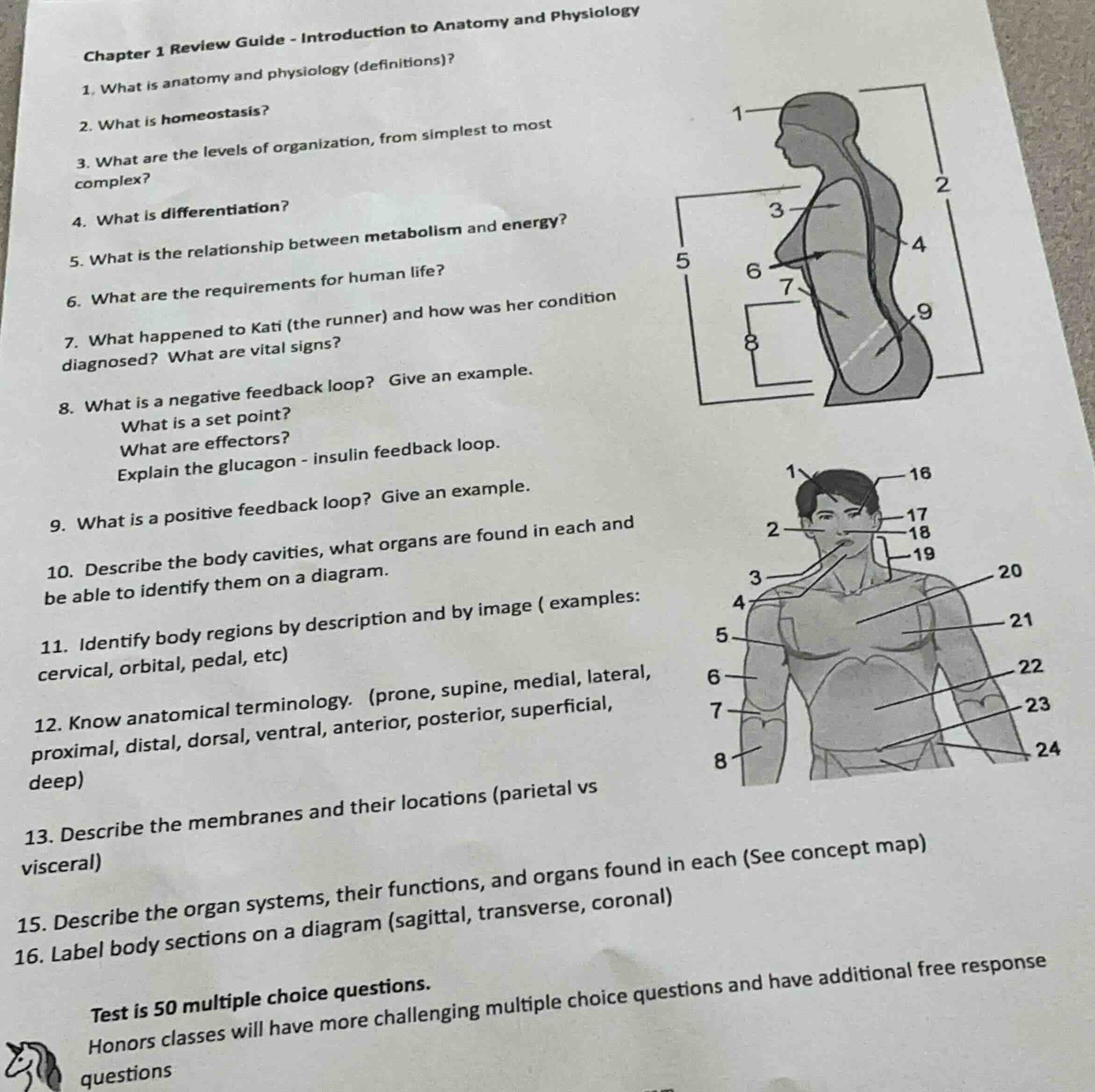
Question
chapter 1 review guide - introduction to anatomy and physiology
- what is anatomy and physiology (definitions)?
- what is homeostasis?
- what are the levels of organization, from simplest to most complex?
- what is differentiation?
- what is the relationship between metabolism and energy?
- what are the requirements for human life?
- what happened to kati (the runner) and how was her condition diagnosed? what are vital signs?
- what is a negative feedback loop? give an example.
what is a set point?
what are effectors?
explain the glucagon - insulin feedback loop.
- what is a positive feedback loop? give an example.
- describe the body cavities, what organs are found in each and be able to identify them on a diagram.
- identify body regions by description and by image ( examples: cervical, orbital, pedal, etc)
- know anatomical terminology. (prone, supine, medial, lateral, proximal, distal, dorsal, ventral, anterior, posterior, superficial, deep)
- describe the membranes and their locations (parietal vs visceral)
- describe the organ systems, their functions, and organs found in each (see concept map)
- label body sections on a diagram (sagittal, transverse, coronal)
test is 50 multiple choice questions.
honors classes will have more challenging multiple choice questions and have additional free response questions
To answer these questions, we'll address them one by one using the Answer-Explanation Format as they are conceptual questions related to Anatomy and Physiology (a subfield of Natural Science - Biology/Medicine and Health).
Question 1: What is anatomy and physiology (definitions)?
Anatomy is the study of the structure of the body (its parts and their organization). Physiology is the study of the functions of these body parts (how they work and interact to sustain life).
Homeostasis is the body’s ability to maintain a stable internal environment (e.g., stable temperature, pH, blood glucose) despite external changes, via regulatory mechanisms (like feedback loops).
The levels are: 1. Chemical (atoms, molecules), 2. Cellular (cells), 3. Tissue (groups of cells), 4. Organ (groups of tissues), 5. Organ System (groups of organs), 6. Organism (whole living being).

Snap & solve any problem in the app
Get step-by-step solutions on Sovi AI
Photo-based solutions with guided steps
Explore more problems and detailed explanations
Anatomy: Study of body structure (parts/organization).
Physiology: Study of body function (how parts work/interact).