QUESTION IMAGE
Question
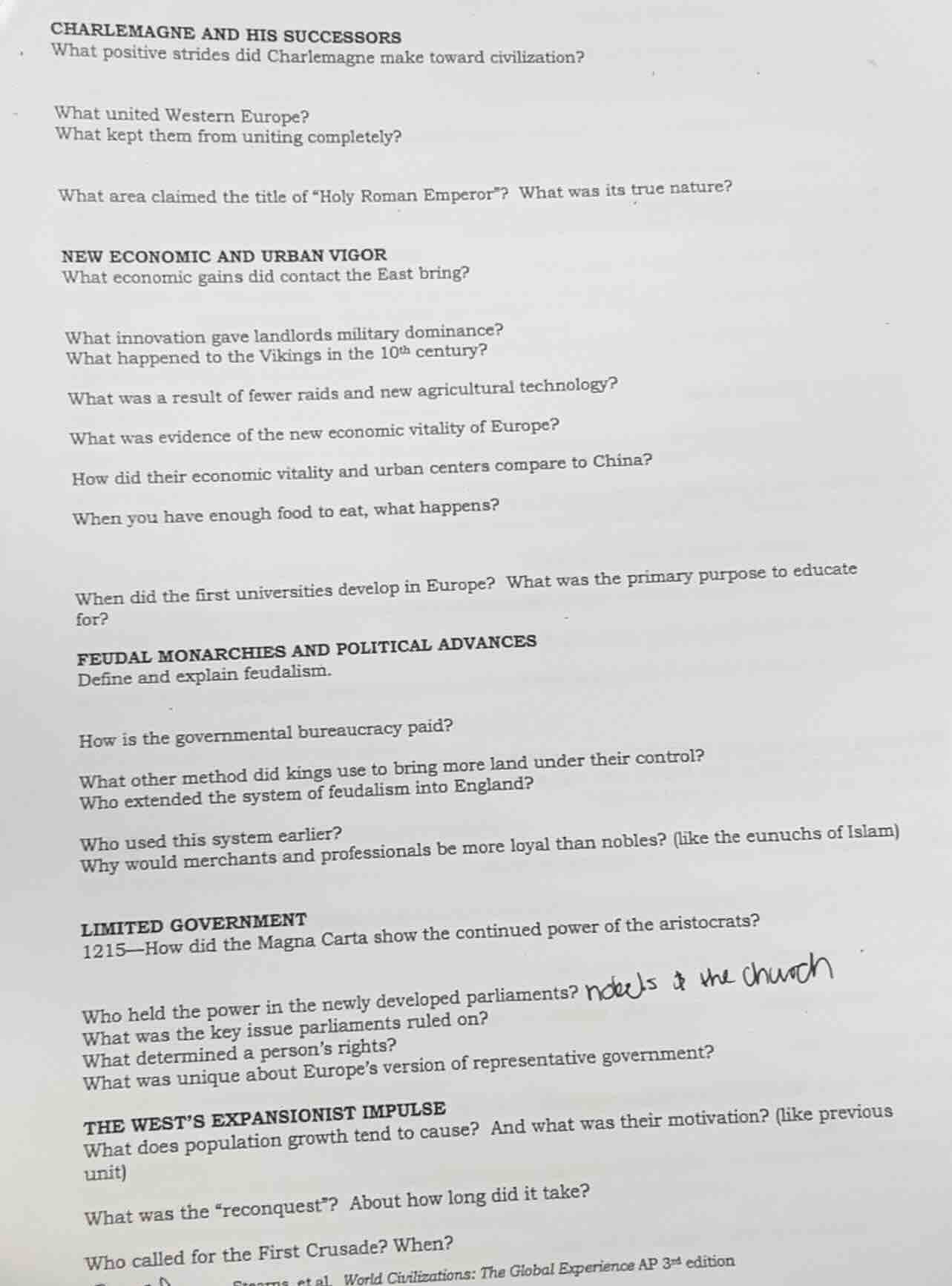
charlemagne and his successors
what positive strides did charlemagne make toward civilization?
what united western europe?
what kept them from uniting completely?
what area claimed the title of \holy roman emperor\? what was its true nature?
new economic and urban vigor
what economic gains did contact the east bring?
what innovation gave landlords military dominance?
what happened to the vikings in the 10th century?
what was a result of fewer raids and new agricultural technology?
what was evidence of the new economic vitality of europe?
how did their economic vitality and urban centers compare to china?
when you have enough food to eat, what happens?
when did the first universities develop in europe? what was the primary purpose to educate for?
feudal monarchies and political advances
define and explain feudalism.
how is the governmental bureaucracy paid?
what other method did kings use to bring more land under their control?
who extended the system of feudalism into england?
who used this system earlier?
why would merchants and professionals be more loyal than nobles? (like the eunuchs of islam)
limited government
1215—how did the magna carta show the continued power of the aristocrats?
who held the power in the newly developed parliaments?
what was the key issue parliaments ruled on?
what determined a person’s rights?
what was unique about europe’s version of representative government?
the west’s expansionist impulse
what does population growth tend to cause? and what was their motivation? (like previous unit)
what was the “reconquest”? about how long did it take?
who called for the first crusade? when?
world civilizations: the global experience ap 3rd edition
CHARLEMAGNE AND HIS SUCCESSORS
- Charlemagne promoted education, standardized laws, unified currency, and spread Christianity, laying structural groundwork for European civilization.
- A shared Christian faith, Charlemagne's centralized rule, and a common Latin cultural sphere united Western Europe.
- Regional loyalties, linguistic diversity, and the fragmentation of power after Charlemagne's death prevented full unification.
- The Germanic-speaking kingdoms of Central Europe claimed the "Holy Roman Emperor" title; it was a decentralized, fragmented confederation of states with limited real central authority.
NEW ECONOMIC AND URBAN VIGOR
- Contact with the East brought new trade goods (spices, silk), agricultural techniques, and access to broader markets, boosting European commerce.
- The stirrup (and later, heavy cavalry armor) gave landlords military dominance.
- In the 10th century, Vikings settled in regions like Normandy, converted to Christianity, and integrated into European societies, ending their raiding era.
- Fewer raids and new agricultural tech (like the three-field system) led to population growth, surplus food, and the rise of trade centers.
- Growth of urban centers, expansion of long-distance trade, and the rise of a merchant class were evidence of new economic vitality.
- Europe's economic vitality and urban centers were smaller and less centralized than China's, which had larger cities, a more developed bureaucracy, and a bigger internal market at the time.
- Surplus food leads to population growth, specialization of labor, and the rise of non-agricultural industries/urban centers.
- The first European universities developed in the 11th-12th centuries; their primary purpose was to train clergy, lawyers, and medical professionals.
FEUDAL MONARCHIES AND POLITICAL ADVANCES
- Feudalism was a hierarchical system where lords granted land (fiefs) to vassals in exchange for military service, loyalty, and labor, maintaining local order in a fragmented political landscape.
- Governmental bureaucracy was often paid with land grants or shares of local taxes/feudal dues.
- Kings used marriage alliances, military conquest, and legal claims to seize more land.
- William the Conqueror extended feudalism into England after the 1066 Norman Conquest.
- Feudalism was used earlier in medieval France and other parts of Western Europe after the collapse of the Carolingian Empire.
- Merchants and professionals relied on royal protection for their trade/livelihoods, unlike nobles who had their own land and military power, making them more loyal to central rulers.
LIMITED GOVERNMENT
- The Magna Carta (1215) forced the king to recognize the aristocrats' legal rights, limit arbitrary taxation, and follow established laws, affirming their ability to check royal power.
- Nobles, clergy, and later wealthy townspeople held power in early parliaments.
- Parliaments primarily ruled on taxation and legal disputes affecting the ruling classes.
- A person's rights were determined by their social status (noble, clergy, peasant, merchant) and feudal/legal privileges tied to that status.
- Europe's representative government included multiple estates (nobility, clergy, commoners) and developed as a check on royal power, unlike many other systems where central authority was more absolute.
THE WEST'S EXPANSIONIST IMPULSE
- Population growth tends to cause competition for land and resources; motivation for expansion included access to new farmland, trade routes, and religious zeal (spreading Christianity).
- The "r…

Snap & solve any problem in the app
Get step-by-step solutions on Sovi AI
Photo-based solutions with guided steps
Explore more problems and detailed explanations
CHARLEMAGNE AND HIS SUCCESSORS
- Promoted education, standardized laws, unified currency, spread Christianity.
- Shared Christianity, Charlemagne's rule, Latin culture.
- Regional loyalties, linguistic divides, post-death fragmentation.
- Central European Germanic kingdoms; decentralized confederation.
NEW ECONOMIC AND URBAN VIGOR
- New trade goods, agricultural tech, broader markets.
- Stirrup and heavy cavalry equipment.
- Settled, converted to Christianity, integrated into Europe.
- Population growth, surplus food, trade center rise.
- Urban growth, long-distance trade, merchant class expansion.
- Smaller, less centralized than China's larger cities/markets.
- Population growth, labor specialization, urbanization.
- 11th-12th centuries; train clergy, lawyers, medics.
FEUDAL MONARCHIES AND POLITICAL ADVANCES
- Hierarchical land-for-service loyalty system.
- Land grants, tax/feudal dues shares.
- Marriage, conquest, legal claims.
- William the Conqueror (1066).
- Medieval France/Carolingian successor states.
- Relied on royal protection for livelihoods.
LIMITED GOVERNMENT
- Restricted royal power, affirmed aristocratic legal rights.
- Nobles, clergy, wealthy townspeople.
- Taxation and ruling-class legal disputes.
- Social status and feudal/legal privileges.
- Multi-estate structure checking royal authority.
THE WEST'S EXPANSIONIST IMPULSE
- Land/resource competition; land, trade, religious zeal.
- Iberian recapture from Muslims; ~700 years.
- Pope Urban II, 1095 CE.