QUESTION IMAGE
Question
check your understanding 2
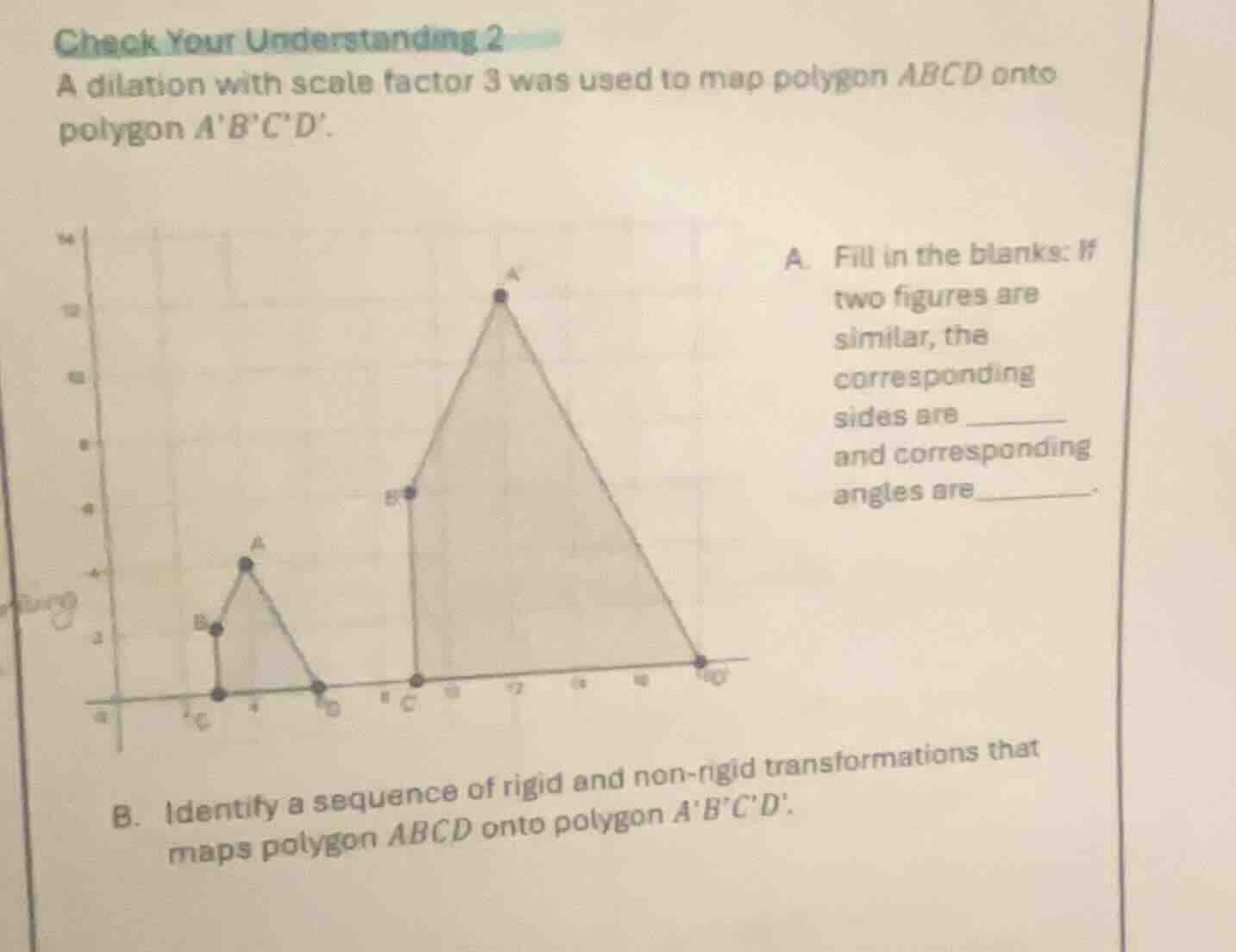
a dilation with scale factor 3 was used to map polygon abcd onto polygon abcd.
a. fill in the blanks: if two figures are similar, the corresponding sides are ____ and corresponding angles are ____.
b. identify a sequence of rigid and non - rigid transformations that maps polygon abcd onto polygon abcd.
Part A
For similar figures, by the definition of similar polygons, corresponding sides have a proportional relationship (they are in proportion or similar figures have sides that are proportional, often described as "proportional" or "in proportion", and corresponding angles are congruent (equal in measure) because similarity preserves angle measures.
- Rigid Transformation (Translation): First, we can translate polygon \(ABCD\) so that its position aligns better with \(A'B'C'D'\). Looking at the coordinates (estimating from the grid), we can find the horizontal and vertical shift. For example, if we consider the base or a key point, we can translate \(ABCD\) to the right and up.
- Non - Rigid Transformation (Dilation): Then, apply a dilation with a scale factor of 3 (as given in the problem) about the appropriate center (usually the center of dilation, which can be determined by the relationship between the pre - image and image). Dilation is a non - rigid transformation as it changes the size (but not the shape, which is consistent with similarity).
A possible sequence is:
- Translate polygon \(ABCD\) horizontally and vertically to a position such that the center of dilation (if we consider the origin or a common center) is appropriately aligned. For example, if we look at the coordinates of \(C\) (let's assume \(C\) in \(ABCD\) is at \((3,0)\) and \(C'\) in \(A'B'C'D'\) is at \((9,0)\), the horizontal distance from \(C\) to \(C'\) is \(6\) units, and the vertical alignment also suggests a translation first.
- Then perform a dilation with a scale factor of \(3\) about the center of dilation (which can be calculated or visually identified from the grid) to map the translated \(ABCD\) onto \(A'B'C'D'\).
A more precise sequence (using the grid):
- Let's assume the coordinates of \(C\) in \(ABCD\) is \((3,0)\) and in \(A'B'C'D'\) is \((9,0)\), \(B\) in \(ABCD\) is \((3,3)\) and in \(A'B'C'D'\) is \((9,9)\), \(A\) in \(ABCD\) is \((4,5)\) and in \(A'B'C'D'\) is \((12,15)\), \(D\) in \(ABCD\) is \((6,0)\) and in \(A'B'C'D'\) is \((18,0)\).
- First, translate \(ABCD\) 0 units vertically (since the y - coordinate of \(C\) and \(C'\) have a ratio of 1:3, and the vertical position of the base is on the x - axis) and 6 units to the right (from \(x = 3\) to \(x=9\) for point \(C\)).
- Then, dilate the translated \(ABCD\) with a scale factor of 3 about the origin (or the center of dilation which is consistent with the ratios). The translation moves \(ABCD\) so that the dilation center is appropriate, and the dilation with scale factor 3 enlarges the figure to the size of \(A'B'C'D'\).
So a sequence is: Translate polygon \(ABCD\) 6 units to the right (a rigid transformation), then dilate the translated polygon with a scale factor of 3 (a non - rigid transformation) about the center of dilation (e.g., the origin or the point that maps \(C\) to \(C'\) after translation) to obtain \(A'B'C'D'\).

Snap & solve any problem in the app
Get step-by-step solutions on Sovi AI
Photo-based solutions with guided steps
Explore more problems and detailed explanations
If two figures are similar, the corresponding sides are \(\boldsymbol{\text{proportional}}\) and corresponding angles are \(\boldsymbol{\text{congruent}}\).