QUESTION IMAGE
Question
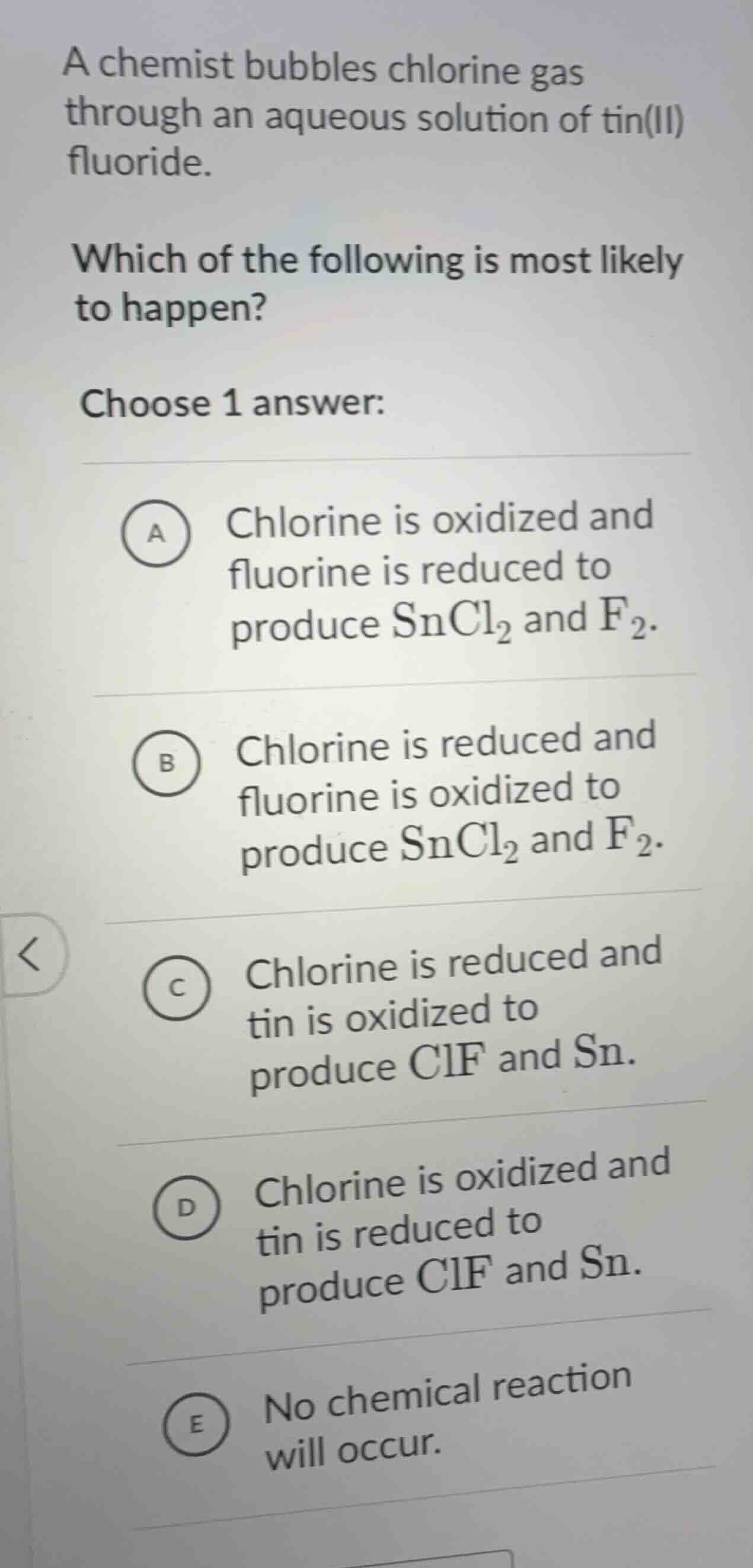
a chemist bubbles chlorine gas through an aqueous solution of tin(ii) fluoride.
which of the following is most likely to happen?
choose 1 answer:
a chlorine is oxidized and fluorine is reduced to produce sncl₂ and f₂.
b chlorine is reduced and fluorine is oxidized to produce sncl₂ and f₂.
c chlorine is reduced and tin is oxidized to produce clf and sn.
d chlorine is oxidized and tin is reduced to produce clf and sn.
e no chemical reaction will occur.
To determine the reaction, we analyze the reactivity based on the activity series of halogens and metals. Fluorine is the most reactive halogen, so it won't be displaced from its compound (tin(II) fluoride, \( \text{SnF}_2 \)) by chlorine. Also, chlorine is a stronger oxidizing agent than tin(II), but the key is the stability of fluoride ions. Fluoride is very stable, and chlorine can't oxidize fluoride to \( \text{F}_2 \). Also, for the tin - chlorine interaction, but since the fluoride is stable, no reaction occurs as chlorine can't displace fluorine (more reactive) and the tin(II) - chlorine reaction isn't feasible here due to the stability of \( \text{F}^- \) and the fact that the reaction would require a redox change that doesn't happen. So no chemical reaction occurs.

Snap & solve any problem in the app
Get step-by-step solutions on Sovi AI
Photo-based solutions with guided steps
Explore more problems and detailed explanations
E. No chemical reaction will occur.