QUESTION IMAGE
Question
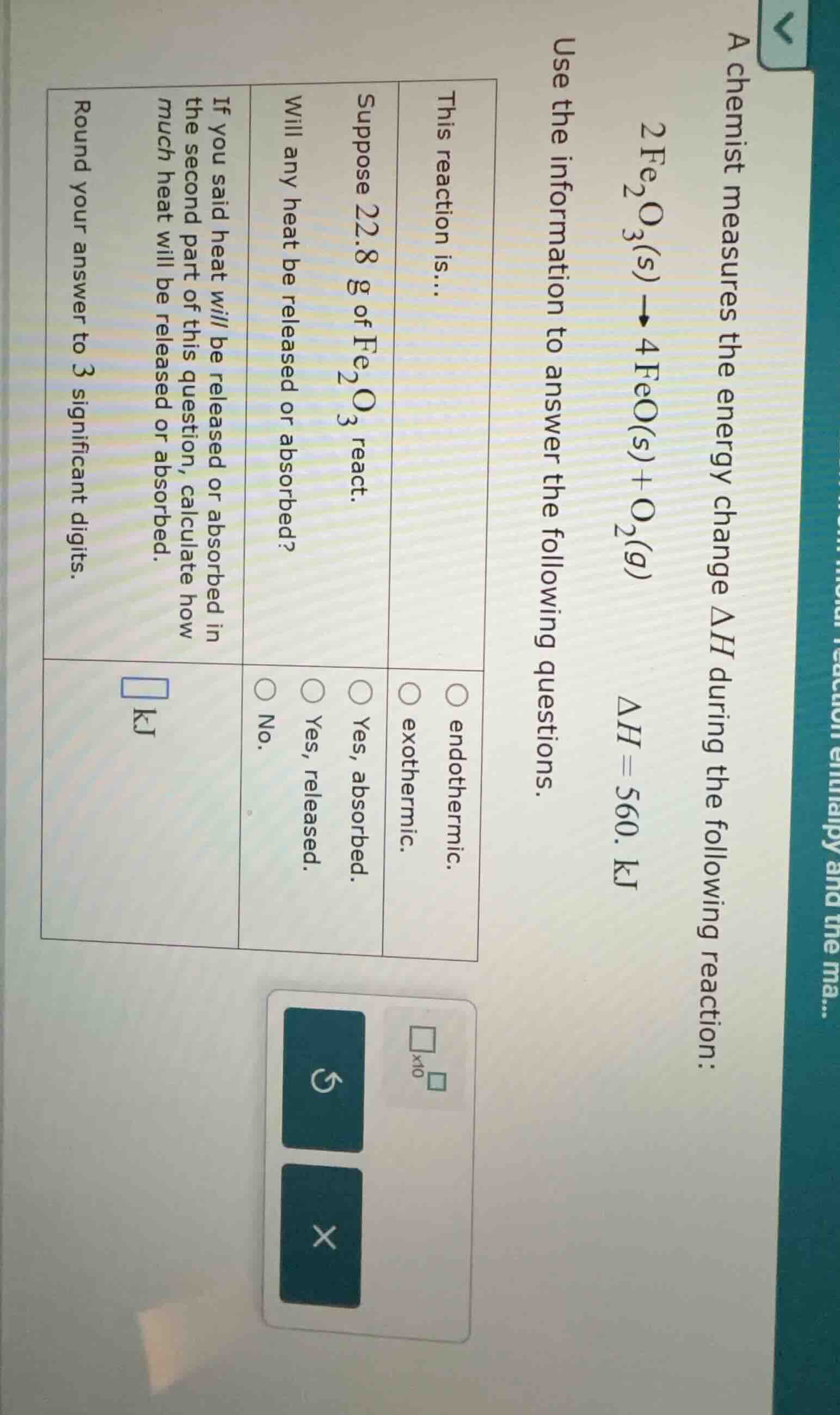
a chemist measures the energy change \\(\delta h\\) during the following reaction: \\(2\ce{fe2o3}(s) \
ightarrow 4\ce{feo}(s) + \ce{o2}(g)\\) \\(\delta h = 560.\\ \text{kj}\\) use the information to answer the following questions. this reaction is... \\(\circ\\) endothermic \\(\circ\\) exothermic suppose 22.8 g of \\(\ce{fe2o3}\\) react. will any heat be released or absorbed? \\(\circ\\) yes, absorbed. \\(\circ\\) yes, released. \\(\circ\\) no. if you said heat will be released or absorbed in the second part of this question, calculate how much heat will be released or absorbed. round your answer to 3 significant digits. \\(\square\\ \text{kj}\\)
Step1: Determine reaction type
The enthalpy change \(\Delta H = 560. \, \text{kJ}\) is positive, so the reaction is endothermic (heat is absorbed). So for the first question, the answer is endothermic. For the second question, since \(\Delta H>0\), heat is absorbed, so "Yes, absorbed".
Step2: Calculate moles of \(\ce{Fe2O3}\)
Molar mass of \(\ce{Fe2O3}\): \(2\times55.85 + 3\times16.00 = 159.7 \, \text{g/mol}\) (approx). Moles of \(\ce{Fe2O3}\): \(n=\frac{22.8 \, \text{g}}{159.7 \, \text{g/mol}} \approx 0.1428 \, \text{mol}\).
Step3: Relate moles to enthalpy change
From the reaction, \(2 \, \text{mol}\) of \(\ce{Fe2O3}\) react with \(\Delta H = 560. \, \text{kJ}\) (absorbed). For \(n = 0.1428 \, \text{mol}\), the heat absorbed \(q\) is calculated as:
\(q=\frac{560. \, \text{kJ}}{2 \, \text{mol}} \times 0.1428 \, \text{mol}\)
\(q = 280. \, \text{kJ/mol} \times 0.1428 \, \text{mol} \approx 39.984 \, \text{kJ} \approx 40.0 \, \text{kJ}\) (rounded to 3 significant digits).

Snap & solve any problem in the app
Get step-by-step solutions on Sovi AI
Photo-based solutions with guided steps
Explore more problems and detailed explanations
s:
- Reaction type: endothermic.
- Heat change: Yes, absorbed.
- Heat absorbed: \(40.0 \, \text{kJ}\)