QUESTION IMAGE
Question
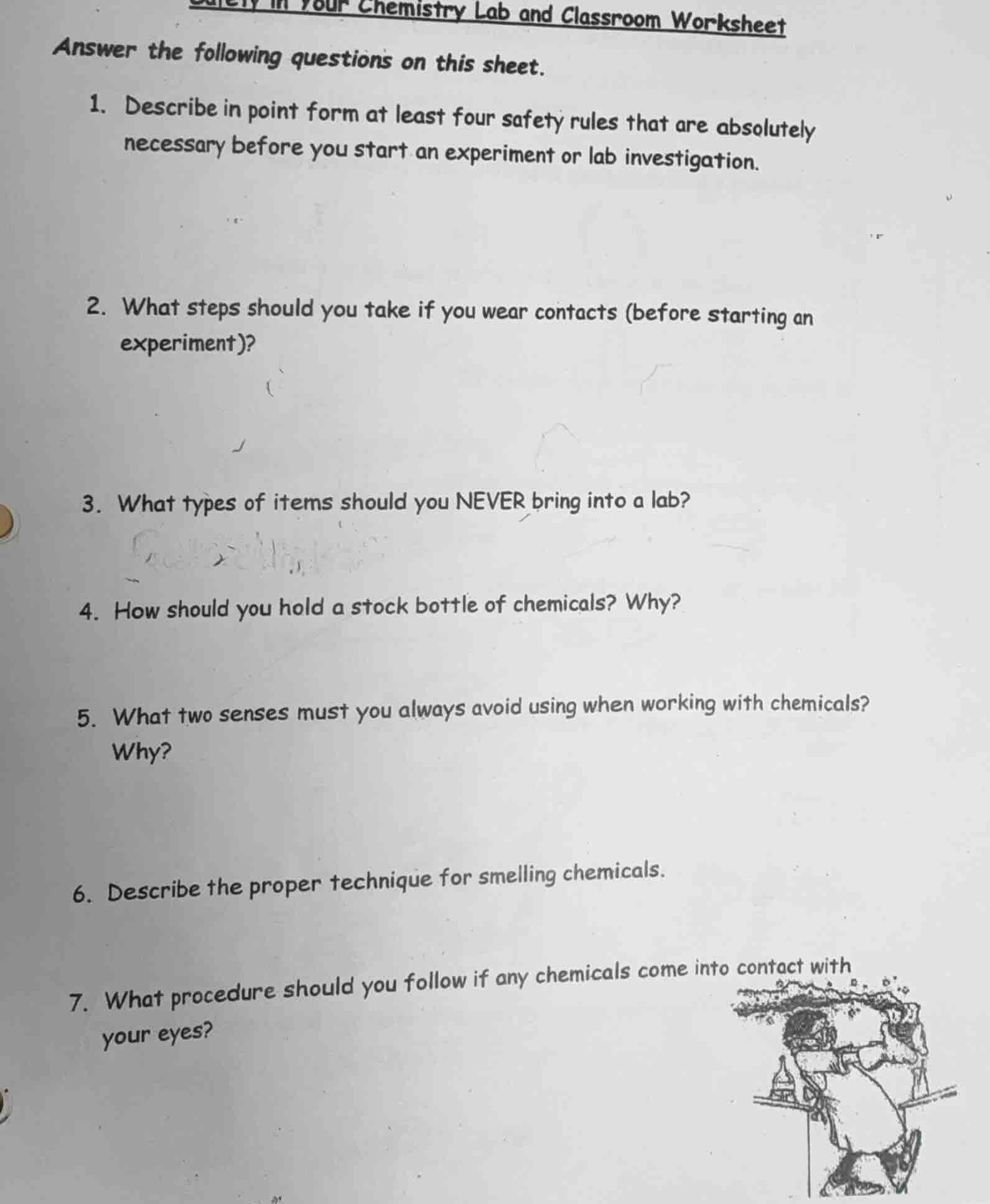
chemistry lab and classroom worksheet
answer the following questions on this sheet.
- describe in point form at least four safety rules that are absolutely necessary before you start an experiment or lab investigation.
- what steps should you take if you wear contacts (before starting an experiment)?
- what types of items should you never bring into a lab?
- how should you hold a stock bottle of chemicals? why?
- what two senses must you always avoid using when working with chemicals? why?
- describe the proper technique for smelling chemicals.
- what procedure should you follow if any chemicals come into contact with your eyes?
Question 1
- Read Instructions: Understand the experiment's steps, hazards, and safety protocols from the lab manual or instructor's guidance.
- Wear PPE: Put on appropriate personal protective equipment (PPE) like lab coats, safety goggles, gloves, and closed - toe shoes to protect against chemical spills, splashes, and physical hazards.
- Inspect Equipment: Check all lab equipment (e.g., glassware, burners, pipettes) for cracks, damage, or malfunctions. Damaged equipment can cause accidents or inaccurate results.
- Prepare Workspace: Clear the lab bench of unnecessary items, organize materials, and ensure there is proper ventilation (e.g., turn on fume hoods if needed) to minimize exposure to harmful fumes.
Contact lenses can trap chemicals against the eyes, increasing the risk of injury. So, before starting an experiment, remove contact lenses and store them safely. Then, wear appropriate eye protection like safety goggles to shield the eyes from chemical splashes, fumes, or debris.
Items that pose a safety risk or can contaminate the lab should be excluded. Food and drinks can be contaminated by chemicals or contaminate experiments. Cosmetics (like lip balm, nail polish) can react with chemicals or introduce contaminants. Electronic devices (e.g., smartphones) can be damaged by chemicals or cause distractions that lead to accidents. Jewelry (especially dangling pieces) can get caught in equipment or come into contact with chemicals, causing injury or contamination.

Snap & solve any problem in the app
Get step-by-step solutions on Sovi AI
Photo-based solutions with guided steps
Explore more problems and detailed explanations
- Read the experiment’s instructions thoroughly.
- Wear proper PPE (lab coat, goggles, gloves, closed - toe shoes).
- Inspect all lab equipment for damage.
- Organize and clear the lab workspace.