QUESTION IMAGE
Question
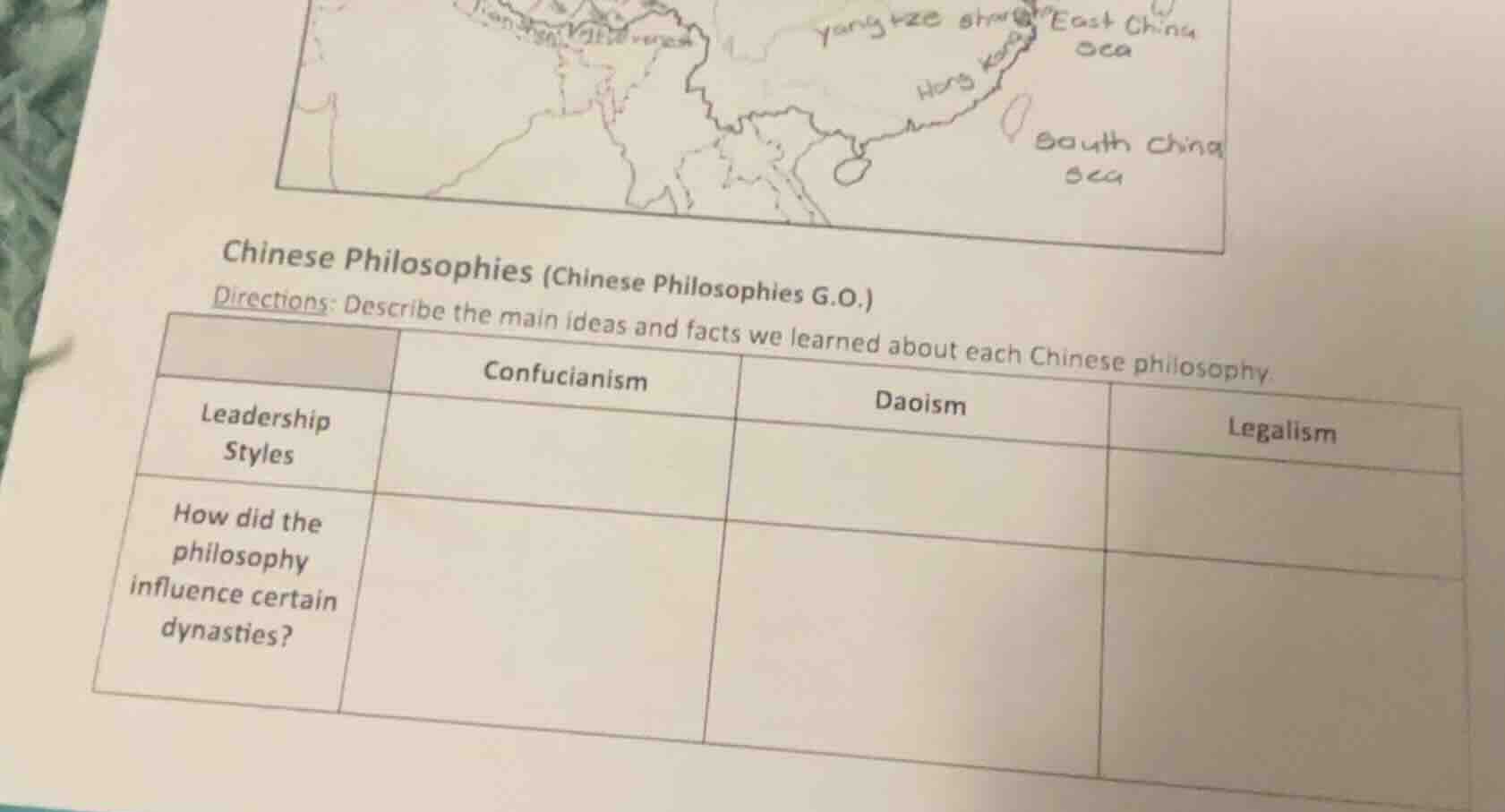
chinese philosophies (chinese philosophies g.o.) directions: describe the main ideas and facts we learned about each chinese philosophy
\t\t\t\t\t\t\t\t| | confucianism | daoism | legalism |
\t\t\t\t\t\t\t\t| leadership styles | | | |
\t\t\t\t\t\t\t\t| how did the philosophy influence certain dynasties? | | | |
Brief Explanations
Leadership Styles
- Confucianism: Focuses on moral leadership, emphasizing benevolence, ritual, and leading by example. Leaders should act with integrity and prioritize the well-being of their people, following the values of ren (benevolence) and li (proper conduct).
- Daoism: Advocates for minimal, hands-off leadership. Leaders should align with the Dao (natural way), avoid excessive control, and let things follow their natural course, rather than imposing strict rules.
- Legalism: Promotes strict, authoritarian leadership based on clear, enforced laws and harsh punishments. Leaders maintain order through absolute control, with no focus on moral persuasion.
How did the philosophy influence certain dynasties?
- Confucianism: Became the state ideology of the Han Dynasty, shaping its bureaucratic system (civil service exams based on Confucian texts). It remained the core of Chinese governance for over 2000 years, influencing dynasties like the Tang and Song by emphasizing social hierarchy and ethical leadership.
- Daoism: Influenced the early Han Dynasty (Western Han) with its "wu wei" (non-action) principle, leading to light taxes and reduced government intervention to rebuild the economy after the Qin Dynasty's collapse. It also shaped cultural and religious practices across later dynasties.
- Legalism: Was the guiding philosophy of the Qin Dynasty. It enabled the unification of China through strict laws, centralized power, and harsh punishments, but its extreme strictness contributed to the dynasty's quick collapse.

Snap & solve any problem in the app
Get step-by-step solutions on Sovi AI
Photo-based solutions with guided steps
Explore more problems and detailed explanations
| Confucianism | Daoism | Legalism | |
|---|---|---|---|
| How did the philosophy influence certain dynasties? | State ideology of Han Dynasty; shaped civil service exams and governance for 2000+ years (Tang, Song) | Guided early Western Han's light governance to rebuild the post-Qin economy | Guided Qin Dynasty's unification via centralized control; strict policies led to its quick collapse |