QUESTION IMAGE
Question
choose the best answers.
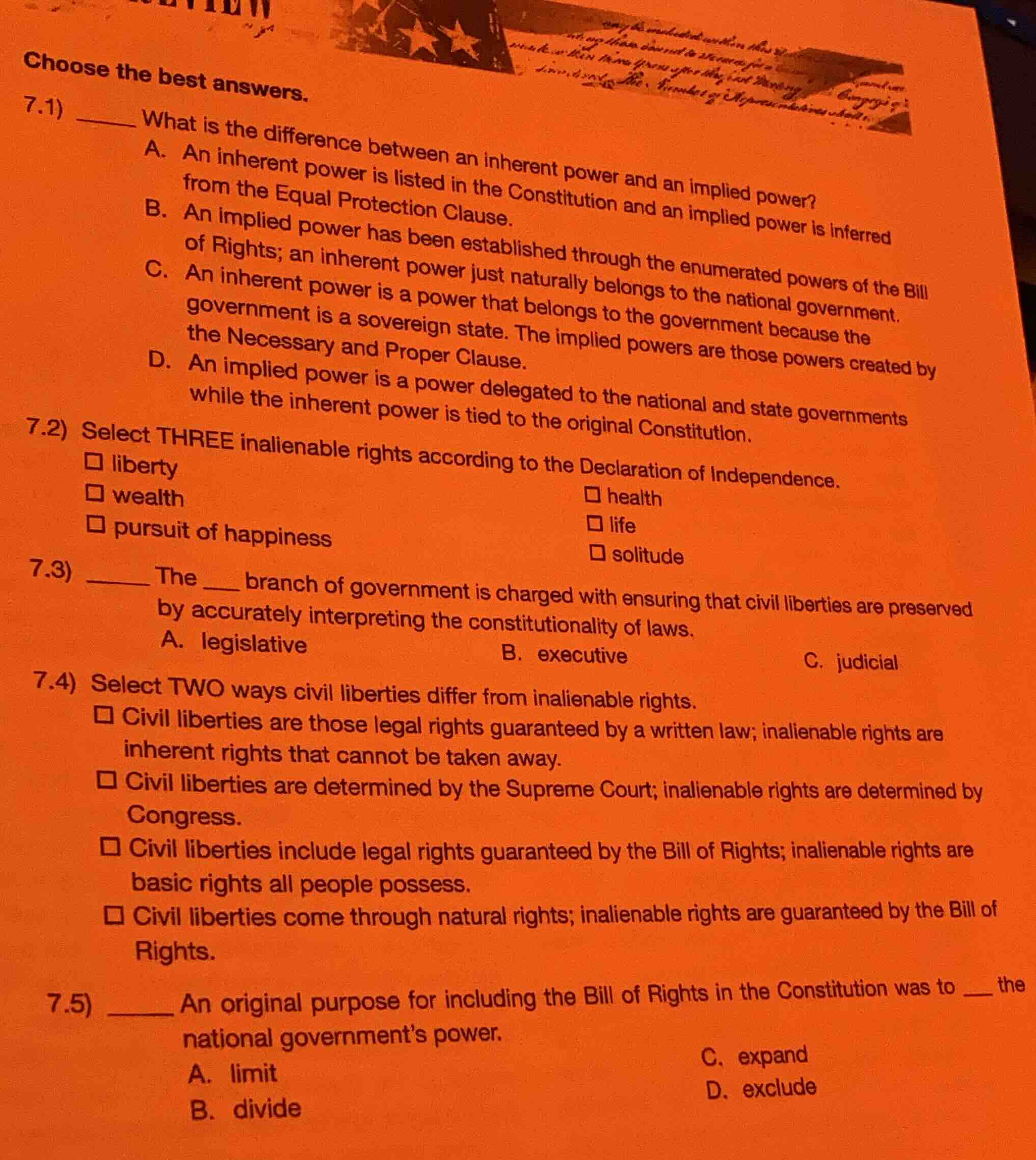
7.1) ______ what is the difference between an inherent power and an implied power?
a. an inherent power is listed in the constitution and an implied power is inferred from the equal protection clause.
b. an implied power has been established through the enumerated powers of the bill of rights; an inherent power just naturally belongs to the national government.
c. an inherent power is a power that belongs to the government because the government is a sovereign state. the implied powers are those powers created by the necessary and proper clause.
d. an implied power is a power delegated to the national and state governments while the inherent power is tied to the original constitution.
7.2) select three inalienable rights according to the declaration of independence.
□ liberty □ health
□ wealth □ life
□ pursuit of happiness □ solitude
7.3) ____ the _ branch of government is charged with ensuring that civil liberties are preserved by accurately interpreting the constitutionality of laws.
a. legislative b. executive c. judicial
7.4) select two ways civil liberties differ from inalienable rights.
□ civil liberties are those legal rights guaranteed by a written law; inalienable rights are inherent rights that cannot be taken away.
□ civil liberties are determined by the supreme court; inalienable rights are determined by congress.
□ civil liberties include legal rights guaranteed by the bill of rights; inalienable rights are basic rights all people possess.
□ civil liberties come through natural rights; inalienable rights are guaranteed by the bill of rights.
7.5) ____ an original purpose for including the bill of rights in the constitution was to _ the national government’s power.
a. limit c. expand
b. divide d. exclude
7.1)
- Option A: Inherent powers are not listed in the Constitution (implied or inherent powers are different from enumerated, and Equal Protection Clause is about equality, not defining inherent/implied powers). Eliminate A.
- Option B: Implied powers come from enumerated powers via Necessary and Proper Clause, not Bill of Rights. Inherent powers are not related to Bill of Rights. Eliminate B.
- Option C: Inherent powers are natural to a sovereign government (like regulating borders, diplomacy as inherent). Implied powers are derived from enumerated powers via Necessary and Proper Clause (e.g., Congress's power to create a national bank implied from commerce power). This matches.
- Option D: Implied powers are for national government (not shared with states in the way described), and inherent powers are not tied to original Constitution text but to sovereignty. Eliminate D.
The Declaration of Independence states "We hold these truths to be self - evident, that all men are created equal, that they are endowed by their Creator with certain unalienable Rights, that among these are Life, Liberty and the pursuit of Happiness." So the three inalienable rights are liberty, life, and pursuit of happiness.
- Legislative branch (A) makes laws.
- Executive branch (B) enforces laws.
- Judicial branch (C) interprets laws and determines their constitutionality, which involves preserving civil liberties by checking if laws violate the Constitution.

Snap & solve any problem in the app
Get step-by-step solutions on Sovi AI
Photo-based solutions with guided steps
Explore more problems and detailed explanations
C. An inherent power is a power that belongs to the government because the government is a sovereign state. The implied powers are those powers created by the Necessary and Proper Clause.