QUESTION IMAGE
Question
choosing appropriate hypotheses
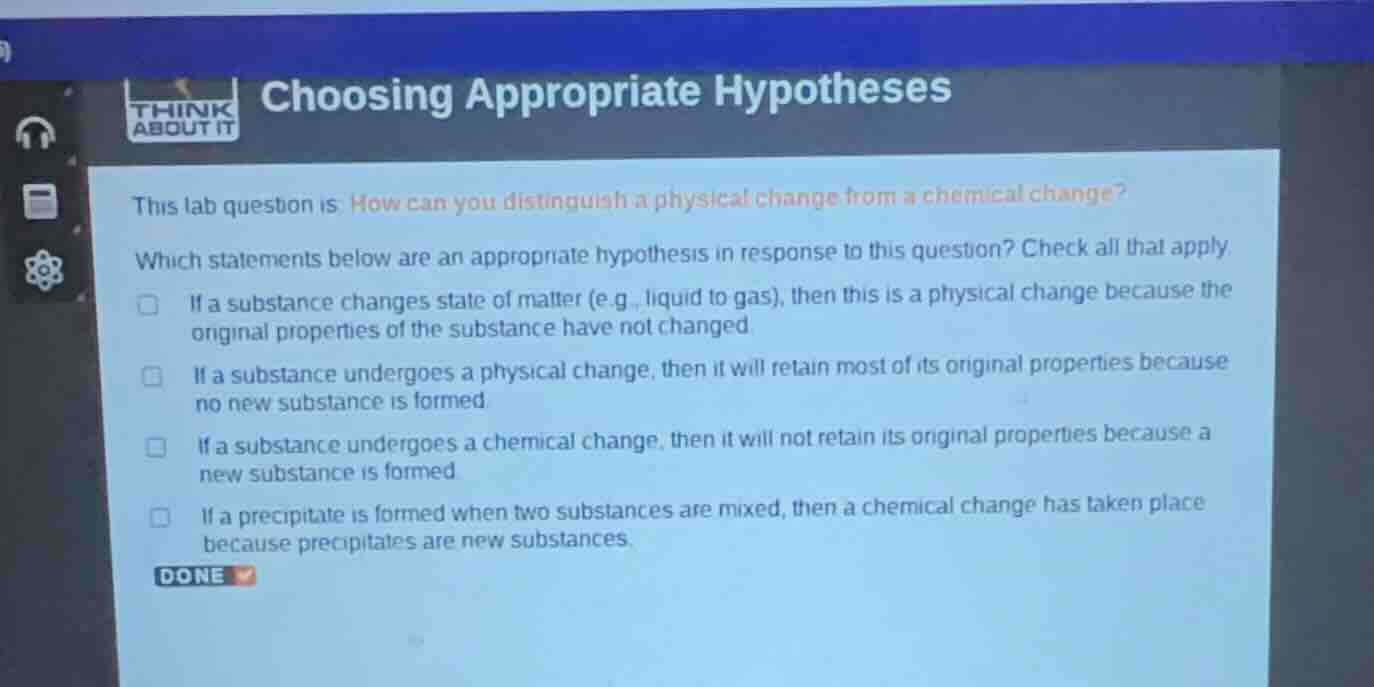
this lab question is: how can you distinguish a physical change from a chemical change?
which statements below are an appropriate hypothesis in response to this question? check all that apply
- if a substance changes state of matter (e.g., liquid to gas), then this is a physical change because the original properties of the substance have not changed.
- if a substance undergoes a physical change, then it will retain most of its original properties because no new substance is formed
- if a substance undergoes a chemical change, then it will not retain its original properties because a new substance is formed
- if a precipitate is formed when two substances are mixed, then a chemical change has taken place because precipitates are new substances.
Brief Explanations
An appropriate hypothesis for distinguishing physical and chemical changes should link observable changes to the core definitions: physical changes retain original properties (no new substance formed), while chemical changes form new substances with different properties.
- The first statement correctly identifies state change as physical, tied to unchanged properties.
- The second statement correctly links physical change to retained properties (no new substance).
- The third statement correctly links chemical change to lost original properties (new substance formed).
- The fourth statement correctly identifies precipitate formation (a new substance) as a chemical change.
All statements align with the criteria for valid hypotheses addressing the lab question.

Snap & solve any problem in the app
Get step-by-step solutions on Sovi AI
Photo-based solutions with guided steps
Explore more problems and detailed explanations
- [x] If a substance changes state of matter (e.g., liquid to gas), then this is a physical change because the original properties of the substance have not changed.
- [x] If a substance undergoes a physical change, then it will retain most of its original properties because no new substance is formed
- [x] If a substance undergoes a chemical change, then it will not retain its original properties because a new substance is formed
- [x] If a precipitate is formed when two substances are mixed, then a chemical change has taken place because precipitates are new substances.