QUESTION IMAGE
Question
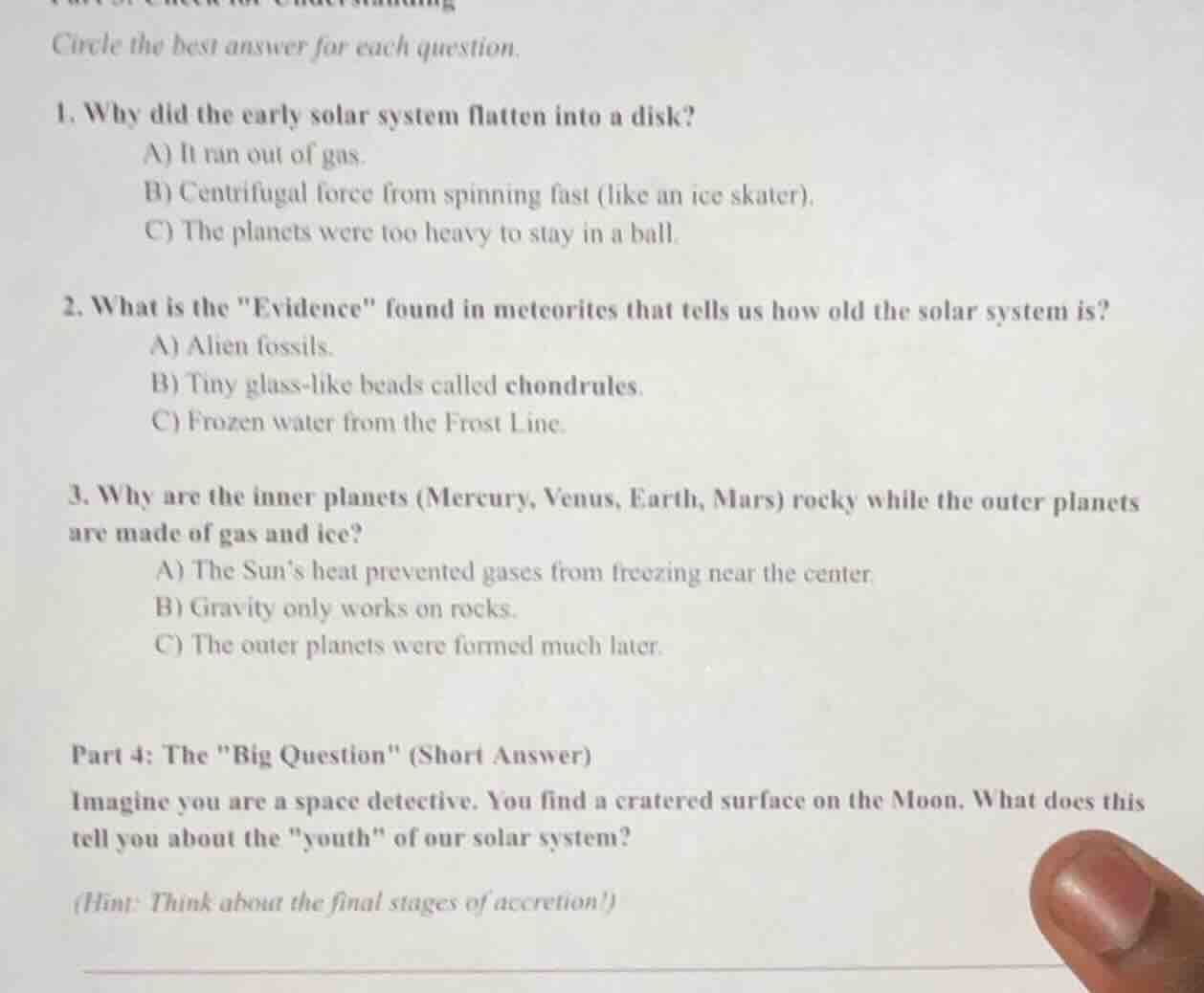
circle the best answer for each question.
- why did the early solar system flatten into a disk?
a) it ran out of gas.
b) centrifugal force from spinning fast (like an ice skater).
c) the planets were too heavy to stay in a ball.
- what is the \evidence\ found in meteorites that tells us how old the solar system is?
a) alien fossils.
b) tiny glass - like beads called chondrules.
c) frozen water from the frost line.
- why are the inner planets (mercury, venus, earth, mars) rocky while the outer planets are made of gas and ice?
a) the sun’s heat prevented gases from freezing near the center.
b) gravity only works on rocks.
c) the outer planets were formed much later.
part 4: the \big question\ (short answer)
imagine you are a space detective. you find a cratered surface on the moon. what does this tell you about the \youth\ of our solar system?
(hint: think about the final stages of accretion!)
Question 1
The early solar system flattened into a disk due to centrifugal force from rapid spinning. As the solar nebula (the cloud of gas and dust that formed the solar system) spun, the centrifugal force pushed material outward, causing it to flatten into a disk. Option A is incorrect as running out of gas isn't related to flattening. Option C is incorrect as planets didn't exist yet when the system was flattening.
Meteorites contain tiny glass - like beads called chondrules, which are important for determining the age of the solar system. Alien fossils (Option A) are not found in meteorites, and frozen water from the Frost Line (Option C) isn't the evidence for the solar system's age.
The inner planets are rocky because the Sun's heat prevented gases from condensing (freezing) near the center of the solar system. Gravity works on all matter, so Option B is wrong. The outer planets were not formed much later than the inner planets, so Option C is incorrect.

Snap & solve any problem in the app
Get step-by-step solutions on Sovi AI
Photo-based solutions with guided steps
Explore more problems and detailed explanations
B. Centrifugal force from spinning fast (like an ice skater).