QUESTION IMAGE
Question
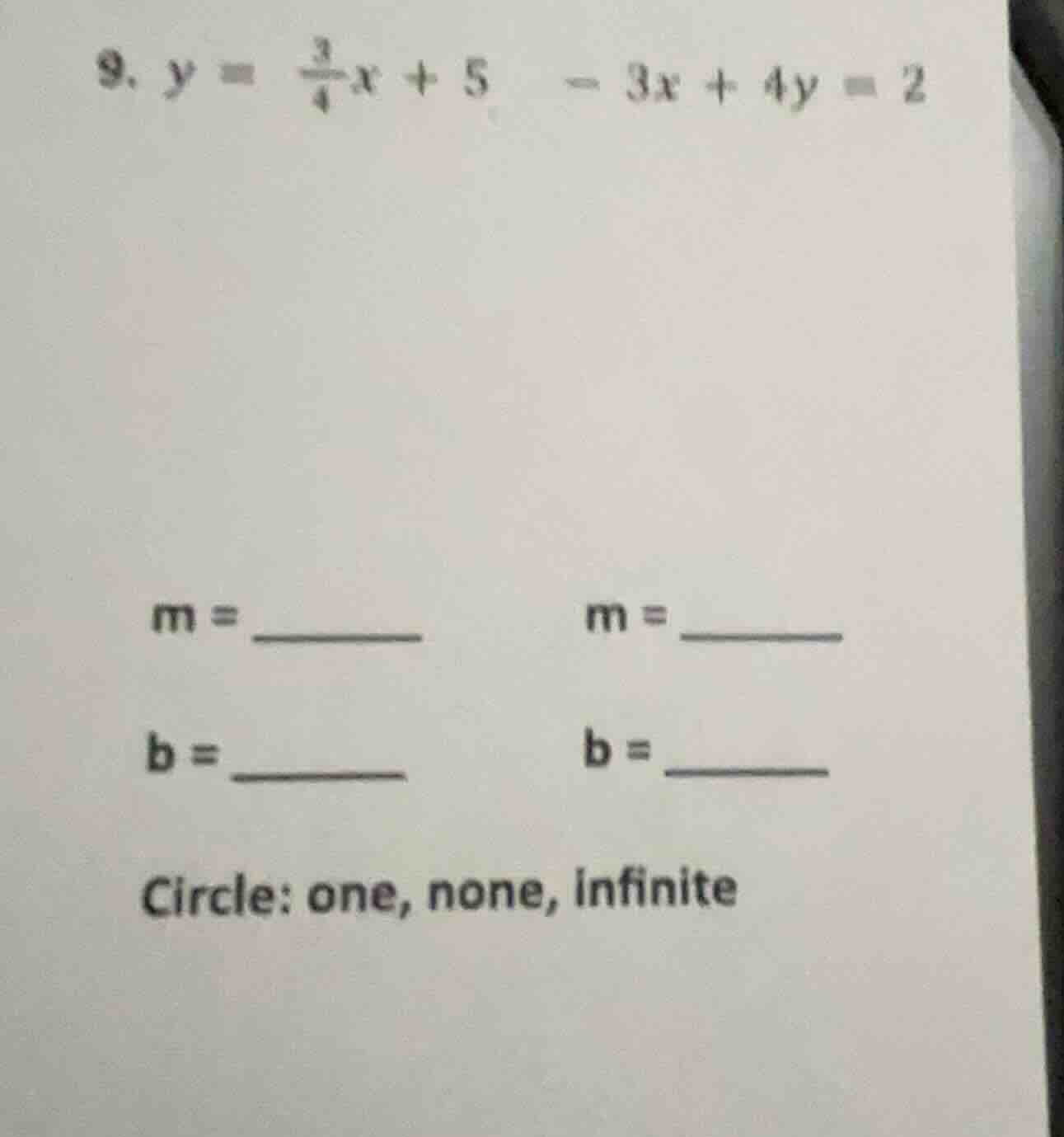
- $y = \frac{3}{4}x + 5$ $-3x + 4y = 2$
$m = \underline{\quad\quad}$ $m = \underline{\quad\quad}$
$b = \underline{\quad\quad}$ $b = \underline{\quad\quad}$
circle: one, none, infinite
Step1: Analyze the first equation \( y = \frac{3}{4}x + 5 \)
The slope-intercept form of a line is \( y = mx + b \), where \( m \) is the slope and \( b \) is the y-intercept. For the equation \( y = \frac{3}{4}x + 5 \), we can directly identify:
\( m = \frac{3}{4} \)
\( b = 5 \)
Step2: Analyze the second equation \( -3x + 4y = 2 \)
We need to rewrite this equation in slope-intercept form (\( y = mx + b \)) by solving for \( y \).
First, add \( 3x \) to both sides:
\( 4y = 3x + 2 \)
Then, divide each term by 4:
\( y = \frac{3}{4}x + \frac{2}{4} = \frac{3}{4}x + \frac{1}{2} \)
Now we can identify the slope \( m \) and y-intercept \( b \):
\( m = \frac{3}{4} \)
\( b = \frac{1}{2} \)
Step3: Determine the number of solutions (circle: one, none, infinite)
Since both lines have the same slope (\( m = \frac{3}{4} \)) but different y-intercepts (\( b = 5 \) and \( b = \frac{1}{2} \)), the lines are parallel. Parallel lines never intersect, so there are no solutions. Wait, but the problem says "circle" which might be a typo (maybe "solution"). If it's about the number of intersection points (solutions) of the two lines:
- If two lines have the same slope and same y-intercept, they are coincident (infinite solutions).
- If two lines have the same slope and different y-intercepts, they are parallel (no solutions).
- If two lines have different slopes, they intersect at one point (one solution).
Here, slopes are equal (\( \frac{3}{4} \)) and y-intercepts are different (5 vs \( \frac{1}{2} \)), so the lines are parallel, meaning no solution (none).

Snap & solve any problem in the app
Get step-by-step solutions on Sovi AI
Photo-based solutions with guided steps
Explore more problems and detailed explanations
For \( y = \frac{3}{4}x + 5 \):
\( m = \frac{3}{4} \), \( b = 5 \)
For \( -3x + 4y = 2 \):
\( m = \frac{3}{4} \), \( b = \frac{1}{2} \)
Circle (solution): none