QUESTION IMAGE
Question
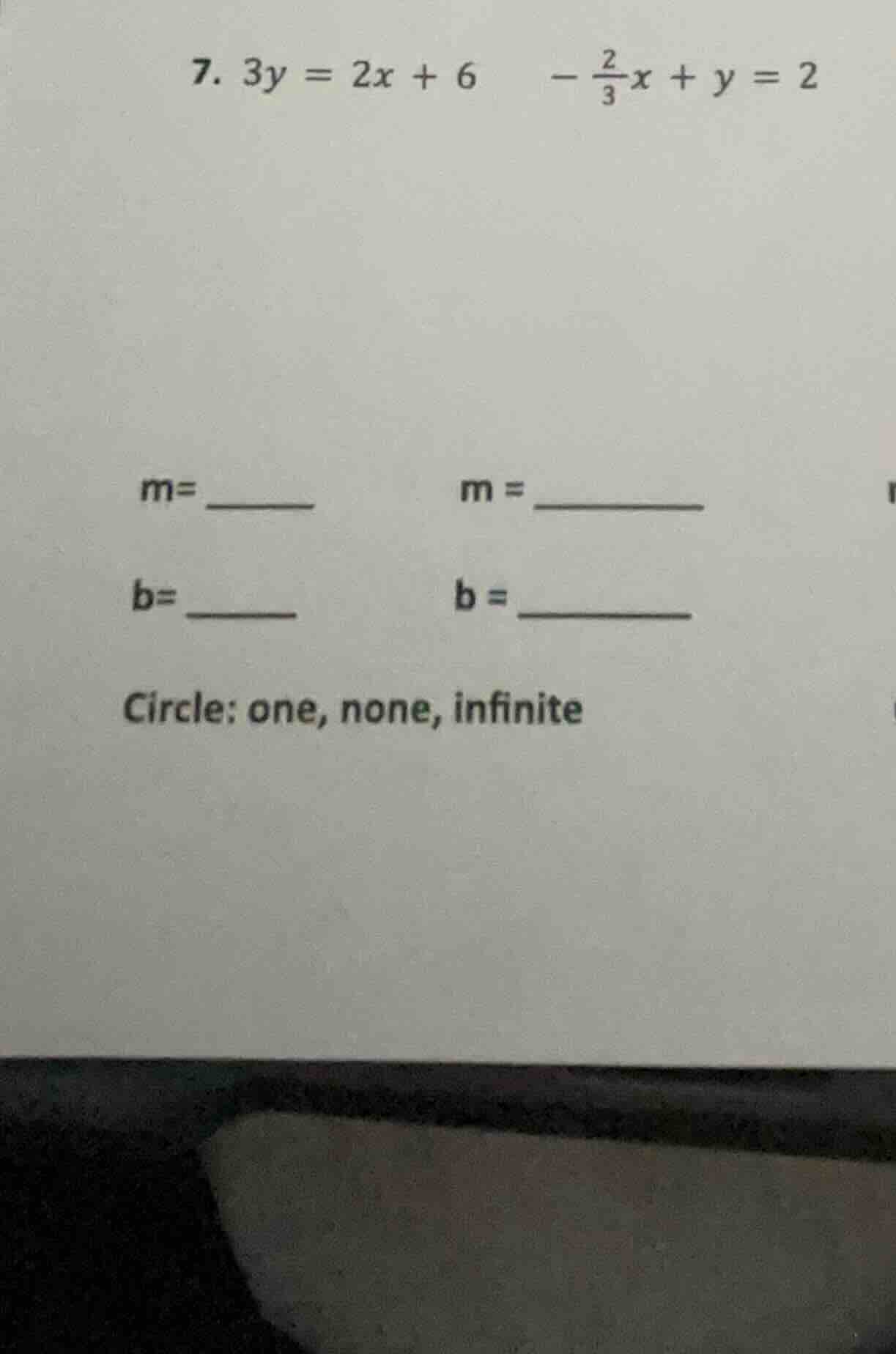
- $3y = 2x + 6$ $-\frac{2}{3}x + y = 2$
$m=$ ____ $m =$ ____
$b=$ ____ $b =$ ____
circle: one, none, infinite
Step1: Rewrite first equation in slope - intercept form
The slope - intercept form of a line is \(y = mx + b\), where \(m\) is the slope and \(b\) is the y - intercept.
Given the equation \(3y=2x + 6\), divide each term by 3:
\(y=\frac{2}{3}x + 2\)
So for the first equation, \(m=\frac{2}{3}\) and \(b = 2\).
Step2: Rewrite second equation in slope - intercept form
Given the equation \(-\frac{2}{3}x + y=2\), add \(\frac{2}{3}x\) to both sides:
\(y=\frac{2}{3}x+2\)
So for the second equation, \(m = \frac{2}{3}\) and \(b = 2\).
Step3: Determine the number of solutions
Since the two equations have the same slope (\(m=\frac{2}{3}\)) and the same y - intercept (\(b = 2\)), the two lines are coincident (they are the same line). So the number of solutions (the number of intersection points) is infinite.

Snap & solve any problem in the app
Get step-by-step solutions on Sovi AI
Photo-based solutions with guided steps
Explore more problems and detailed explanations
For the first equation: \(m=\frac{2}{3}\), \(b = 2\)
For the second equation: \(m=\frac{2}{3}\), \(b = 2\)
Circle (should be "Number of solutions"): infinite