QUESTION IMAGE
Question
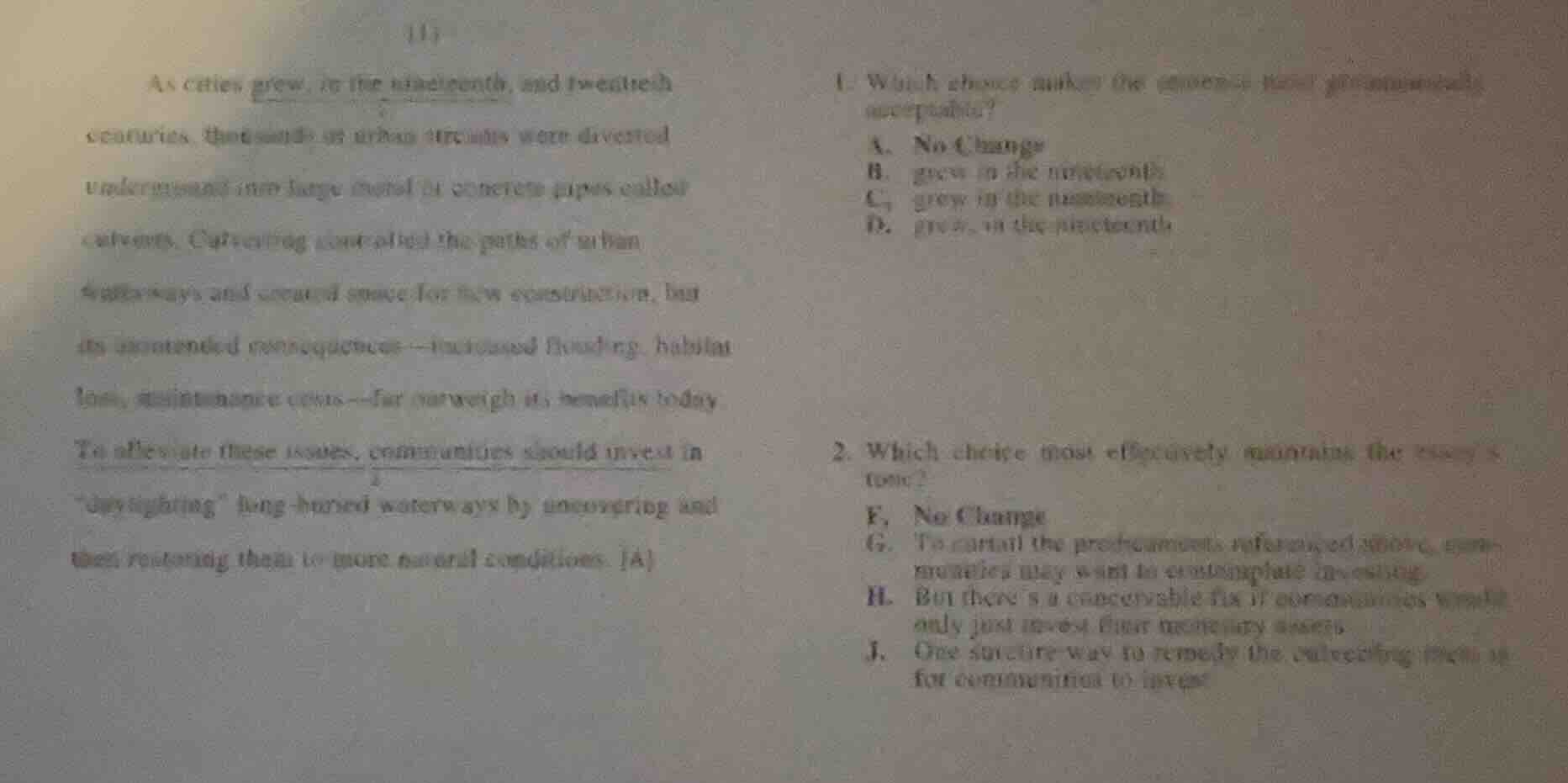
as cities grow, in the nineteenth, and twentieth centuries, thousands of urban streams were diverted underground into large metal or concrete pipes called culverts. culverting controlled the paths of urban waterways and created space for new construction, but its unintended consequences—increased flooding, habitat loss, maintenance costs—far outweigh its benefits today. to alleviate these issues, communities should invest in “daylighting” long - buried waterways by uncovering and then restoring them to more natural conditions. a 1. which choice makes the sentence most grammatically acceptable? a. no change b. grew in the nineteenth c. grow in the nineteenth d. grew, in the nineteenth 2. which choice most effectively maintains the essay’s tone? f. no change g. to curtail the predicaments referenced above, communities may want to contemplate investing h. but there’s a conceivable fix if communities would only just invest their monetary assets j. one surefire way to remedy the aforenoted ills is for communities to invest
Question 1
To determine the grammatically acceptable choice, we analyze the comma usage for years. The correct format for "in the nineteenth and twentieth centuries" should have a comma after "grew" to separate the introductory phrase. Option D ("grew, in the nineteenth") uses the comma correctly to set off the prepositional phrase "in the nineteenth (and twentieth centuries)". Options B and C lack the necessary comma, and A (No Change) has incorrect comma placement as the original likely has an error.
The essay's tone is formal and informative. Option F (No Change) maintains a formal, objective tone suitable for discussing urban infrastructure issues and solutions. Option G is wordy and less direct, H is informal ("fix" and "simply just" are casual), and J is awkwardly phrased. The original sentence ("To alleviate these issues, communities should invest...") is clear and appropriate in tone.

Snap & solve any problem in the app
Get step-by-step solutions on Sovi AI
Photo-based solutions with guided steps
Explore more problems and detailed explanations
D. grew, in the nineteenth