QUESTION IMAGE
Question
claims and arguments
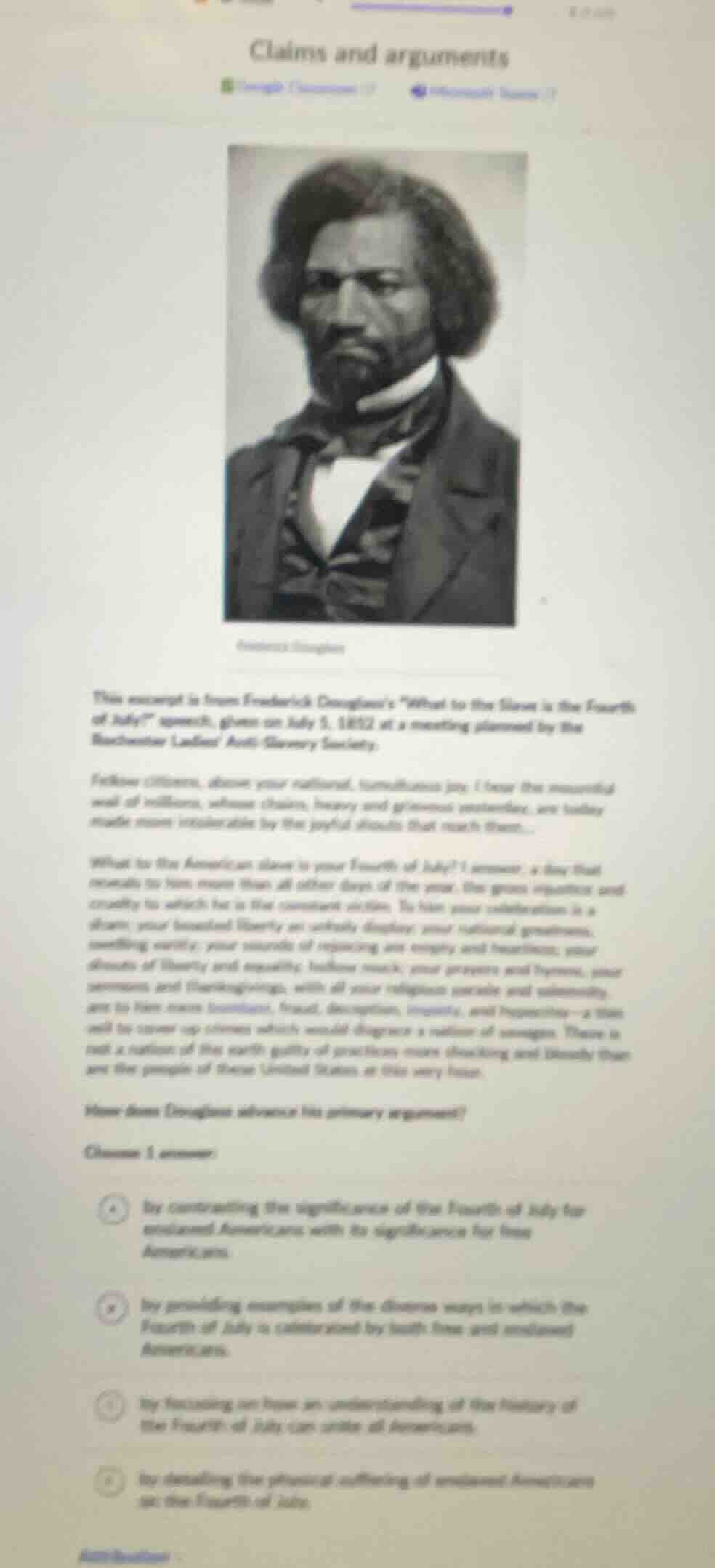
frederick douglass
this excerpt is from frederick douglass’s “what to the slave is the fourth of july?” speech, given on july 5, 1852 at a meeting planned by the rochester ladies’ anti - slavery society.
fellow citizens, above your national, tumultuous joy, i hear the mournful wail of millions, whose chains, heavy and grievous yesterday, are today made more intolerable by the joyful shouts that reach them...
what to the american slave is your fourth of july? i answer, a day that reveals to him, more than all other days of the year, the gross injustice and cruelty to which he is the constant victim. to him your celebration is a sham; your boasted liberty, an unholy license; your national greatness, swelling vanity; your sounds of rejoicing are empty and heartless; your denunciation of tyrants, brass fronted impudence; your shouts of liberty and equality, hollow mockery; your prayers and hymns, your sermons and thanksgivings, with all your religious parade and solemnity, are to him mere bombast, fraud, deception, impiety, and hypocrisy — a thin veil to cover up crimes which would disgrace a nation of savages. there is not a nation on the earth guilty of practices more shocking and bloody than are the people of these united states, at this very hour.
how does douglass advance his primary argument?
choose 1 answer:
- by contrasting the significance of the fourth of july for enslaved americans with its significance for free americans.
- by providing examples of the diverse ways in which the fourth of july is celebrated by both free and enslaved americans.
- by focusing on how an understanding of the history of the fourth of july can unite all americans.
- by detailing the physical suffering of enslaved americans on the fourth of july.
To determine how Douglass advances his argument, we analyze the options:
- The correct option (first one) is valid because Douglass contrasts the Fourth of July's meaning for free Americans (joy, celebration of liberty) with its meaning for enslaved Americans (reminder of injustice, cruelty).
- The second option is incorrect as he doesn't show how both celebrate it similarly.
- The third option is incorrect as he doesn't focus on uniting via history.
- The fourth option is incorrect as he focuses on the ideological/social suffering, not just physical, and the contrast is key, not just detailing enslaved suffering.

Snap & solve any problem in the app
Get step-by-step solutions on Sovi AI
Photo-based solutions with guided steps
Explore more problems and detailed explanations
A. by contrasting the significance of the Fourth of July for enslaved Americans with its significance for free Americans.