QUESTION IMAGE
Question
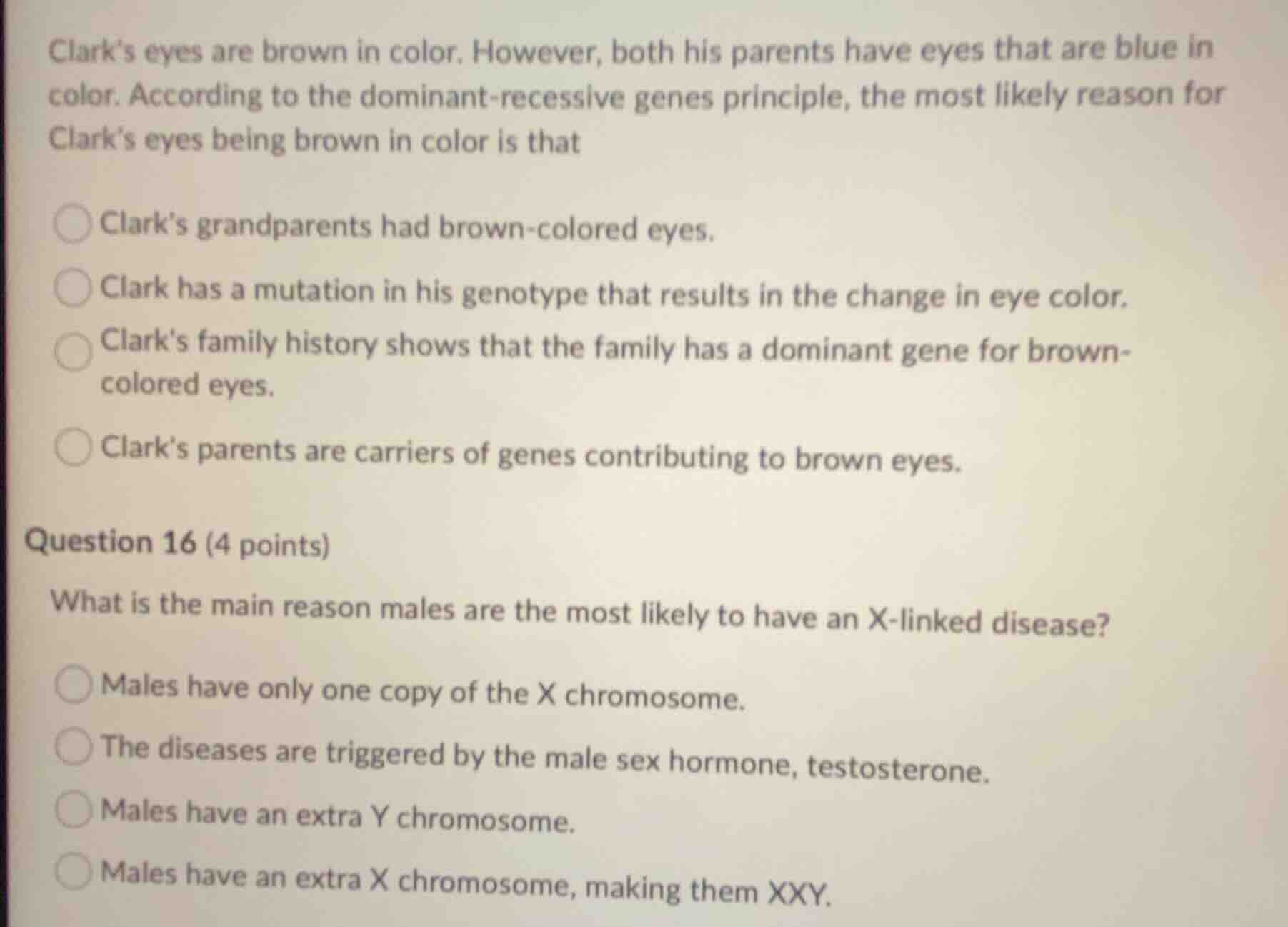
clark’s eyes are brown in color. however, both his parents have eyes that are blue in color. according to the dominant-recessive genes principle, the most likely reason for clark’s eyes being brown in color is that
clark’s grandparents had brown - colored eyes.
clark has a mutation in his genotype that results in the change in eye color.
clark’s family history shows that the family has a dominant gene for brown - colored eyes.
clark’s parents are carriers of genes contributing to brown eyes.
question 16 (4 points)
what is the main reason males are the most likely to have an x - linked disease?
males have only one copy of the x chromosome.
the diseases are triggered by the male sex hormone, testosterone.
males have an extra y chromosome.
males have an extra x chromosome, making them xxy.
First Question (Eye Color Genetics)
To solve this, we use the dominant - recessive gene principle. Blue eyes are usually recessive (let's represent the blue - eye allele as \(b\)) and brown eyes are dominant (let's represent the brown - eye allele as \(B\)). If both parents have blue eyes, their genotype should be \(bb\) (since blue is recessive, to express the blue - eye phenotype, they must have two recessive alleles). But Clark has brown eyes, so his genotype must be \(Bb\) or \(BB\). For him to get a dominant \(B\) allele, his parents must be carriers of the brown - eye (dominant) gene.
- Option 1: Grandparents' eye color doesn't directly explain Clark's eye color as we focus on his parents' genetics.
- Option 2: Mutation is a less likely explanation compared to the normal inheritance of a recessive - carried dominant allele.
- Option 3: If the family had a dominant gene for brown eyes, his parents (with blue eyes) would not have the blue - eye phenotype as blue is recessive.
- Option 4: This is correct because if parents are carriers (they have one \(B\) and one \(b\) allele, but the \(b\) is expressed as blue eyes are recessive), they can pass on the \(B\) allele to Clark, resulting in brown eyes.
X - linked diseases are related to genes on the X chromosome. Males have a genotype of \(XY\) (one X and one Y chromosome), while females have \(XX\). For a recessive X - linked disease, a female would need two copies of the mutated allele (one on each X) to show the disease, but a male, with only one X chromosome, will show the disease if he has the mutated allele on his single X.
- Option 1: This is correct. Since males have only one X chromosome, if that X has the mutated allele for an X - linked disease, they will express the disease.
- Option 2: X - linked diseases are not triggered by testosterone.
- Option 3: Males have one Y chromosome, not an extra Y, and Y has no role in X - linked diseases.
- Option 4: XXY is a chromosomal disorder (Klinefelter syndrome) and not the normal male genotype, and it's not the reason for males being more likely to have X - linked diseases.

Snap & solve any problem in the app
Get step-by-step solutions on Sovi AI
Photo-based solutions with guided steps
Explore more problems and detailed explanations
D. Clark's parents are carriers of genes contributing to brown eyes.