QUESTION IMAGE
Question
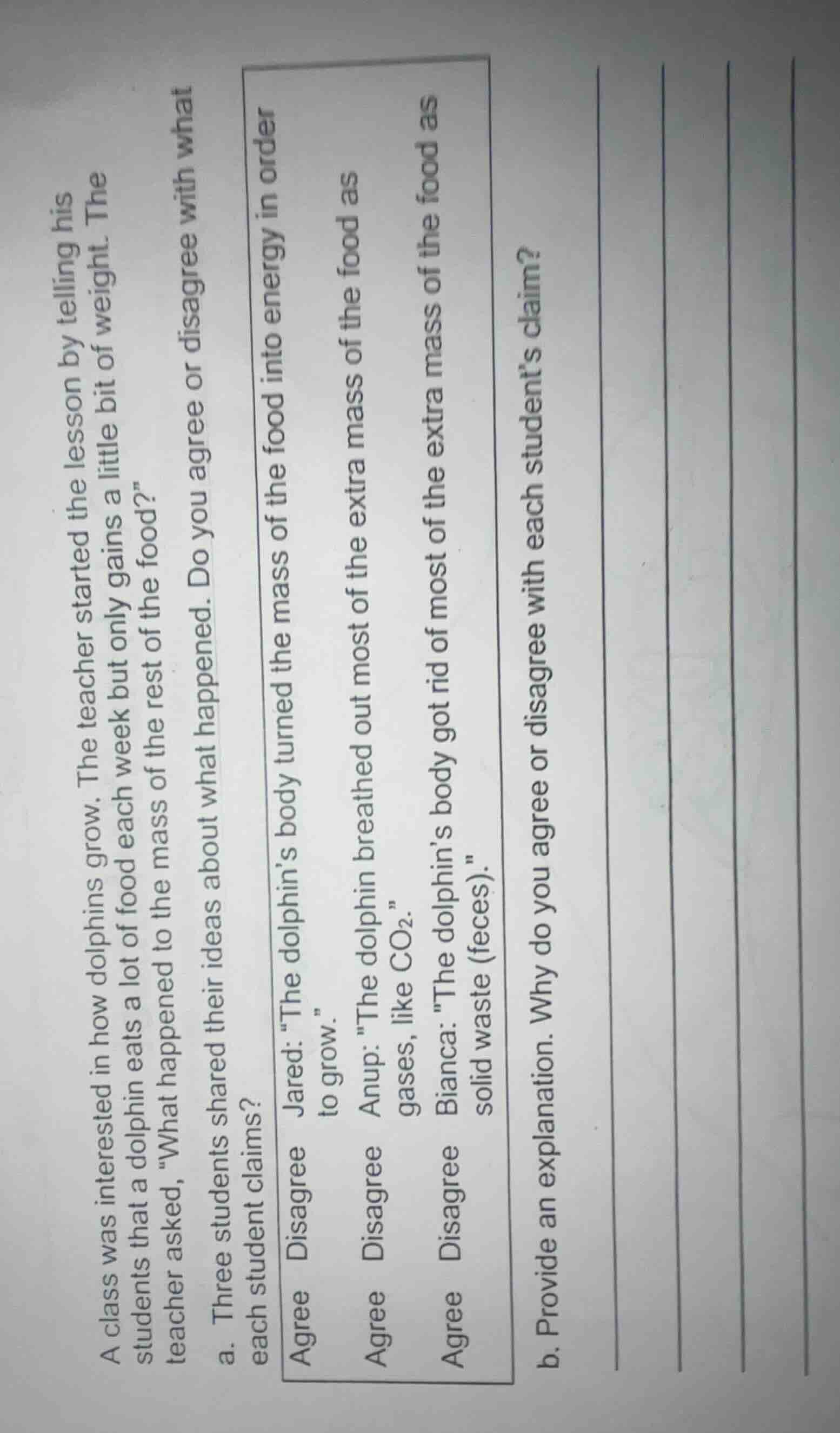
a class was interested in how dolphins grow. the teacher started the lesson by telling his students that a dolphin eats a lot of food each week but only gains a little bit of weight. the teacher asked, \what happened to the mass of the rest of the food?\ three students shared their ideas about what happened. do you agree or disagree with what each student claims?
a. three students shared their ideas about what happened. do you agree or disagree with what each student claims?
disagree agree jared: \the dolphin’s body turned the mass of the food into energy in order to grow.\
disagree agree anup: \the dolphin breathed out most of the extra mass of the food as gases, like co₂.\
disagree agree bianca: \the dolphin’s body got rid of most of the extra mass of the food as solid waste (feces).\
b. provide an explanation. why do you agree or disagree with each student’s claim?
For Jared's claim:
Food mass is used for energy via cellular respiration, but also for building body mass (growth) and waste. Not all non-gain mass becomes energy, so this is incorrect.
For Anup's claim:
Cellular respiration breaks down food, converting most of the unused mass into carbon dioxide gas that is exhaled. This aligns with biological processes of energy production and waste removal.
For Bianca's claim:
Feces are undigested food, but most of the food mass that is not used for growth is broken down and released as gas (CO₂), not excreted as solid waste. So this is incorrect.

Snap & solve any problem in the app
Get step-by-step solutions on Sovi AI
Photo-based solutions with guided steps
Explore more problems and detailed explanations
a.
- Jared: Disagree
- Anup: Agree
- Bianca: Disagree
b.
- Jared: Disagree because food mass is split into energy, growth, and waste; not all non-growth mass becomes energy.
- Anup: Agree because cellular respiration converts most unused food mass to CO₂, which is exhaled.
- Bianca: Disagree because most unused food mass is released as gas, not solid feces (feces are mostly undigested food, not processed mass).