QUESTION IMAGE
Question
class selection
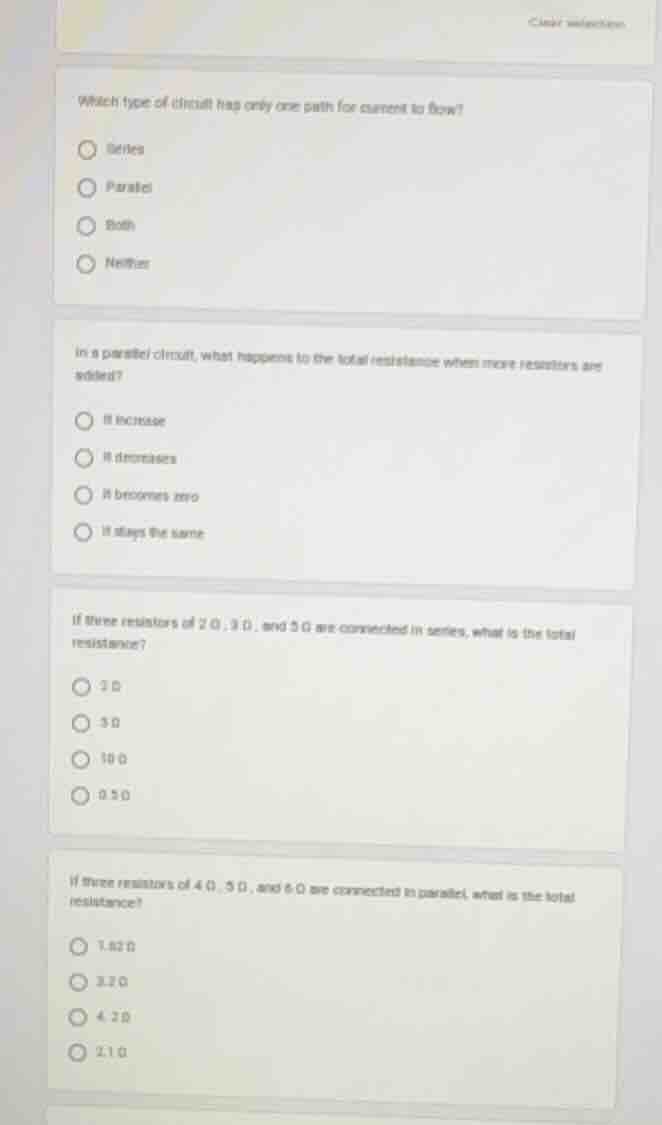
- which type of circuit has only one path for current to flow?
○ series
○ parallel
○ both
○ neither
- in a parallel circuit, what happens to the total resistance when more resistors are added?
○ it increases
○ it decreases
○ it becomes zero
○ it stays the same
- if three resistors of $2\\ \omega$, $3\\ \omega$, and $5\\ \omega$ are connected in series, what is the total resistance?
○ $2\\ \omega$
○ $3\\ \omega$
○ $10\\ \omega$
○ $0.5\\ \omega$
- if three resistors of $4\\ \omega$, $5\\ \omega$, and $6\\ \omega$ are connected in parallel, what is the total resistance?
○ $1.62\\ \omega$
○ $3.2\\ \omega$
○ $4.2\\ \omega$
○ $2.1\\ \omega$
Step1: Identify series circuit definition
A series circuit has only one current path.
Step2: Analyze parallel resistance change
For parallel circuits, adding resistors lowers total resistance.
Step3: Calculate series total resistance
Sum resistances: $2\,\Omega + 3\,\Omega + 5\,\Omega = 10\,\Omega$
Step4: Calculate parallel total resistance
Use parallel formula: $\frac{1}{R_{total}} = \frac{1}{4} + \frac{1}{5} + \frac{1}{6} = \frac{15+12+10}{60} = \frac{37}{60}$
$R_{total} = \frac{60}{37} \approx 1.62\,\Omega$

Snap & solve any problem in the app
Get step-by-step solutions on Sovi AI
Photo-based solutions with guided steps
Explore more problems and detailed explanations
- Series
- It decreases
- 10 Ω
- 1.62 Ω