QUESTION IMAGE
Question
classify the triangle by its sides and angles if it has angle measures of 37°, 59°, and 84°. (check all that apply)
a scalene
b acute
c obtuse
d isosceles
e i have not learned this yet.
question 6
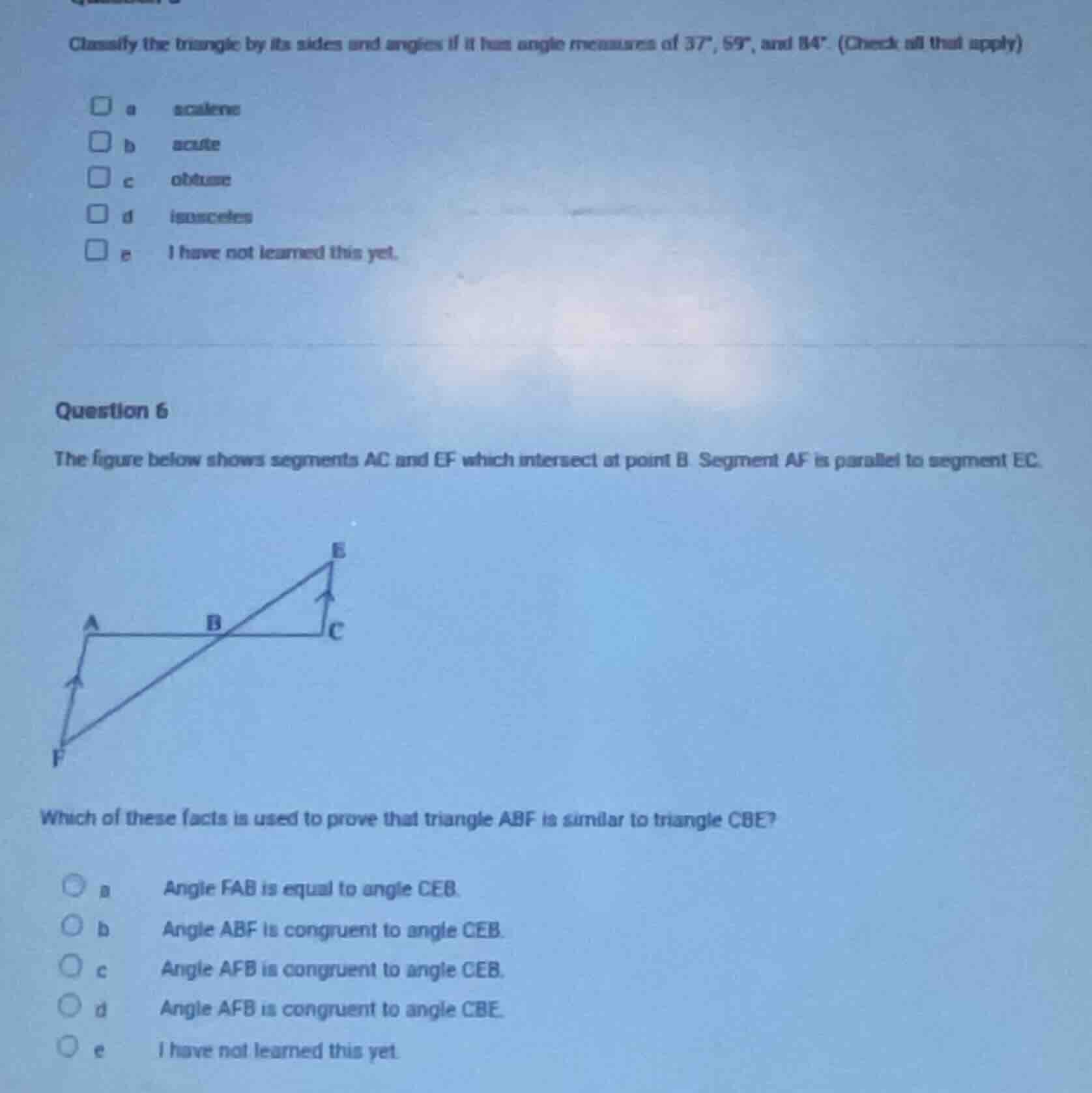
the figure below shows segments ac and ef which intersect at point b. segment af is parallel to segment ec.
which of these facts is used to prove that triangle abf is similar to triangle cbe?
a angle fab is equal to angle ceb.
b angle abf is congruent to angle ceb.
c angle afb is congruent to angle ceb.
d angle afb is congruent to angle cbe.
e i have not learned this yet.
Question 5
- By sides: A scalene triangle has all sides of different lengths (corresponding to all angles different). An isosceles triangle has at least two equal sides (and two equal angles). Here, all angles \(37^\circ\), \(59^\circ\), \(84^\circ\) are different, so it is scalene (not isosceles).
- By angles: An acute triangle has all angles less than \(90^\circ\). An obtuse triangle has one angle greater than \(90^\circ\). All given angles (\(37^\circ<90^\circ\), \(59^\circ<90^\circ\), \(84^\circ<90^\circ\)) are acute, so it is acute (not obtuse). Option "e" is incorrect as the concepts of triangle classification by sides and angles are standardly taught in geometry.
To prove \(\triangle ABF \sim \triangle CBE\), we use the AA (Angle - Angle) similarity criterion.
- Since \(AF \parallel EC\), alternate interior angles are congruent. \(\angle AFB\) and \(\angle CEB\) are alternate interior angles (formed by transversal \(EF\) cutting parallel lines \(AF\) and \(EC\)), so \(\angle AFB \cong \angle CEB\). Also, \(\angle ABF\) and \(\angle CBE\) are vertical angles (and thus congruent).
- Option a: \(\angle FAB\) and \(\angle CEB\) are not necessarily equal.
- Option b: \(\angle ABF\) and \(\angle CEB\) are not congruent.
- Option d: \(\angle AFB\) and \(\angle CBE\) are not congruent.
- Option e is incorrect as the concept of similar triangles via AA similarity (using alternate interior angles for parallel lines) is a standard geometry topic.

Snap & solve any problem in the app
Get step-by-step solutions on Sovi AI
Photo-based solutions with guided steps
Explore more problems and detailed explanations
a. scalene, b. acute