QUESTION IMAGE
Question
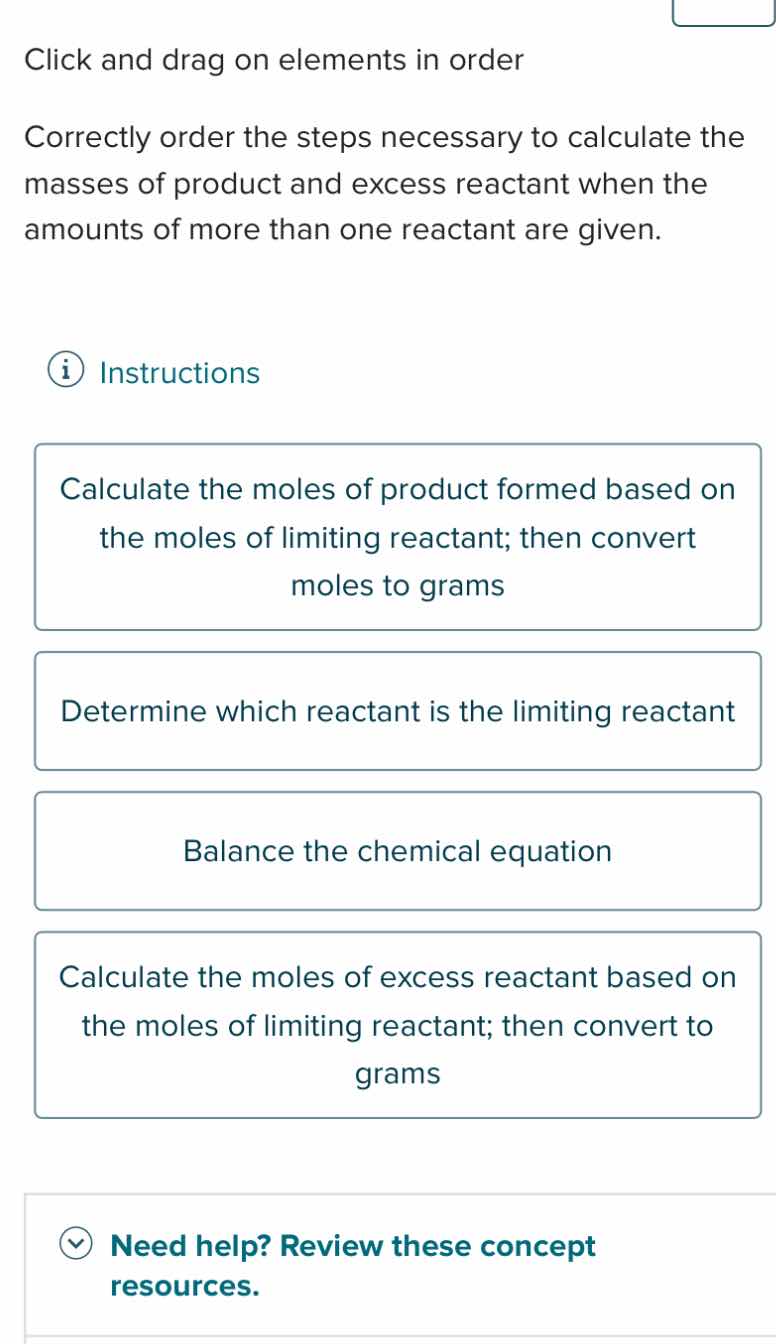
click and drag on elements in order correctly order the steps necessary to calculate the masses of product and excess reactant when the amounts of more than one reactant are given. instructions calculate the moles of product formed based on the moles of limiting reactant; then convert moles to grams determine which reactant is the limiting reactant balance the chemical equation calculate the moles of excess reactant based on the moles of limiting reactant; then convert to grams need help? review these concept resources.
To solve this, we follow the logical order for stoichiometric calculations with limiting reactants:
Step 1: Balance the chemical equation
A balanced chemical equation is essential to determine the mole ratios between reactants and products.
Step 2: Determine the limiting reactant
Before calculating product or excess reactant, we must identify which reactant is consumed first (limiting reactant) as it dictates the amount of product formed.
Step 3: Calculate product mass (from limiting reactant)
Using the moles of the limiting reactant, we find moles of product (via mole ratios) and convert to grams (using molar mass).
Step 4: Calculate excess reactant mass
Using the moles of the limiting reactant, we find how much of the excess reactant is used, then subtract from the initial amount (and convert to grams) to find the remaining excess.
The correct order is:
- Balance the chemical equation
- Determine which reactant is the limiting reactant
- Calculate the moles of product formed based on the moles of limiting reactant; then convert moles to grams
- Calculate the moles of excess reactant based on the moles of limiting reactant; then convert to grams

Snap & solve any problem in the app
Get step-by-step solutions on Sovi AI
Photo-based solutions with guided steps
Explore more problems and detailed explanations
To solve this, we follow the logical order for stoichiometric calculations with limiting reactants:
Step 1: Balance the chemical equation
A balanced chemical equation is essential to determine the mole ratios between reactants and products.
Step 2: Determine the limiting reactant
Before calculating product or excess reactant, we must identify which reactant is consumed first (limiting reactant) as it dictates the amount of product formed.
Step 3: Calculate product mass (from limiting reactant)
Using the moles of the limiting reactant, we find moles of product (via mole ratios) and convert to grams (using molar mass).
Step 4: Calculate excess reactant mass
Using the moles of the limiting reactant, we find how much of the excess reactant is used, then subtract from the initial amount (and convert to grams) to find the remaining excess.
The correct order is:
- Balance the chemical equation
- Determine which reactant is the limiting reactant
- Calculate the moles of product formed based on the moles of limiting reactant; then convert moles to grams
- Calculate the moles of excess reactant based on the moles of limiting reactant; then convert to grams