QUESTION IMAGE
Question
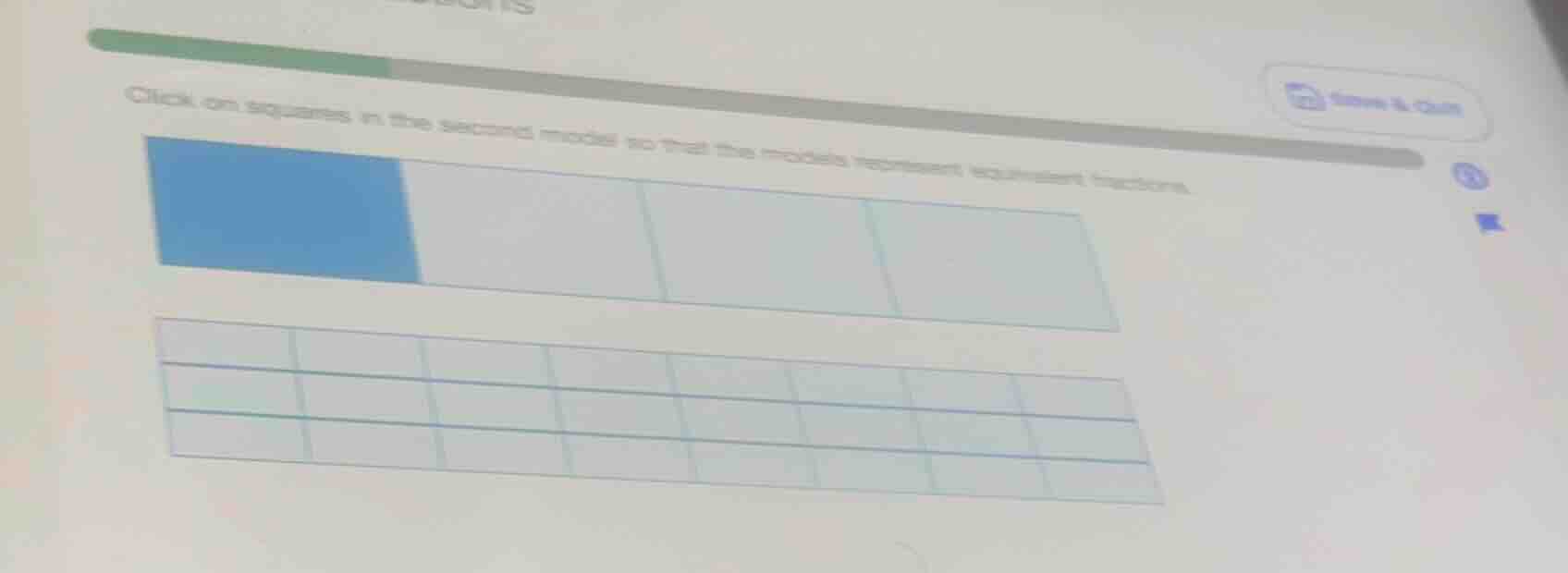
click on squares in the second model so that the models represent equivalent fractions.
Step1: Analyze the first model
The first rectangle is divided into 4 equal parts, and 1 part is shaded. So the fraction is $\frac{1}{4}$.
Step2: Determine the number of shaded parts in the second model
The second rectangle is divided into a total of $4\times6 = 24$? Wait, no, looking at the second model, it seems to be a grid with 3 rows and 8 columns? Wait, no, let's re - examine. Wait, the first model has 4 columns (since 1 shaded out of 4). The second model: let's count the number of small squares. Wait, maybe the first model is 1 out of 4, so to find equivalent fractions, if we multiply numerator and denominator by 6 (assuming the second model has 46 = 24? No, maybe the second model is divided into 46? Wait, no, looking at the second model, it's a grid with 3 rows and 8 columns? Wait, no, the first model: 1 shaded out of 4. Let's see the second model's total number of squares. Wait, maybe the second model is made up of 4 groups of 6? No, perhaps the first model is 1/4, and the second model is divided into 4*6 = 24? No, maybe the second model has 4 columns and 6 rows? Wait, no, let's do it properly.
The first fraction is $\frac{1}{4}$. Let's assume the second model has a total of $4\times6=24$ squares? No, maybe the second model is divided into 4 parts each divided into 6? Wait, no, the key is that equivalent fractions have the same value. So if the first is $\frac{1}{4}$, to find how many to shade in the second model, we need to find a fraction equal to $\frac{1}{4}$. Let's say the second model has, for example, 24 squares (4 columns 6 rows). Then the number of shaded squares should be $\frac{1}{4}\times24 = 6$. Wait, but maybe the second model is divided into 46 = 24? Wait, looking at the second model, it's a grid with 3 rows and 8 columns? No, maybe the first model is 1 out of 4, and the second model is 6 out of 24 (since $\frac{1}{4}=\frac{6}{24}$). But maybe the second model is divided into 4 groups of 6, so we need to shade 6 squares.
Wait, maybe the first model: 1 shaded square out of 4. The second model: let's count the number of small squares. Let's say the second model has 4 columns and 6 rows, so total 24 squares. Then the number of shaded squares is $\frac{1}{4}\times24 = 6$. So we need to shade 6 squares in the second model.

Snap & solve any problem in the app
Get step-by-step solutions on Sovi AI
Photo-based solutions with guided steps
Explore more problems and detailed explanations
Shade 6 squares in the second model (assuming the second model has 24 small squares, as $\frac{1}{4}=\frac{6}{24}$).