QUESTION IMAGE
Question
close reading
origins of american constitutional government
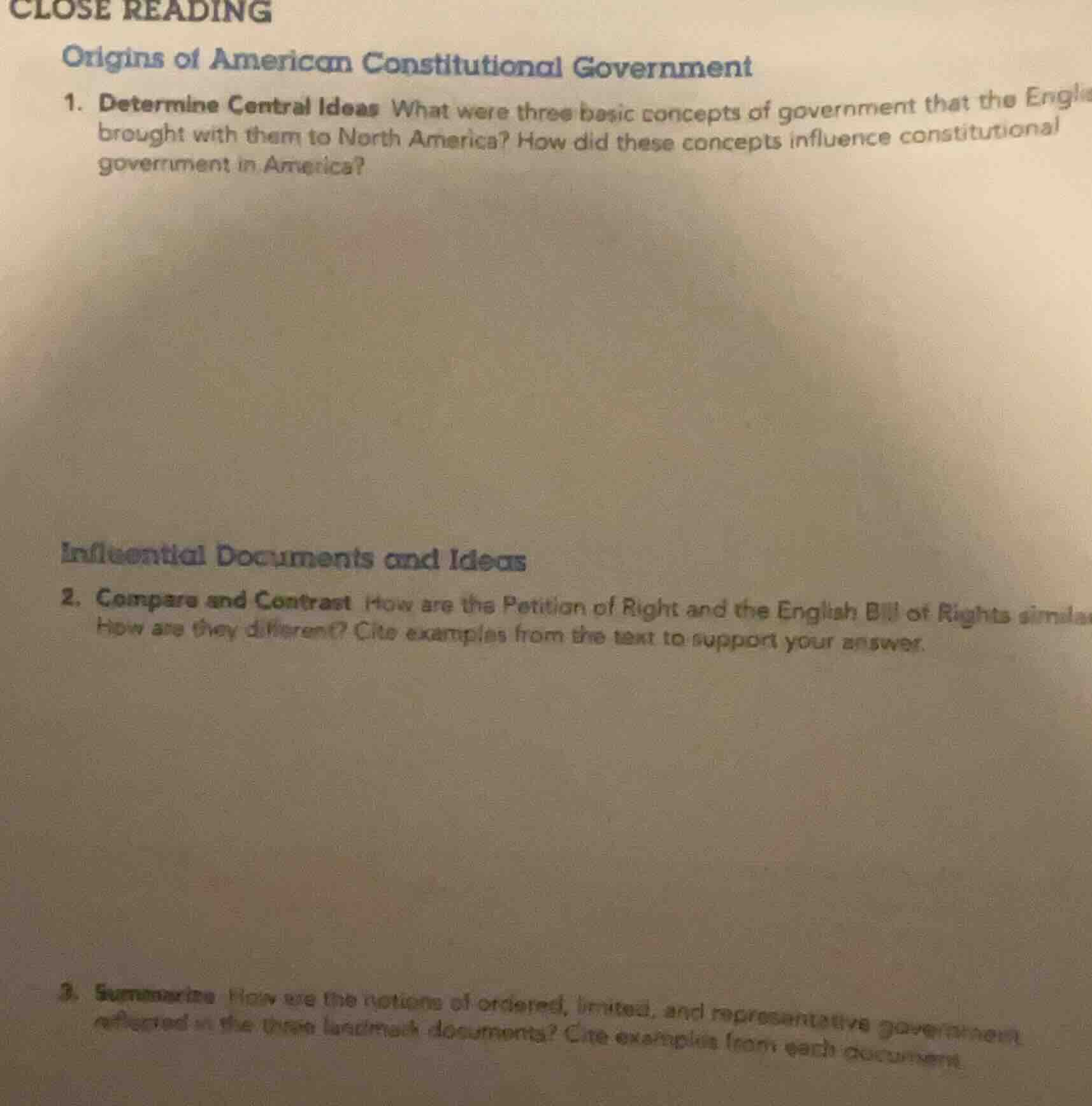
- determine central ideas what were three basic concepts of government that the englis brought with them to north america? how did these concepts influence constitutional government in america?
influential documents and ideas
- compare and contrast how are the petition of right and the english bill of rights simila how are they different? cite examples from the text to support your answer.
- summarize how are the notions of ordered, limited, and representative government reflected in the three landmark documents? cite examples from each document.
Brief Explanations
- For question 1: The three core English government concepts brought to North America are limited government, representative government, and ordered government. Limited government meant rulers were not all-powerful, which shaped the U.S. Constitution's system of checks and balances. Representative government, rooted in English Parliament, led to the U.S. Congress as a legislative body elected by the people. Ordered government, based on English common law and local governance structures, formed the basis for state and local government systems in America.
- For question 2: Similarity: Both the Petition of Right (1628) and English Bill of Rights (1689) aimed to limit the power of the English monarch and protect the rights of citizens/Parliament. For example, both restricted the king's ability to tax without parliamentary consent. Difference: The Petition of Right focused on specific grievances against King Charles I, like ending forced quartering of soldiers and arbitrary imprisonment. The English Bill of Rights was broader, establishing rules for parliamentary elections, free speech in Parliament, and banning cruel and unusual punishment, while also solidifying Parliament's supremacy over the monarchy.
- For question 3:
- Ordered government: Reflected in English common law (used in colonial courts) which provided consistent rules, the Petition of Right's enforcement of legal processes against arbitrary royal acts, and the English Bill of Rights' establishment of clear procedures for governance.
- Limited government: The Petition of Right prohibited the king from acting without parliamentary approval for taxes or imprisonment; the English Bill of Rights restricted royal power over laws and elections; these ideas directly informed the U.S. Constitution's limits on federal and executive power.
- Representative government: English Parliament (the model for colonial assemblies) was the foundation; the Petition of Right affirmed Parliament's role in approving taxes, and the English Bill of Rights protected parliamentary elections and free debate, which shaped the U.S. system of elected representatives.

Snap & solve any problem in the app
Get step-by-step solutions on Sovi AI
Photo-based solutions with guided steps
Explore more problems and detailed explanations
- The three concepts are limited government, representative government, and ordered government.
- Limited government influenced the U.S. Constitution's checks and balances to restrict governmental power.
- Representative government led to the creation of the elected U.S. Congress.
- Ordered government formed the basis for structured state and local governance systems in America.
- Similarity: Both documents limit monarchical power and protect citizen/Parliamentary rights, e.g., both ban taxation without parliamentary consent.
Difference: The Petition of Right addressed specific abuses by Charles I (forced quartering, arbitrary imprisonment), while the English Bill of Rights set broader, permanent rules for parliamentary supremacy, free speech in Parliament, and banned cruel punishment.
3.
- Ordered government: Seen in common law's consistent rules (colonial courts), the Petition of Right's curbs on arbitrary royal acts, and the English Bill of Rights' formal governance procedures.
- Limited government: The Petition of Right restricted royal taxes/imprisonment; the English Bill of Rights limited royal lawmaking power; these informed U.S. constitutional limits on government.
- Representative government: Parliament (colonial assembly model) was validated by the Petition of Right's tax approval rule and the English Bill of Rights' protection of parliamentary elections, shaping U.S. elected representation.