QUESTION IMAGE
Question
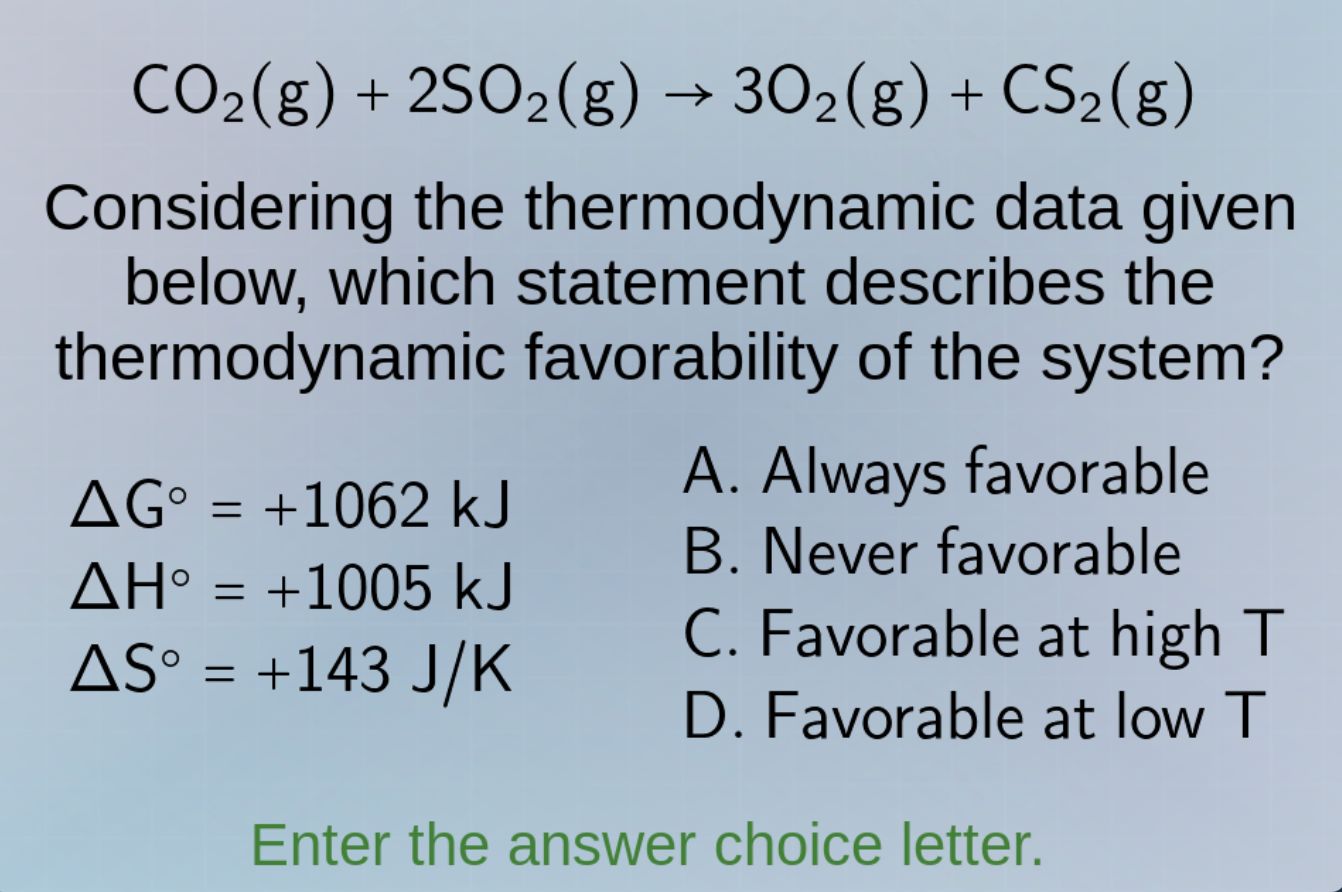
co₂(g) + 2so₂(g) → 3o₂(g) + cs₂(g)
considering the thermodynamic data given below, which statement describes the thermodynamic favorability of the system?
δg° = +1062 kj a. always favorable
δh° = +1005 kj b. never favorable
δs° = +143 j/k c. favorable at high t
d. favorable at low t
enter the answer choice letter.
Step1: Recall Gibbs Free Energy Formula
The spontaneity of a reaction is determined by the Gibbs free energy change, \(\Delta G\), using the formula \(\Delta G = \Delta H - T\Delta S\). A reaction is spontaneous (favorable) when \(\Delta G < 0\).
Step2: Analyze Sign of \(\Delta H\) and \(\Delta S\)
Here, \(\Delta H^\circ = +1005\space kJ\) (endothermic, positive) and \(\Delta S^\circ = +143\space J/K = +0.143\space kJ/K\) (increase in entropy, positive).
Step3: Determine Temperature Dependence
For \(\Delta G\) to be negative:
\[
\Delta H - T\Delta S < 0 \\
1005 - T(0.143) < 0 \\
T(0.143) > 1005 \\
T > \frac{1005}{0.143} \approx 7028\space K
\]
Since \(\Delta H\) is positive and \(\Delta S\) is positive, the reaction becomes favorable ( \(\Delta G < 0\)) at high temperatures (when \(T\) is large enough to make \(T\Delta S > \Delta H\)). But wait, the given \(\Delta G^\circ\) is positive, but we analyze the general case. Wait, no—wait, the standard \(\Delta G^\circ\) is positive, but the formula \(\Delta G = \Delta G^\circ + RT\ln Q\), but for the thermodynamic favorability (spontaneity), we use \(\Delta G = \Delta H - T\Delta S\). Wait, actually, the standard \(\Delta G^\circ\) is at 298 K. Let's check at 298 K: \(\Delta G = 1005 - 298\times0.143 \approx 1005 - 42.6 = 962.4\space kJ > 0\). But as temperature increases, \(T\Delta S\) increases. So when \(T\) is very high, \(T\Delta S\) will exceed \(\Delta H\), making \(\Delta G < 0\). But wait, the options: but wait, the given \(\Delta G^\circ\) is positive, but maybe the question is about the general case. Wait, no—wait, the options are about "thermodynamic favorability" (spontaneity). Wait, but the \(\Delta G^\circ\) is positive, but let's re-express. Wait, maybe I made a mistake. Wait, the formula is \(\Delta G = \Delta H - T\Delta S\). So:
- If \(\Delta H > 0\) and \(\Delta S > 0\): reaction is favorable at high \(T\) (because \(T\Delta S\) can overcome \(\Delta H\)).
- If \(\Delta H < 0\) and \(\Delta S < 0\): favorable at low \(T\).
- If \(\Delta H > 0\) and \(\Delta S < 0\): never favorable (since both terms make \(\Delta G\) more positive).
- If \(\Delta H < 0\) and \(\Delta S > 0\): always favorable.
In this case, \(\Delta H > 0\), \(\Delta S > 0\): so favorable at high \(T\). But wait, the given \(\Delta G^\circ\) is positive, but the question is about "thermodynamic favorability" (spontaneity). Wait, but the options: option C is "Favorable at high T", D is "Favorable at low T". Wait, but let's check the numbers. Wait, \(\Delta H = +1005\space kJ\), \(\Delta S = +0.143\space kJ/K\). So the temperature where \(\Delta G = 0\) is \(T = \Delta H / \Delta S = 1005 / 0.143 \approx 7028\space K\). So above this temperature, \(\Delta G < 0\) (favorable). But the options: but wait, the given \(\Delta G^\circ\) is positive, but maybe the question is using the standard values? Wait, no—maybe I messed up. Wait, the standard \(\Delta G^\circ\) is positive, but the formula for spontaneity is \(\Delta G = \Delta H - T\Delta S\). So with \(\Delta H\) positive and \(\Delta S\) positive, the reaction is spontaneous (favorable) at high temperatures. But wait, the options: option C is "Favorable at high T", but wait, the \(\Delta G^\circ\) is positive, but maybe the question is about the general case. Wait, no—wait, maybe the question has a typo, but according to the signs: \(\Delta H\) positive, \(\Delta S\) positive: so favorable at high T. But wait, the \(\Delta G^\circ\) is positive, but that's at 298 K. So the correct answer should be C? Wait, no—wait, wait, the \(\Delta G^\ci…

Snap & solve any problem in the app
Get step-by-step solutions on Sovi AI
Photo-based solutions with guided steps
Explore more problems and detailed explanations
C. Favorable at high T