QUESTION IMAGE
Question
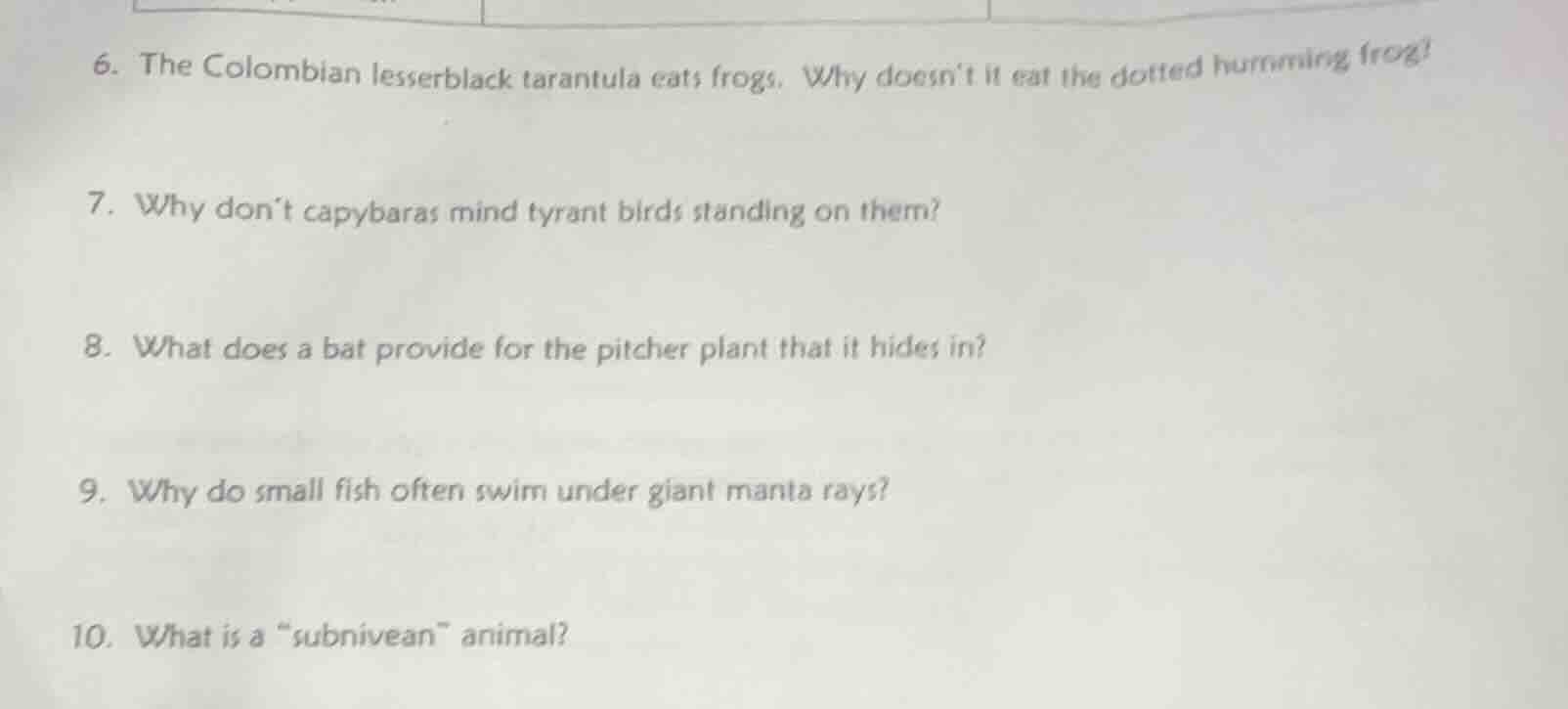
- the colombian lesserblack tarantula eats frogs. why doesnt it eat the dotted humming frog?
- why dont capybaras mind tyrant birds standing on them?
- what does a bat provide for the pitcher plant that it hides in?
- why do small fish often swim under giant manta rays?
- what is a \subnivean\ animal?
Question 6
The dotted humming frog likely has a defense mechanism (e.g., toxic skin secretions) or a symbiotic/avoidance relationship with the tarantula. The tarantula may avoid it due to the frog's toxicity or the frog may benefit the tarantula (e.g., eating pests near the tarantula's burrow), so the tarantula doesn't eat it.
Tyrant birds (like oxpeckers - though not exactly tyrant birds, similar mutualism) likely provide a cleaning service for capybaras, eating parasites (like ticks) off their skin. So capybaras tolerate them as it benefits their health by reducing parasites.
Bats that hide in pitcher plants (like the Nepenthes hemsleyana) provide nitrogen - rich feces (guano) to the plant. The pitcher plant, which is a carnivorous plant, can absorb nutrients from the bat’s guano, and in return, the bat gets a safe hiding place.

Snap & solve any problem in the app
Get step-by-step solutions on Sovi AI
Photo-based solutions with guided steps
Explore more problems and detailed explanations
The dotted humming frog may have toxic skin secretions that deter the tarantula from eating it, or they may have a mutualistic relationship (e.g., the frog eats pests near the tarantula’s burrow), so the tarantula avoids eating it.