QUESTION IMAGE
Question
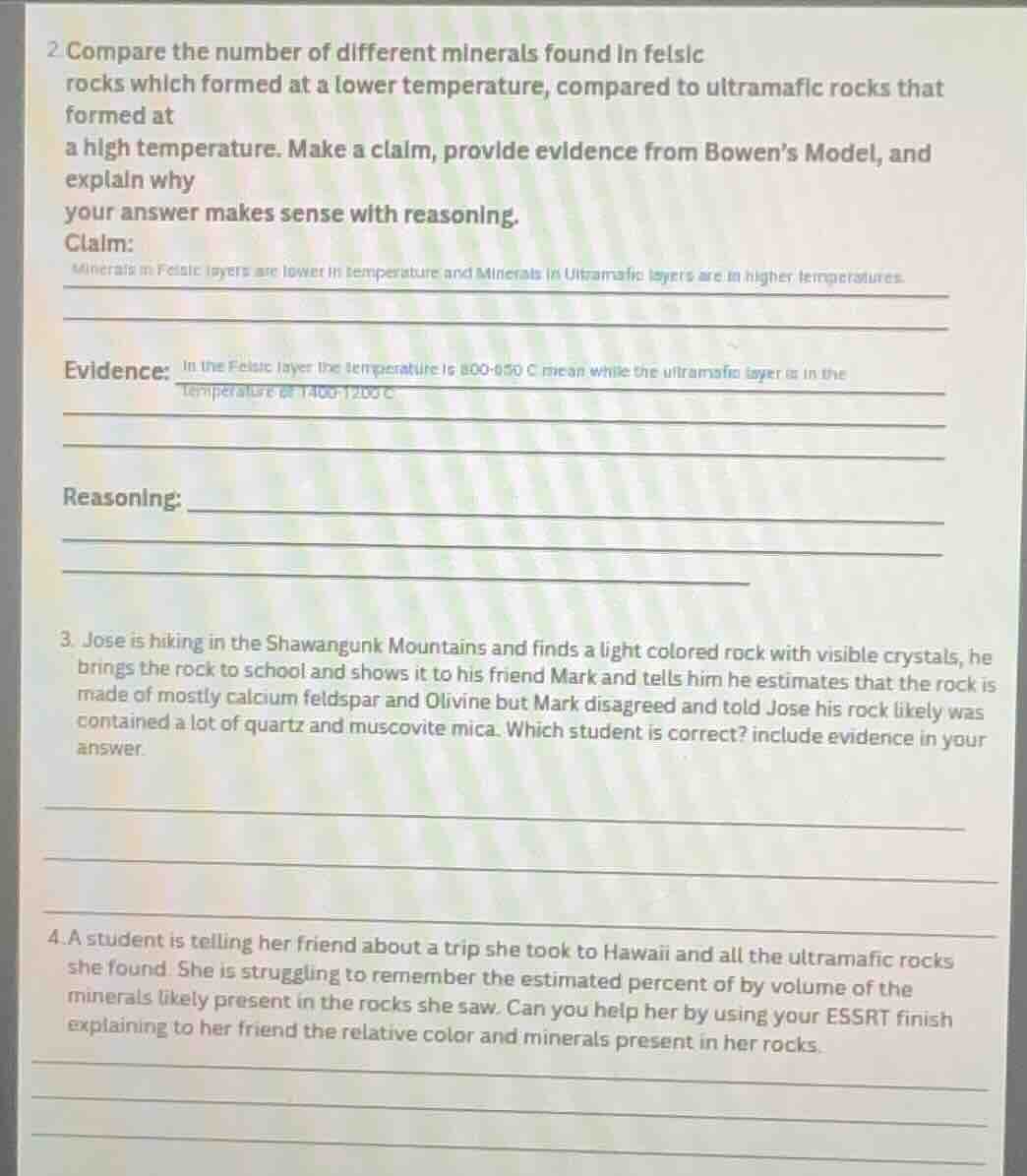
2 compare the number of different minerals found in felsic rocks which formed at a lower temperature, compared to ultramafic rocks that formed at
a high temperature. make a claim, provide evidence from bowen’s model, and
explain why
your answer makes sense with reasoning.
claim:
minerals in felsic layers are lower in temperature and minerals in ultramafic layers are in higher temperatures.
evidence: in the felsic layer the temperature is 800-650 c mean while the ultramafic layer is in the
temperature of 1400-1200 c
reasoning:
- jose is hiking in the shawangunk mountains and finds a light colored rock with visible crystals, he
brings the rock to school and shows it to his friend mark and tells him he estimates that the rock is
made of mostly calcium feldspar and olivine but mark disagreed and told jose his rock likely was
contained a lot of quartz and muscovite mica. which student is correct? include evidence in your
answer.
- a student is telling her friend about a trip she took to hawaii and all the ultramafic rocks
she found. she is struggling to remember the estimated percent of by volume of the
minerals likely present in the rocks she saw. can you help her by using your essrt finish
explaining to her friend the relative color and minerals present in her rocks.
Question 2
Step1: State refined claim
Felsic rocks have more distinct minerals than ultramafic rocks.
Step2: Cite Bowen's model evidence
Bowen's Reaction Series:
- Ultramafic rocks form at $1200^\circ\text{C}-1400^\circ\text{C}$ (discontinuous series start: olivine, pyroxene only)
- Felsic rocks form at $600^\circ\text{C}-850^\circ\text{C}$ (full discontinuous + continuous series: quartz, feldspars, micas, amphibole)
Step3: Explain mineral count logic
High temp = few stable minerals; low temp = more stable minerals.
Light-colored, visible-crystal rocks are felsic/granitic. Olivine is a dark, high-temperature ultramafic mineral that does not coexist with quartz/muscovite (low-temperature felsic minerals). Quartz and muscovite are characteristic of light-colored felsic rocks.
Ultramafic rocks follow Bowen's Reaction Series and standard igneous rock composition rules. They form at the highest temperatures, so only early-forming dark minerals are stable.

Snap & solve any problem in the app
Get step-by-step solutions on Sovi AI
Photo-based solutions with guided steps
Explore more problems and detailed explanations
Claim: Felsic rocks (formed at lower temperatures) contain a greater number of different distinct minerals than ultramafic rocks (formed at higher temperatures).
Evidence: Bowen's Reaction Series shows ultramafic rocks form at $1200^\circ\text{C}-1400^\circ\text{C}$, only containing early-forming minerals like olivine and pyroxene. Felsic rocks form at $600^\circ\text{C}-850^\circ\text{C}$, containing late-forming minerals including quartz, potassium feldspar, plagioclase feldspar, muscovite mica, and amphibole.
Reasoning: At the high temperatures where ultramafic rocks form, only a small number of minerals are stable and can crystallize. As temperature drops to the range where felsic rocks form, more minerals become stable and crystallize, resulting in a larger variety of distinct minerals in felsic rocks.
---