QUESTION IMAGE
Question
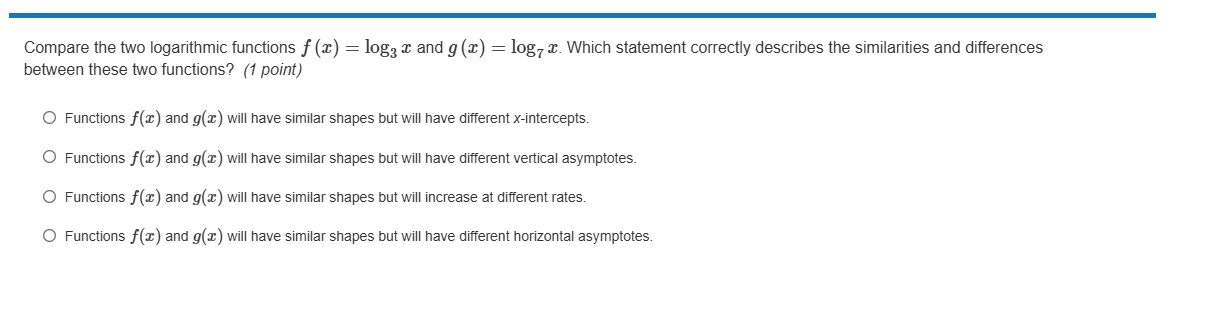
compare the two logarithmic functions $f(x) = \log_{3} x$ and $g(x) = \log_{7} x$. which statement correctly describes the similarities and differences between these two functions? (1 point)\
\
\bigcirc functions $f(x)$ and $g(x)$ will have similar shapes but will have different $x$-intercepts.\
\bigcirc functions $f(x)$ and $g(x)$ will have similar shapes but will have different vertical asymptotes.\
\bigcirc functions $f(x)$ and $g(x)$ will have similar shapes but will increase at different rates.\
\bigcirc functions $f(x)$ and $g(x)$ will have similar shapes but will have different horizontal asymptotes.
- Analyze the x - intercept: For a logarithmic function \(y = \log_{a}x\), the x - intercept occurs when \(y = 0\). So, \(\log_{a}x=0\) implies \(x = a^{0}=1\) for any \(a>0,a
eq1\). So both \(f(x)=\log_{3}x\) and \(g(x)=\log_{7}x\) have an x - intercept at \(x = 1\). So the first option is incorrect.
- Analyze the vertical asymptote: The vertical asymptote of \(y=\log_{a}x\) is \(x = 0\) (the y - axis) for any \(a>0,a
eq1\). So both \(f(x)\) and \(g(x)\) have the same vertical asymptote \(x = 0\). So the second option is incorrect.
- Analyze the rate of increase: The derivative of \(y=\log_{a}x=\frac{\ln x}{\ln a}\) is \(y^\prime=\frac{1}{x\ln a}\). For \(f(x)=\log_{3}x\), the derivative is \(f^\prime(x)=\frac{1}{x\ln 3}\), and for \(g(x)=\log_{7}x\), the derivative is \(g^\prime(x)=\frac{1}{x\ln 7}\). Since \(\ln 3
eq\ln 7\), the slopes of the tangent lines (rate of change) of the two functions are different. So the functions have similar shapes (both are increasing, concave - down logarithmic curves) but increase at different rates.
- Analyze the horizontal asymptote: Logarithmic functions \(y = \log_{a}x\) do not have horizontal asymptotes. As \(x
ightarrow\infty\), \(\log_{a}x
ightarrow\infty\) (for \(a > 1\)), and as \(x
ightarrow0^{+}\), \(\log_{a}x
ightarrow-\infty\) (for \(a>1\)). So the fourth option is incorrect.

Snap & solve any problem in the app
Get step-by-step solutions on Sovi AI
Photo-based solutions with guided steps
Explore more problems and detailed explanations
C. Functions \(f(x)\) and \(g(x)\) will have similar shapes but will increase at different rates.