QUESTION IMAGE
Question
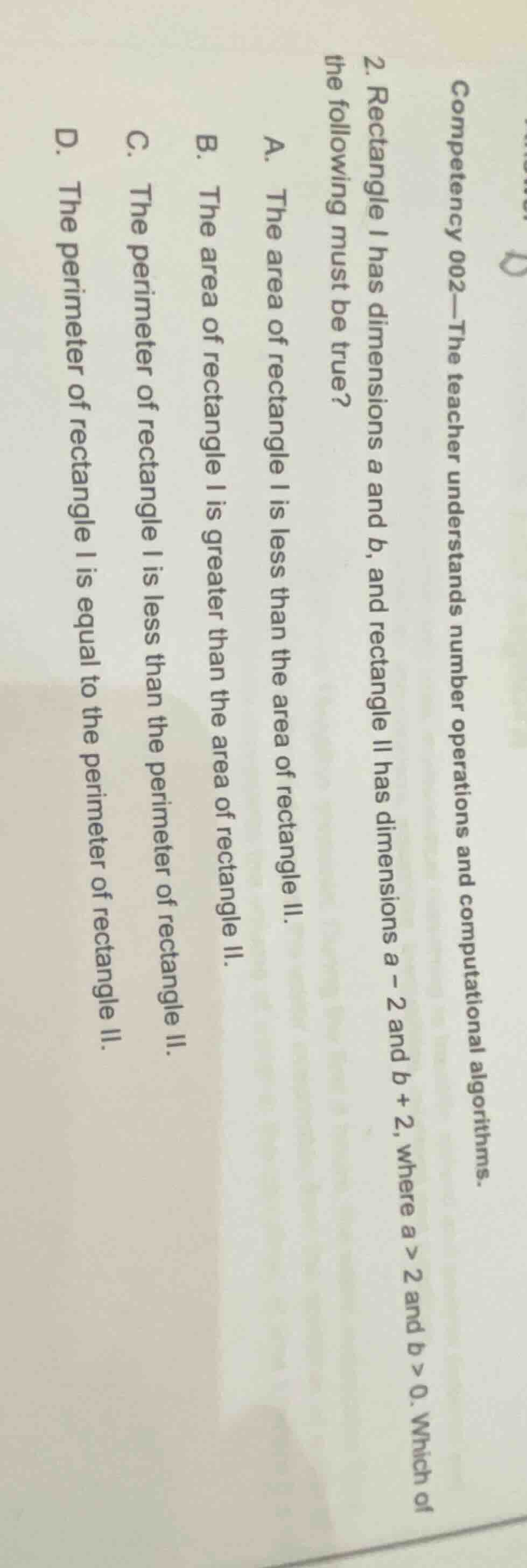
competency 002—the teacher understands number operations and computational algorithms. 2. rectangle i has dimensions a and b, and rectangle ii has dimensions a - 2 and b + 2, where a > 2 and b > 0. which of the following must be true? a. the area of rectangle i is less than the area of rectangle ii. b. the area of rectangle i is greater than the area of rectangle ii. c. the perimeter of rectangle i is less than the perimeter of rectangle ii. d. the perimeter of rectangle i is equal to the perimeter of rectangle ii.
Step1: Calculate Area of Rectangle I
The area of a rectangle is given by the formula \( A = \text{length} \times \text{width} \). For Rectangle I with dimensions \( a \) and \( b \), the area \( A_1 = a \times b = ab \).
Step2: Calculate Area of Rectangle II
For Rectangle II with dimensions \( a - 2 \) and \( b + 2 \), the area \( A_2=(a - 2)(b + 2) \). We expand this using the distributive property (FOIL method):
\[
\]
Step3: Compare \( A_1 \) and \( A_2 \)
Now, we find the difference between \( A_2 \) and \( A_1 \):
\[
\]
We don't know the relationship between \( a \) and \( b \) to determine if \( A_2>A_1 \) or \( A_2 < A_1 \), so we can't conclude about the area.
Step4: Calculate Perimeter of Rectangle I
The perimeter of a rectangle is given by \( P = 2(\text{length}+\text{width}) \). For Rectangle I, \( P_1 = 2(a + b)=2a + 2b \).
Step5: Calculate Perimeter of Rectangle II
For Rectangle II, \( P_2 = 2((a - 2)+(b + 2)) \). Simplify the expression inside the parentheses:
\[
\]
So, \( P_2 = 2(a + b)=2a + 2b \).
Step6: Compare Perimeters
Since \( P_1 = 2a + 2b \) and \( P_2 = 2a + 2b \), we have \( P_1 = P_2 \).

Snap & solve any problem in the app
Get step-by-step solutions on Sovi AI
Photo-based solutions with guided steps
Explore more problems and detailed explanations
D. The perimeter of rectangle I is equal to the perimeter of rectangle II.