QUESTION IMAGE
Question
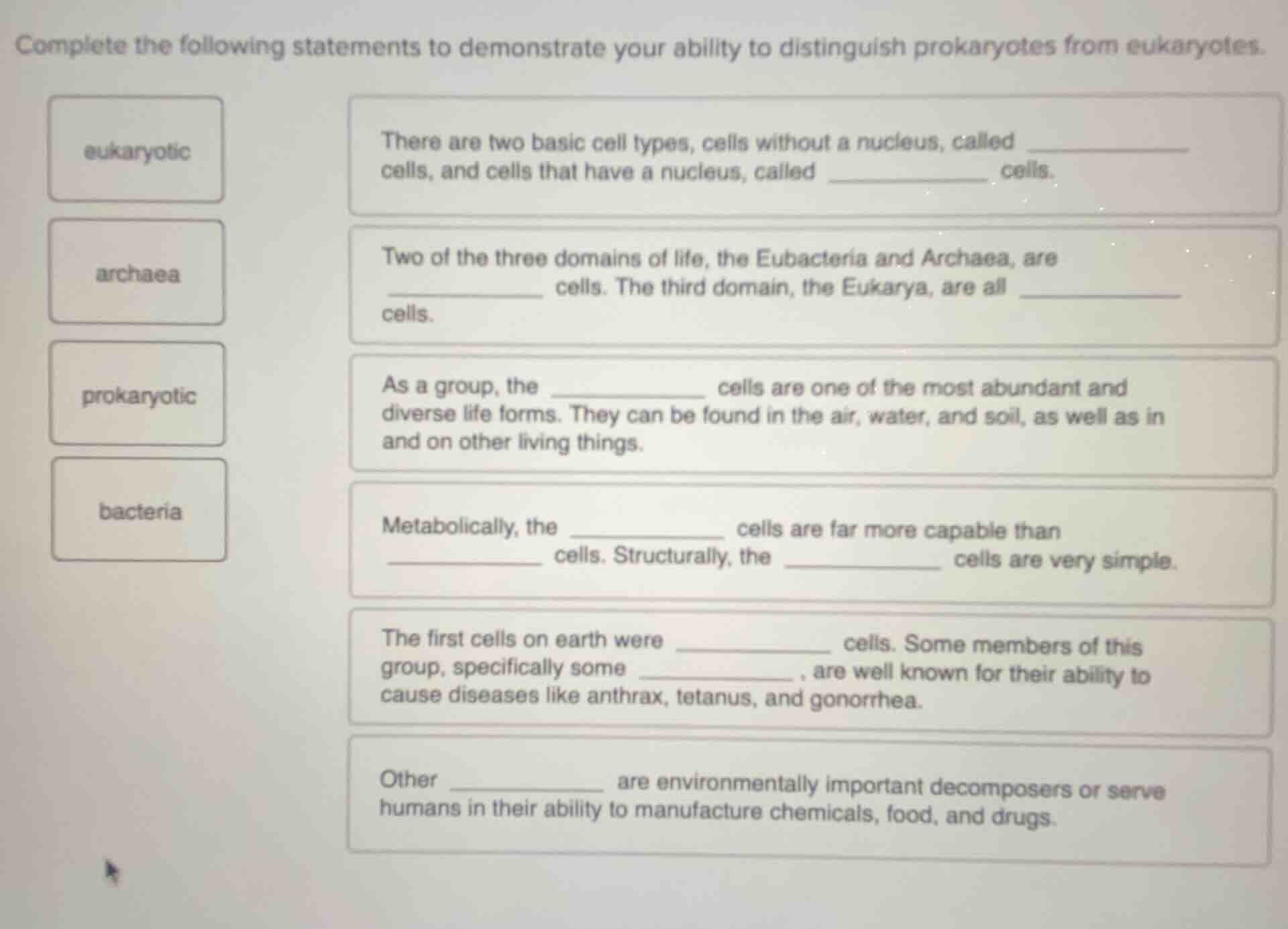
complete the following statements to demonstrate your ability to distinguish prokaryotes from eukaryotes.
eukaryotic
there are two basic cell types, cells without a nucleus, called ____ cells, and cells that have a nucleus, called ____ cells.
archaea
two of the three domains of life, the eubacteria and archaea, are ____ cells. the third domain, the eukarya, are all ____ cells.
prokaryotic
as a group, the ______ cells are one of the most abundant and diverse life forms. they can be found in the air, water, and soil, as well as in and on other living things.
bacteria
metabolically, the ____ cells are far more capable than __ cells. structurally, the ____ cells are very simple.
the first cells on earth were ____ cells. some members of this group, specifically some ____, are well known for their ability to cause diseases like anthrax, tetanus, and gonorrhea.
other ______ are environmentally important decomposers or serve humans in their ability to manufacture chemicals, food, and drugs.
1st statement:
- Cells without a nucleus are prokaryotic, and with a nucleus are eukaryotic. So blanks: prokaryotic, eukaryotic.
2nd statement:
- Eubacteria and Archaea are prokaryotic domains; Eukarya are eukaryotic. Blanks: prokaryotic, eukaryotic.
3rd statement:
- Prokaryotic cells (including bacteria and archaea) are abundant and diverse. Blank: prokaryotic.
4th statement:
- Prokaryotic cells have diverse metabolism, and are structurally simple; eukaryotic are more complex in structure (but here comparing metabolic capability: prokaryotic more capable than eukaryotic? Wait, no—wait, metabolically prokaryotes are more diverse (can do more types of metabolism), structurally prokaryotes are simple. So blanks: prokaryotic, eukaryotic, prokaryotic.
5th statement:
- First cells on Earth were prokaryotic. Some bacteria cause diseases (anthrax, tetanus, gonorrhea are bacterial). Blanks: prokaryotic, bacteria.
6th statement:
- Bacteria (prokaryotes) are decomposers or used in manufacturing. Blank: bacteria (or prokaryotic, but bacteria is more specific here as decomposers/biofactories).
Filled Statements:
- There are two basic cell types, cells without a nucleus, called \(\boldsymbol{\text{prokaryotic}}\) cells, and cells that have a nucleus, called \(\boldsymbol{\text{eukaryotic}}\) cells.
- Two of the three domains of life, the Eubacteria and Archaea, are \(\boldsymbol{\text{prokaryotic}}\) cells. The third domain, the Eukarya, are all \(\boldsymbol{\text{eukaryotic}}\) cells.
- As a group, the \(\boldsymbol{\text{prokaryotic}}\) cells are one of the most abundant and diverse life forms. They can be found in the air, water, and soil, as well as in and on other living things.
- Metabolically, the \(\boldsymbol{\text{prokaryotic}}\) cells are far more capable than \(\boldsymbol{\text{eukaryotic}}\) cells. Structurally, the \(\boldsymbol{\text{prokaryotic}}\) cells are very simple.
- The first cells on earth were \(\boldsymbol{\text{prokaryotic}}\) cells. Some members of this group, specifically some \(\boldsymbol{\text{bacteria}}\), are well known for their ability to cause diseases like anthrax, tetanus, and gonorrhea.
- Other \(\boldsymbol{\text{bacteria}}\) are environmentally important decomposers or serve humans in their ability to manufacture chemicals, food, and drugs.
(Note: For the 4th statement, "metabolically prokaryotic more capable" refers to their metabolic diversity (e.g., anaerobic, photosynthetic, chemosynthetic, etc.), while eukaryotes have more complex structures but narrower metabolic range in many cases. Structurally, prokaryotes lack membrane - bound organelles, so they are simple.)

Snap & solve any problem in the app
Get step-by-step solutions on Sovi AI
Photo-based solutions with guided steps
Explore more problems and detailed explanations
1st statement:
- Cells without a nucleus are prokaryotic, and with a nucleus are eukaryotic. So blanks: prokaryotic, eukaryotic.
2nd statement:
- Eubacteria and Archaea are prokaryotic domains; Eukarya are eukaryotic. Blanks: prokaryotic, eukaryotic.
3rd statement:
- Prokaryotic cells (including bacteria and archaea) are abundant and diverse. Blank: prokaryotic.
4th statement:
- Prokaryotic cells have diverse metabolism, and are structurally simple; eukaryotic are more complex in structure (but here comparing metabolic capability: prokaryotic more capable than eukaryotic? Wait, no—wait, metabolically prokaryotes are more diverse (can do more types of metabolism), structurally prokaryotes are simple. So blanks: prokaryotic, eukaryotic, prokaryotic.
5th statement:
- First cells on Earth were prokaryotic. Some bacteria cause diseases (anthrax, tetanus, gonorrhea are bacterial). Blanks: prokaryotic, bacteria.
6th statement:
- Bacteria (prokaryotes) are decomposers or used in manufacturing. Blank: bacteria (or prokaryotic, but bacteria is more specific here as decomposers/biofactories).
Filled Statements:
- There are two basic cell types, cells without a nucleus, called \(\boldsymbol{\text{prokaryotic}}\) cells, and cells that have a nucleus, called \(\boldsymbol{\text{eukaryotic}}\) cells.
- Two of the three domains of life, the Eubacteria and Archaea, are \(\boldsymbol{\text{prokaryotic}}\) cells. The third domain, the Eukarya, are all \(\boldsymbol{\text{eukaryotic}}\) cells.
- As a group, the \(\boldsymbol{\text{prokaryotic}}\) cells are one of the most abundant and diverse life forms. They can be found in the air, water, and soil, as well as in and on other living things.
- Metabolically, the \(\boldsymbol{\text{prokaryotic}}\) cells are far more capable than \(\boldsymbol{\text{eukaryotic}}\) cells. Structurally, the \(\boldsymbol{\text{prokaryotic}}\) cells are very simple.
- The first cells on earth were \(\boldsymbol{\text{prokaryotic}}\) cells. Some members of this group, specifically some \(\boldsymbol{\text{bacteria}}\), are well known for their ability to cause diseases like anthrax, tetanus, and gonorrhea.
- Other \(\boldsymbol{\text{bacteria}}\) are environmentally important decomposers or serve humans in their ability to manufacture chemicals, food, and drugs.
(Note: For the 4th statement, "metabolically prokaryotic more capable" refers to their metabolic diversity (e.g., anaerobic, photosynthetic, chemosynthetic, etc.), while eukaryotes have more complex structures but narrower metabolic range in many cases. Structurally, prokaryotes lack membrane - bound organelles, so they are simple.)