QUESTION IMAGE
Question
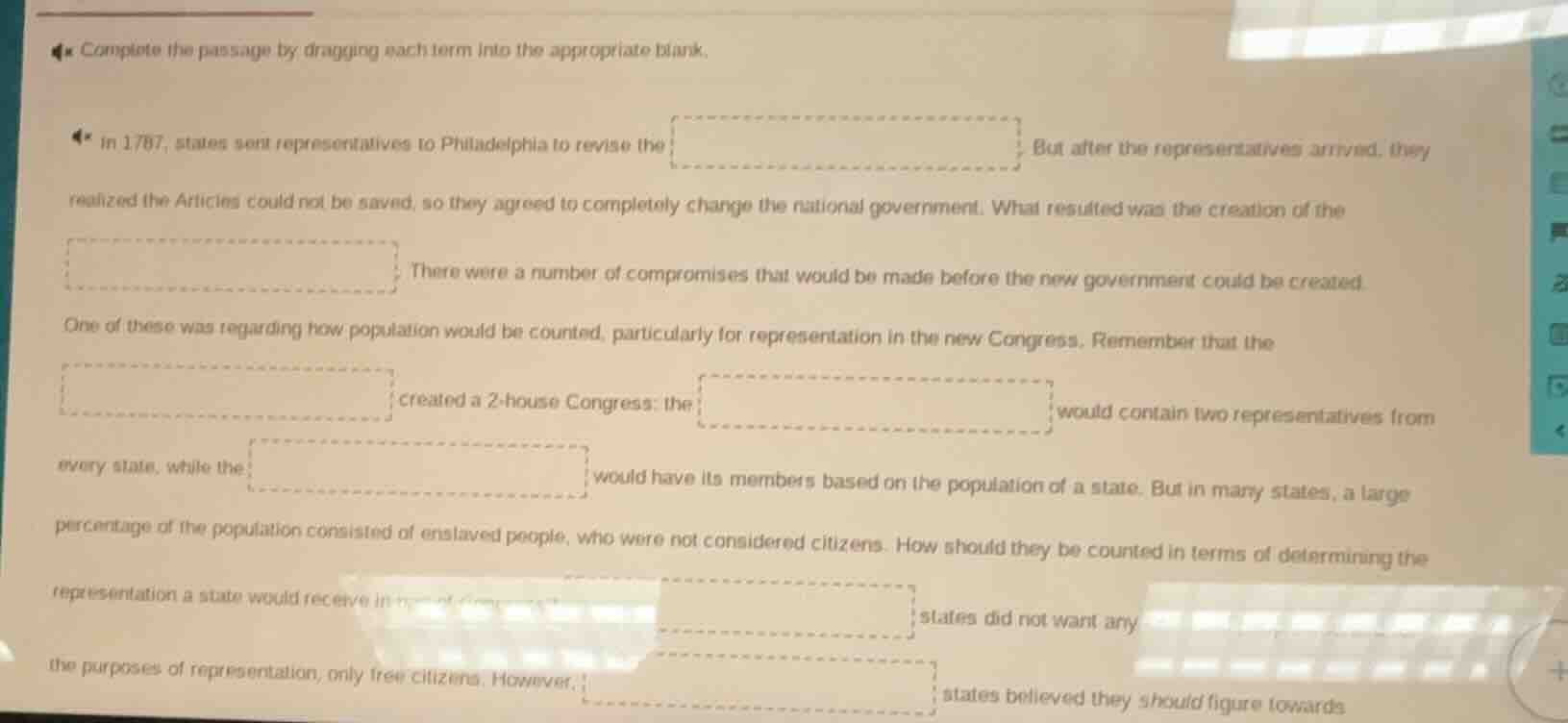
complete the passage by dragging each term into the appropriate blank.
in 1787, states sent representatives to philadelphia to revise the
but after the representatives arrived, they realized the articles could not be saved, so they agreed to completely change the national government. what resulted was the creation of the
there were a number of compromises that would be made before the new government could be created.
one of these was regarding how population would be counted, particularly for representation in the new congress. remember that the
created a 2 - house congress: the
would contain two representatives from every state, while the
would have its members based on the population of a state. but in many states, a large percentage of the population consisted of enslaved people, who were not considered citizens. how should they be counted in terms of determining the representation a state would receive in
states did not want any
the purposes of representation, only free citizens. however,
states believed they should figure towards
To solve this fill - in - the - blank problem about the U.S. Constitutional Convention and related concepts, we analyze each blank based on historical knowledge:
Blank 1
In 1787, the original plan was to revise the Articles of Confederation. The Articles of Confederation was the first governing document of the United States, and by 1787, its shortcomings were becoming very apparent, so the states sent representatives to Philadelphia with the initial intention of revising it.
Blank 2
After deciding that the Articles of Confederation could not be salvaged, the representatives created the United States Constitution. This new document established the framework for the national government of the United States.
Blank 3
The Great Compromise (also known as the Connecticut Compromise) created a two - house Congress. This compromise was crucial in resolving the dispute between large and small states over representation.
Blank 4
The Senate is the house of Congress that has two representatives from each state. This was a part of the Great Compromise to satisfy the concerns of small states, who were worried about being overshadowed by large states in a legislature based solely on population.
Blank 5
The House of Representatives is the house of Congress where the number of members from each state is based on the state's population. This was a concession to the large states, who believed that population should be the primary factor in determining representation.
Blank 6 (related to the counting of enslaved people)
Northern states generally did not want enslaved people to be counted for the purposes of representation. Since Northern states had relatively few enslaved people, counting them would not benefit their representation in the House of Representatives, and they also had moral and political reasons related to the status of enslaved people.
Blank 7 (related to the counting of enslaved people)
Southern states believed that enslaved people should be counted for the purposes of representation. Southern states had a large number of enslaved people, and counting them would increase their representation in the House of Representatives, which was important for their political power at the national level.
Final Answers for each blank (in order):
- Articles of Confederation
- United States Constitution
- Great Compromise
- Senate
- House of Representatives
- Northern
- Southern

Snap & solve any problem in the app
Get step-by-step solutions on Sovi AI
Photo-based solutions with guided steps
Explore more problems and detailed explanations
To solve this fill - in - the - blank problem about the U.S. Constitutional Convention and related concepts, we analyze each blank based on historical knowledge:
Blank 1
In 1787, the original plan was to revise the Articles of Confederation. The Articles of Confederation was the first governing document of the United States, and by 1787, its shortcomings were becoming very apparent, so the states sent representatives to Philadelphia with the initial intention of revising it.
Blank 2
After deciding that the Articles of Confederation could not be salvaged, the representatives created the United States Constitution. This new document established the framework for the national government of the United States.
Blank 3
The Great Compromise (also known as the Connecticut Compromise) created a two - house Congress. This compromise was crucial in resolving the dispute between large and small states over representation.
Blank 4
The Senate is the house of Congress that has two representatives from each state. This was a part of the Great Compromise to satisfy the concerns of small states, who were worried about being overshadowed by large states in a legislature based solely on population.
Blank 5
The House of Representatives is the house of Congress where the number of members from each state is based on the state's population. This was a concession to the large states, who believed that population should be the primary factor in determining representation.
Blank 6 (related to the counting of enslaved people)
Northern states generally did not want enslaved people to be counted for the purposes of representation. Since Northern states had relatively few enslaved people, counting them would not benefit their representation in the House of Representatives, and they also had moral and political reasons related to the status of enslaved people.
Blank 7 (related to the counting of enslaved people)
Southern states believed that enslaved people should be counted for the purposes of representation. Southern states had a large number of enslaved people, and counting them would increase their representation in the House of Representatives, which was important for their political power at the national level.
Final Answers for each blank (in order):
- Articles of Confederation
- United States Constitution
- Great Compromise
- Senate
- House of Representatives
- Northern
- Southern