QUESTION IMAGE
Question
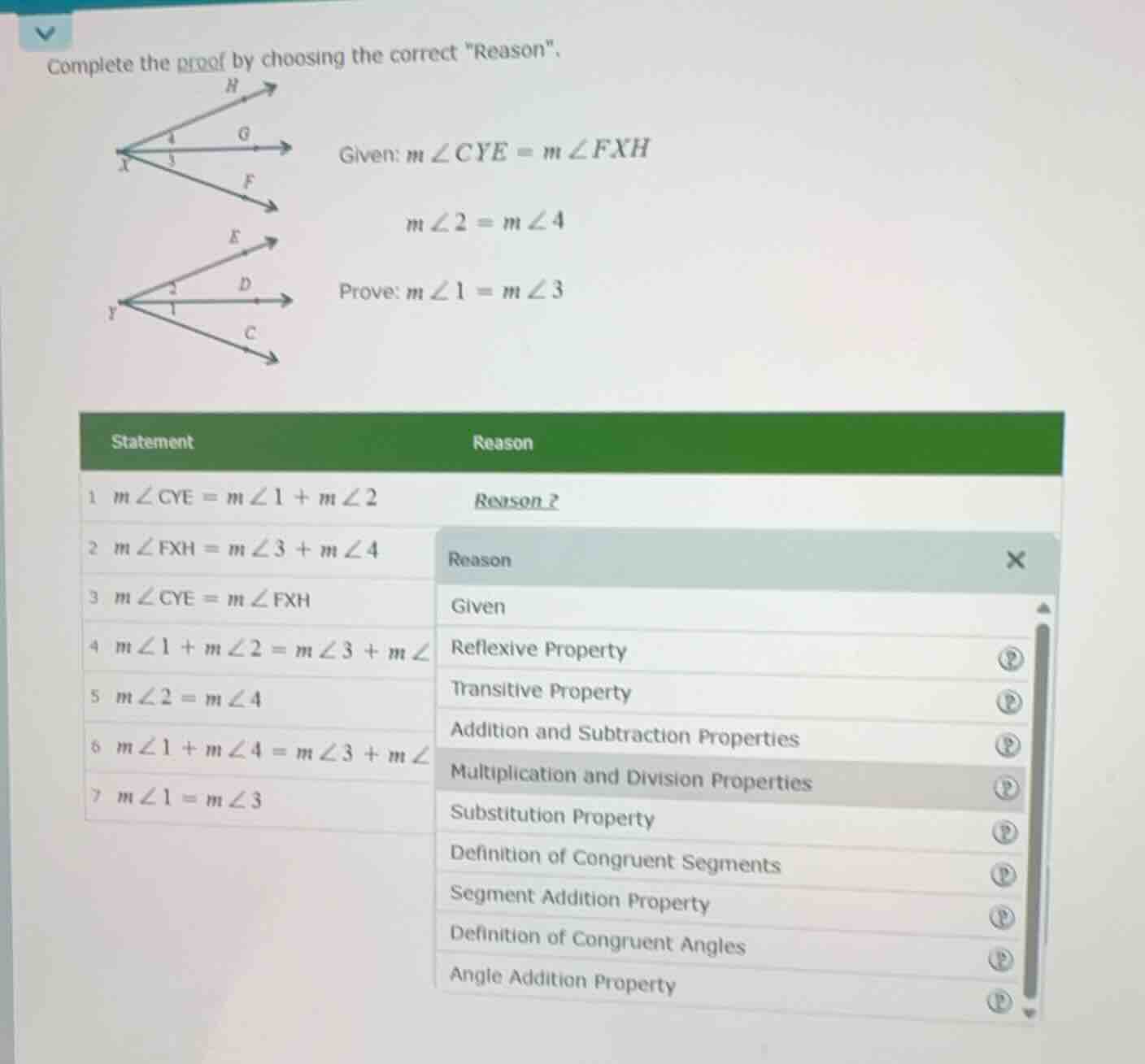
complete the proof by choosing the correct
eason\.
given: ( mangle cye = mangle fxh )
( mangle 2 = mangle 4 )
prove: ( mangle 1 = mangle 3 )
| statement | reason |
|---|---|
| 2 ( mangle fxh = mangle 3 + mangle 4 ) | reason |
| 3 ( mangle cye = mangle fxh ) | given |
| 4 ( mangle 1 + mangle 2 = mangle 3 + mangle ) | reflexive property, transitive property, addition and subtraction properties, multiplication and division properties, substitution property, definition of congruent segments, segment addition property, definition of congruent angles, angle addition property |
| 5 ( mangle 2 = mangle 4 ) | |
| 6 ( mangle 1 + mangle 4 = mangle 3 + mangle ) | |
| 7 ( mangle 1 = mangle 3 ) |
Step1: Match Statement 1 reason
Statement 1: $m\angle CYE = m\angle 1 + m\angle 2$
This uses the Angle Addition Property (the measure of an angle formed by two adjacent angles is the sum of their measures).
Step2: Match Statement 2 reason
Statement 2: $m\angle FXH = m\angle 3 + m\angle 4$
This also uses the Angle Addition Property (same logic as Step 1, for the angle at point $X$).
Step3: Match Statement 4 reason
Statement 4: $m\angle 1 + m\angle 2 = m\angle 3 + m\angle 4$
Substitute $m\angle CYE = m\angle 1 + m\angle 2$ and $m\angle FXH = m\angle 3 + m\angle 4$ into the given $m\angle CYE = m\angle FXH$. This uses the Substitution Property.
Step4: Match Statement 5 reason
Statement 5: $m\angle 2 = m\angle 4$
This is given directly in the problem, so the reason is Given.
Step5: Match Statement 6 reason
Statement 6: $m\angle 1 + m\angle 4 = m\angle 3 + m\angle 4$
Substitute $m\angle 2 = m\angle 4$ into $m\angle 1 + m\angle 2 = m\angle 3 + m\angle 4$. This uses the Substitution Property.
Step6: Match Statement 7 reason
Statement 7: $m\angle 1 = m\angle 3$
Subtract $m\angle 4$ from both sides of $m\angle 1 + m\angle 4 = m\angle 3 + m\angle 4$. This uses the Addition and Subtraction Properties.

Snap & solve any problem in the app
Get step-by-step solutions on Sovi AI
Photo-based solutions with guided steps
Explore more problems and detailed explanations
| Statement | Reason |
|---|---|
| 2 $m\angle FXH = m\angle 3 + m\angle 4$ | Angle Addition Property |
| 3 $m\angle CYE = m\angle FXH$ | Given |
| 4 $m\angle 1 + m\angle 2 = m\angle 3 + m\angle 4$ | Substitution Property |
| 5 $m\angle 2 = m\angle 4$ | Given |
| 6 $m\angle 1 + m\angle 4 = m\angle 3 + m\angle 4$ | Substitution Property |
| 7 $m\angle 1 = m\angle 3$ | Addition and Subtraction Properties |