QUESTION IMAGE
Question
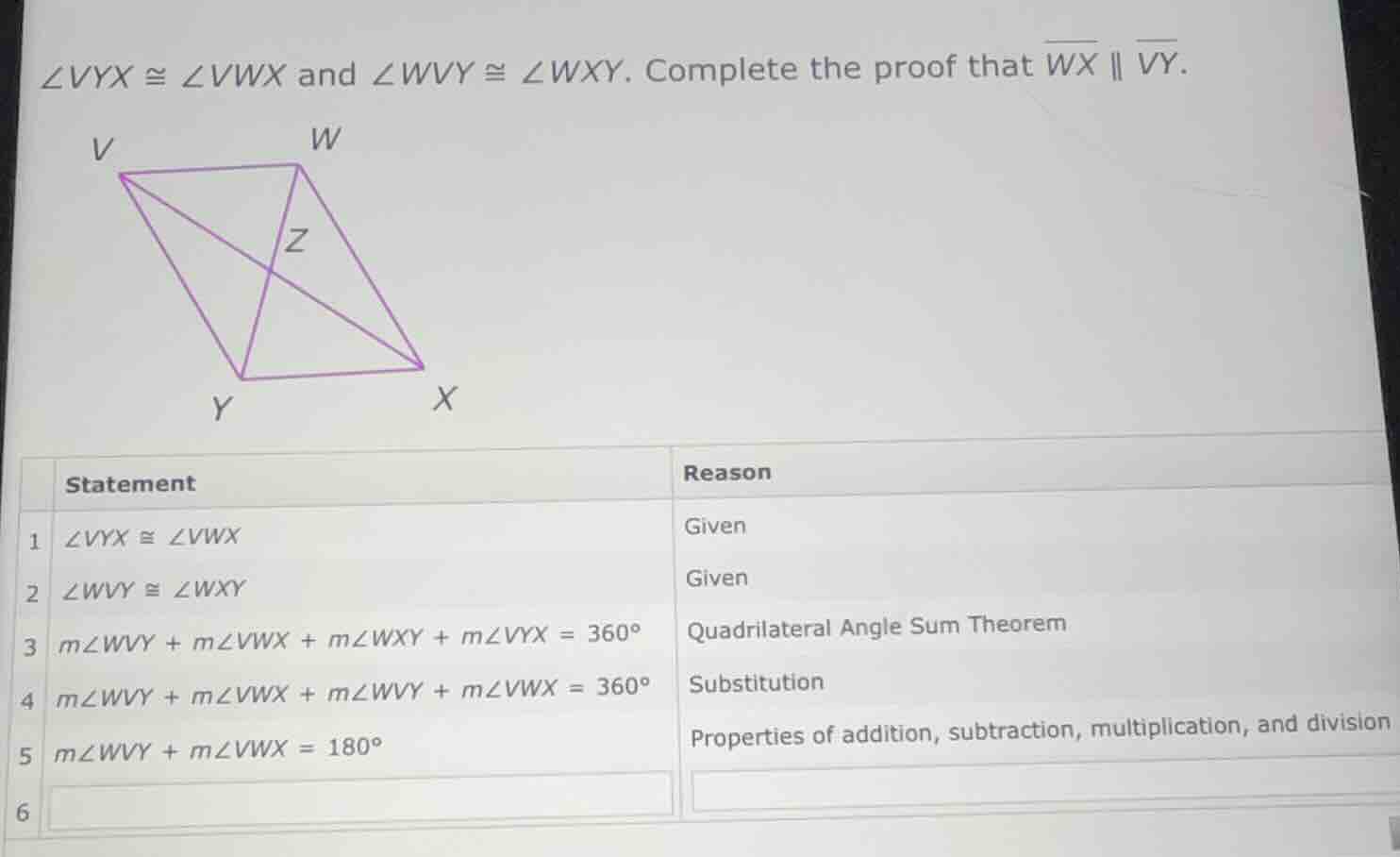
$\angle vyx \cong \angle vwx$ and $\angle wvy \cong \angle wxy$. complete the proof that $\overline{wx} \parallel \overline{vy}$.
| statement | reason |
|---|---|
| 2 $\angle wvy \cong \angle wxy$ | given |
| 3 $m\angle wvy + m\angle vwx + m\angle wxy + m\angle vyx = 360^\circ$ | quadrilateral angle sum theorem |
| 4 $m\angle wvy + m\angle vwx + m\angle wvy + m\angle vwx = 360^\circ$ | substitution |
| 5 $m\angle wvy + m\angle vwx = 180^\circ$ | properties of addition, subtraction, multiplication, and division |
| 6 |
Step1: Identify the consecutive interior angles
We know from step 5 that \( m\angle WVY + m\angle VWX = 180^\circ \). Notice that \( \angle WVY \) and \( \angle VWX \) are consecutive interior angles formed by the transversal \( VW \) intersecting lines \( WX \) and \( VY \).
Step2: Apply the Consecutive Interior Angles Theorem
The Consecutive Interior Angles Theorem states that if two consecutive interior angles are supplementary (their measures sum to \( 180^\circ \)), then the two lines cut by the transversal are parallel. Since \( m\angle WVY + m\angle VWX = 180^\circ \), by the Consecutive Interior Angles Theorem, we can conclude that \( \overline{WX} \parallel \overline{VY} \).

Snap & solve any problem in the app
Get step-by-step solutions on Sovi AI
Photo-based solutions with guided steps
Explore more problems and detailed explanations
Statement 6: \( \overline{WX} \parallel \overline{VY} \)
Reason 6: Consecutive Interior Angles Theorem (If two consecutive interior angles are supplementary, then the lines are parallel)