QUESTION IMAGE
Question
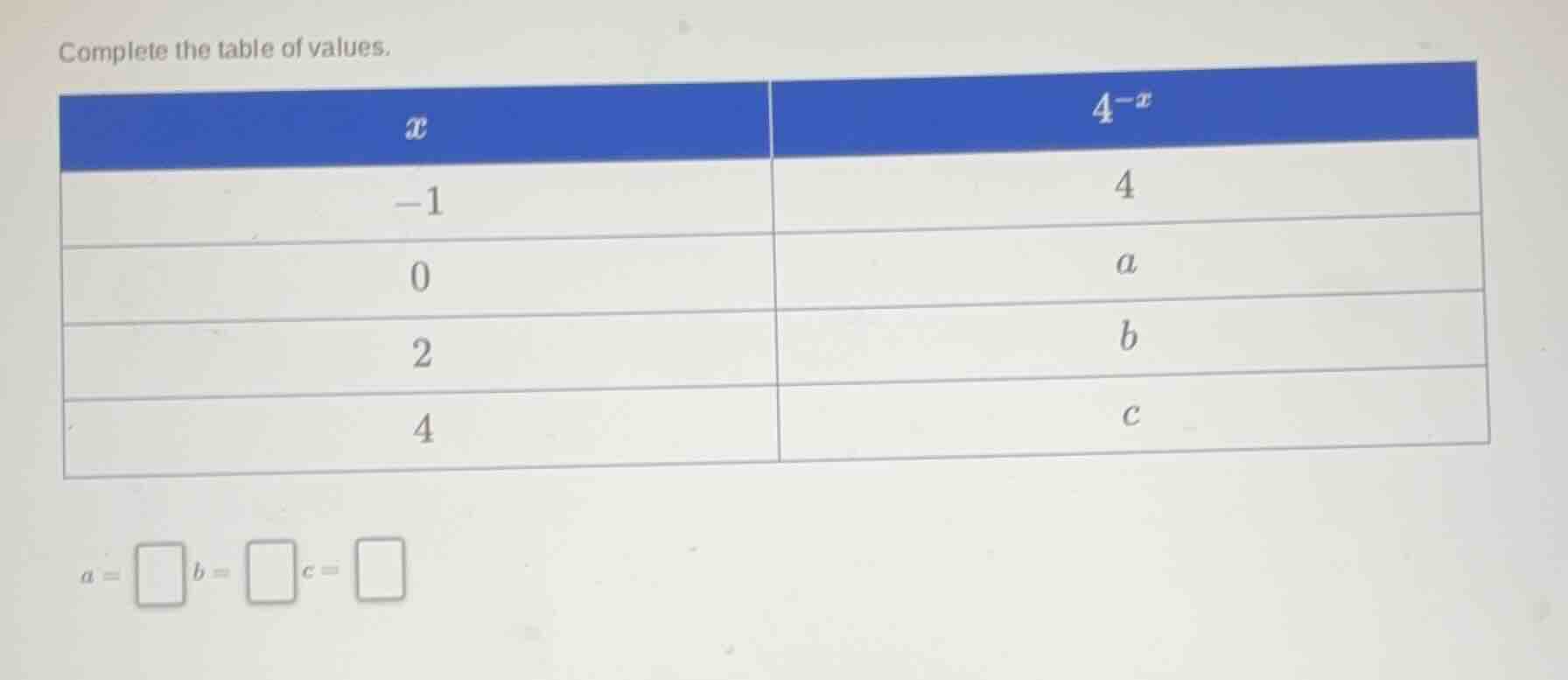
complete the table of values.
| $x$ | $4^{-x}$ |
|---|---|
| $0$ | $a$ |
| $2$ | $b$ |
| $4$ | $c$ |
$a = \square$ $b = \square$ $c = \square$
Step1: Find the value of \(a\) when \(x = 0\)
Substitute \(x = 0\) into the function \(y = 4^{-x}\). According to the exponent rule \(a^0 = 1\) (where \(a
eq0\)), we have \(4^{-0}=4^{0} = 1\). So \(a = 1\).
Step2: Find the value of \(b\) when \(x = 2\)
Substitute \(x = 2\) into the function \(y = 4^{-x}\). We get \(4^{-2}\). Using the exponent rule \(a^{-n}=\frac{1}{a^{n}}\), so \(4^{-2}=\frac{1}{4^{2}}=\frac{1}{16}\). Thus, \(b=\frac{1}{16}\).
Step3: Find the value of \(c\) when \(x = 4\)
Substitute \(x = 4\) into the function \(y = 4^{-x}\). We have \(4^{-4}\). By the exponent rule \(a^{-n}=\frac{1}{a^{n}}\), \(4^{-4}=\frac{1}{4^{4}}=\frac{1}{256}\). So \(c = \frac{1}{256}\).

Snap & solve any problem in the app
Get step-by-step solutions on Sovi AI
Photo-based solutions with guided steps
Explore more problems and detailed explanations
\(a = \boldsymbol{1}\), \(b=\boldsymbol{\frac{1}{16}}\), \(c=\boldsymbol{\frac{1}{256}}\)