QUESTION IMAGE
Question
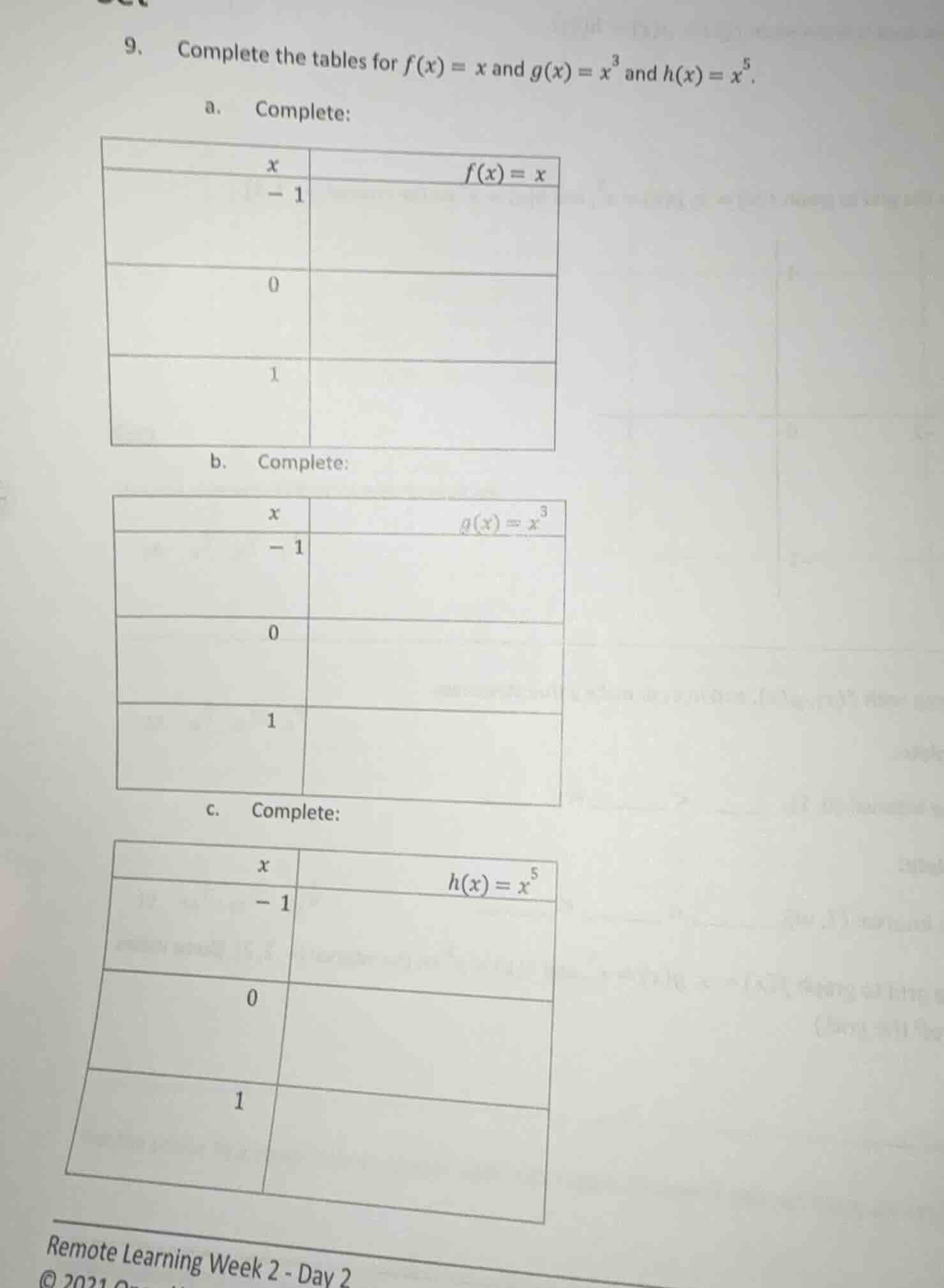
- complete the tables for $f(x) = x$ and $g(x) = x^3$ and $h(x) = x^5$.
a. complete:
| $x$ | $f(x) = x$ |
|---|---|
| $0$ | |
| $1$ |
b. complete:
| $x$ | $g(x) = x^3$ |
|---|---|
| $0$ | |
| $1$ |
c. complete:
| $x$ | $h(x) = x^5$ |
|---|---|
| $0$ | |
| $1$ |
remote learning week 2 - day 2
© 2021
Part a: For \( f(x) = x \)
Step1: When \( x = -1 \)
Substitute \( x = -1 \) into \( f(x) = x \), so \( f(-1) = -1 \).
Step2: When \( x = 0 \)
Substitute \( x = 0 \) into \( f(x) = x \), so \( f(0) = 0 \).
Step3: When \( x = 1 \)
Substitute \( x = 1 \) into \( f(x) = x \), so \( f(1) = 1 \).
The completed table for \( f(x)=x \) is:
| \( x \) | \( f(x) = x \) |
|---|---|
| \( 0 \) | \( 0 \) |
| \( 1 \) | \( 1 \) |
Part b: For \( g(x) = x^3 \)
Step1: When \( x = -1 \)
Substitute \( x = -1 \) into \( g(x) = x^3 \), we get \( g(-1)=(-1)^3=-1 \).
Step2: When \( x = 0 \)
Substitute \( x = 0 \) into \( g(x) = x^3 \), we get \( g(0)=0^3 = 0 \).
Step3: When \( x = 1 \)
Substitute \( x = 1 \) into \( g(x) = x^3 \), we get \( g(1)=1^3 = 1 \).
The completed table for \( g(x)=x^3 \) is:
| \( x \) | \( g(x) = x^3 \) |
|---|---|
| \( 0 \) | \( 0 \) |
| \( 1 \) | \( 1 \) |
Part c: For \( h(x) = x^5 \)
Step1: When \( x = -1 \)
Substitute \( x = -1 \) into \( h(x) = x^5 \), we get \( h(-1)=(-1)^5=-1 \).
Step2: When \( x = 0 \)
Substitute \( x = 0 \) into \( h(x) = x^5 \), we get \( h(0)=0^5 = 0 \).
Step3: When \( x = 1 \)
Substitute \( x = 1 \) into \( h(x) = x^5 \), we get \( h(1)=1^5 = 1 \).
The completed table for \( h(x)=x^5 \) is:
| \( x \) | \( h(x) = x^5 \) |
|---|---|
| \( 0 \) | \( 0 \) |
| \( 1 \) | \( 1 \) |

Snap & solve any problem in the app
Get step-by-step solutions on Sovi AI
Photo-based solutions with guided steps
Explore more problems and detailed explanations
Step1: When \( x = -1 \)
Substitute \( x = -1 \) into \( h(x) = x^5 \), we get \( h(-1)=(-1)^5=-1 \).
Step2: When \( x = 0 \)
Substitute \( x = 0 \) into \( h(x) = x^5 \), we get \( h(0)=0^5 = 0 \).
Step3: When \( x = 1 \)
Substitute \( x = 1 \) into \( h(x) = x^5 \), we get \( h(1)=1^5 = 1 \).
The completed table for \( h(x)=x^5 \) is:
| \( x \) | \( h(x) = x^5 \) |
|---|---|
| \( 0 \) | \( 0 \) |
| \( 1 \) | \( 1 \) |