QUESTION IMAGE
Question
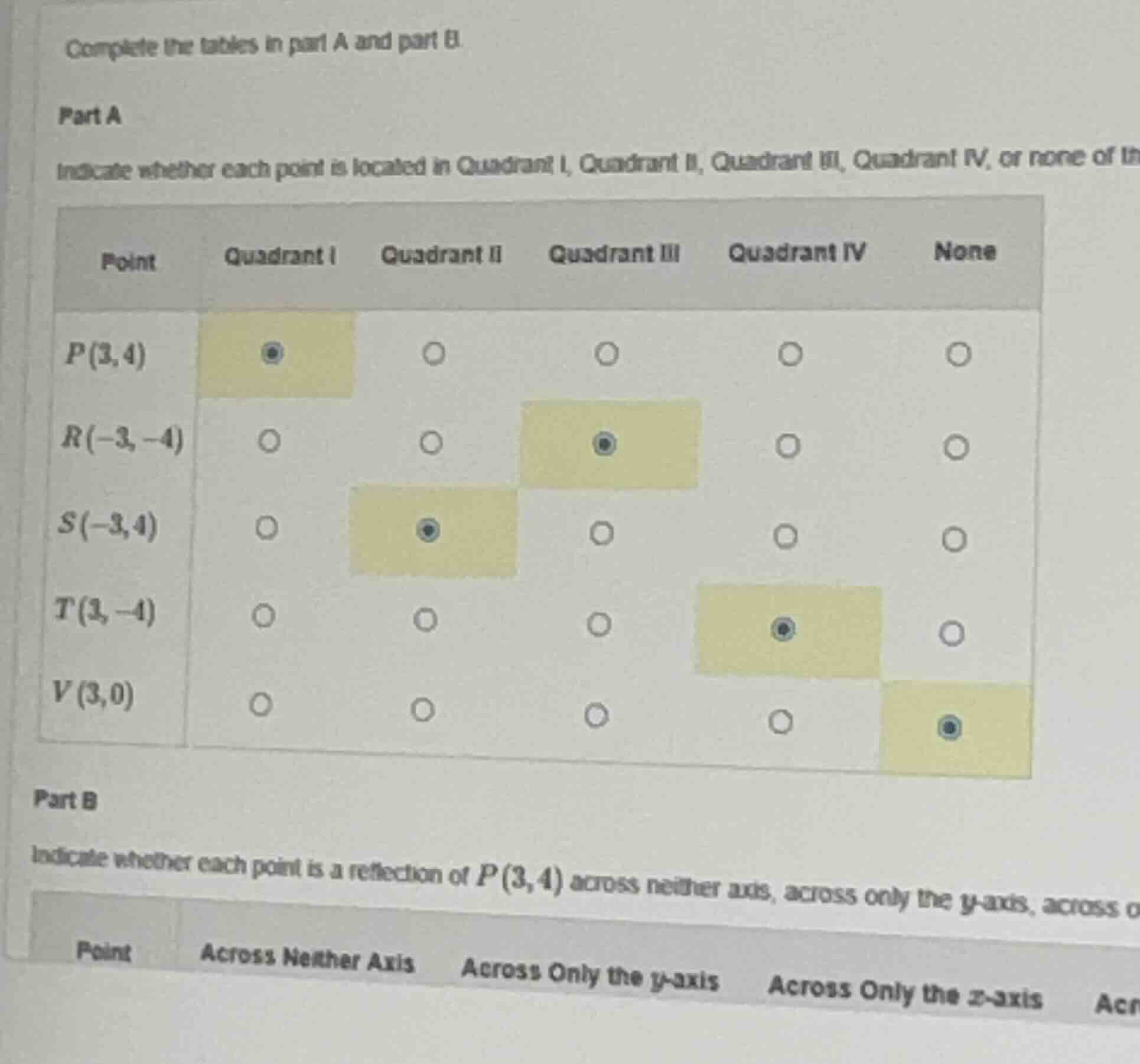
complete the tables in part a and part b.
part a
indicate whether each point is located in quadrant i, quadrant ii, quadrant iii, quadrant iv, or none of th
point quadrant i quadrant ii quadrant iii quadrant iv none
p(3,4)
r(-3,-4)
s(-3,4)
t(1,-4)
v(3,0)
part b
indicate whether each point is a reflection of p(3,4) across neither axis, across only the y - axis, across o
point across neither axis across only the y - axis across only the x - axis acn
Part A Explanation (for each point, we use the rule of quadrants: Quadrant I: (+, +); Quadrant II: (-, +); Quadrant III: (-, -); Quadrant IV: (+, -); points on axes are "None")
- Point \( P(3, 4) \): \( x = 3>0 \), \( y = 4>0 \), so Quadrant I (already marked correctly).
- Point \( R(-3, -4) \): \( x=-3 < 0 \), \( y = - 4<0 \), so Quadrant III (already marked correctly).
- Point \( S(-3, 4) \): \( x=-3 < 0 \), \( y = 4>0 \), so Quadrant II (already marked correctly).
- Point \( T(3, -4) \): \( x = 3>0 \), \( y=-4 < 0 \), so Quadrant IV (already marked correctly).
- Point \( V(3, 0) \): \( y = 0 \), so it lies on the \( x \)-axis, so "None" (already marked correctly).
Part B (assuming we need to analyze reflections, let's take each point relative to \( P(3,4) \))
- Reflection across \( y \)-axis: changes \( x \) to \( -x \), so the reflection of \( P(3,4) \) across \( y \)-axis is \( (-3,4) \) (which is point \( S \)).
- Reflection across \( x \)-axis: changes \( y \) to \( -y \), so the reflection of \( P(3,4) \) across \( x \)-axis is \( (3,-4) \) (which is point \( T \)).
- Reflection across both axes: changes \( x \) to \( -x \) and \( y \) to \( -y \), so the reflection of \( P(3,4) \) across both axes is \( (-3,-4) \) (which is point \( R \)).
- Point \( P(3,4) \): reflection across neither axis (since it's the original point).
- Point \( V(3,0) \): not a reflection of \( P \) across any axis (since \( y \)-coordinate is 0, not related to reflection of \( P \)'s \( y = 4 \)).
If we need to fill the Part B table (assuming the columns are "Across Neither Axis", "Across Only the \( y \)-axis", "Across Only the \( x \)-axis", "Across Both Axes"):
- Point \( P(3,4) \): Across Neither Axis (mark this).
- Point \( R(-3,-4) \): Across Both Axes (since \( x \) and \( y \) are negated).
- Point \( S(-3,4) \): Across Only the \( y \)-axis (since only \( x \) is negated).
- Point \( T(3,-4) \): Across Only the \( x \)-axis (since only \( y \) is negated).
- Point \( V(3,0) \): Across Neither Axis (not a reflection of \( P \) across any axis).
(Note: Since the Part B table is partially visible, the above is a standard analysis of reflections for the given points relative to \( P(3,4) \).)
If the task was to complete the tables as per the markings, the given Part A table is already correctly marked for each point's quadrant. For Part B, using the reflection rules, we can mark each point's reflection category as above.

Snap & solve any problem in the app
Get step-by-step solutions on Sovi AI
Photo-based solutions with guided steps
Explore more problems and detailed explanations
Part A Explanation (for each point, we use the rule of quadrants: Quadrant I: (+, +); Quadrant II: (-, +); Quadrant III: (-, -); Quadrant IV: (+, -); points on axes are "None")
- Point \( P(3, 4) \): \( x = 3>0 \), \( y = 4>0 \), so Quadrant I (already marked correctly).
- Point \( R(-3, -4) \): \( x=-3 < 0 \), \( y = - 4<0 \), so Quadrant III (already marked correctly).
- Point \( S(-3, 4) \): \( x=-3 < 0 \), \( y = 4>0 \), so Quadrant II (already marked correctly).
- Point \( T(3, -4) \): \( x = 3>0 \), \( y=-4 < 0 \), so Quadrant IV (already marked correctly).
- Point \( V(3, 0) \): \( y = 0 \), so it lies on the \( x \)-axis, so "None" (already marked correctly).
Part B (assuming we need to analyze reflections, let's take each point relative to \( P(3,4) \))
- Reflection across \( y \)-axis: changes \( x \) to \( -x \), so the reflection of \( P(3,4) \) across \( y \)-axis is \( (-3,4) \) (which is point \( S \)).
- Reflection across \( x \)-axis: changes \( y \) to \( -y \), so the reflection of \( P(3,4) \) across \( x \)-axis is \( (3,-4) \) (which is point \( T \)).
- Reflection across both axes: changes \( x \) to \( -x \) and \( y \) to \( -y \), so the reflection of \( P(3,4) \) across both axes is \( (-3,-4) \) (which is point \( R \)).
- Point \( P(3,4) \): reflection across neither axis (since it's the original point).
- Point \( V(3,0) \): not a reflection of \( P \) across any axis (since \( y \)-coordinate is 0, not related to reflection of \( P \)'s \( y = 4 \)).
If we need to fill the Part B table (assuming the columns are "Across Neither Axis", "Across Only the \( y \)-axis", "Across Only the \( x \)-axis", "Across Both Axes"):
- Point \( P(3,4) \): Across Neither Axis (mark this).
- Point \( R(-3,-4) \): Across Both Axes (since \( x \) and \( y \) are negated).
- Point \( S(-3,4) \): Across Only the \( y \)-axis (since only \( x \) is negated).
- Point \( T(3,-4) \): Across Only the \( x \)-axis (since only \( y \) is negated).
- Point \( V(3,0) \): Across Neither Axis (not a reflection of \( P \) across any axis).
(Note: Since the Part B table is partially visible, the above is a standard analysis of reflections for the given points relative to \( P(3,4) \).)
If the task was to complete the tables as per the markings, the given Part A table is already correctly marked for each point's quadrant. For Part B, using the reflection rules, we can mark each point's reflection category as above.