QUESTION IMAGE
Question
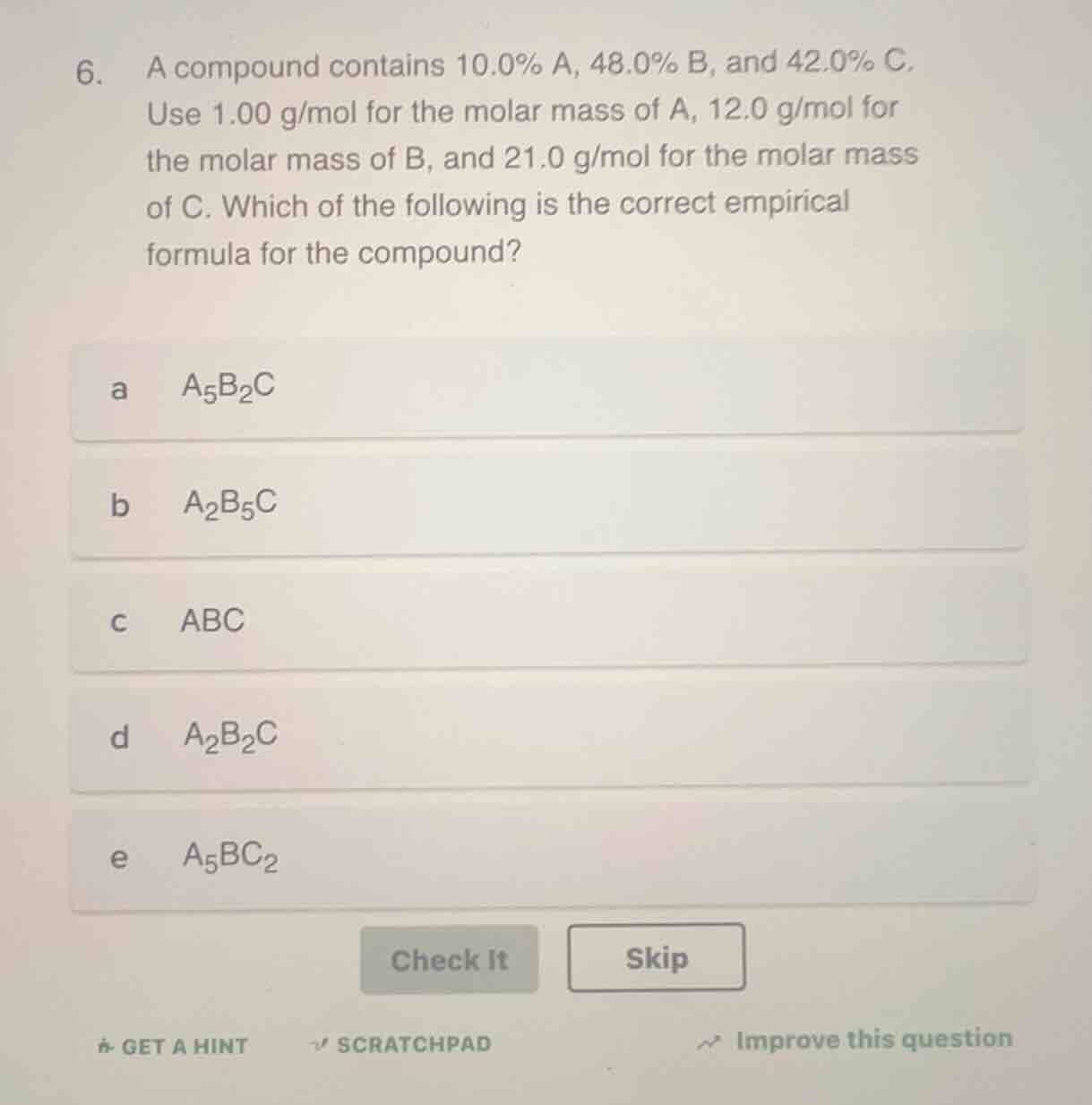
- a compound contains 10.0% a, 48.0% b, and 42.0% c. use 1.00 g/mol for the molar mass of a, 12.0 g/mol for the molar mass of b, and 21.0 g/mol for the molar mass of c. which of the following is the correct empirical formula for the compound?
a $a_5b_2c$
b $a_2b_5c$
c $abc$
d $a_2b_2c$
e $a_5bc_2$
Step1: Assume 100g of compound
Mass of A = 10.0 g, Mass of B = 48.0 g, Mass of C = 42.0 g
Step2: Calculate moles of each element
Moles of A: $\frac{10.0\ \text{g}}{1.00\ \text{g/mol}} = 10.0\ \text{mol}$
Moles of B: $\frac{48.0\ \text{g}}{12.0\ \text{g/mol}} = 4.00\ \text{mol}$
Moles of C: $\frac{42.0\ \text{g}}{21.0\ \text{g/mol}} = 2.00\ \text{mol}$
Step3: Find mole ratio (divide by smallest)
Smallest moles = 2.00 mol
Ratio of A: $\frac{10.0}{2.00} = 5$
Ratio of B: $\frac{4.00}{2.00} = 2$
Ratio of C: $\frac{2.00}{2.00} = 1$

Snap & solve any problem in the app
Get step-by-step solutions on Sovi AI
Photo-based solutions with guided steps
Explore more problems and detailed explanations
a. $A_5B_2C$