QUESTION IMAGE
Question
conclusion
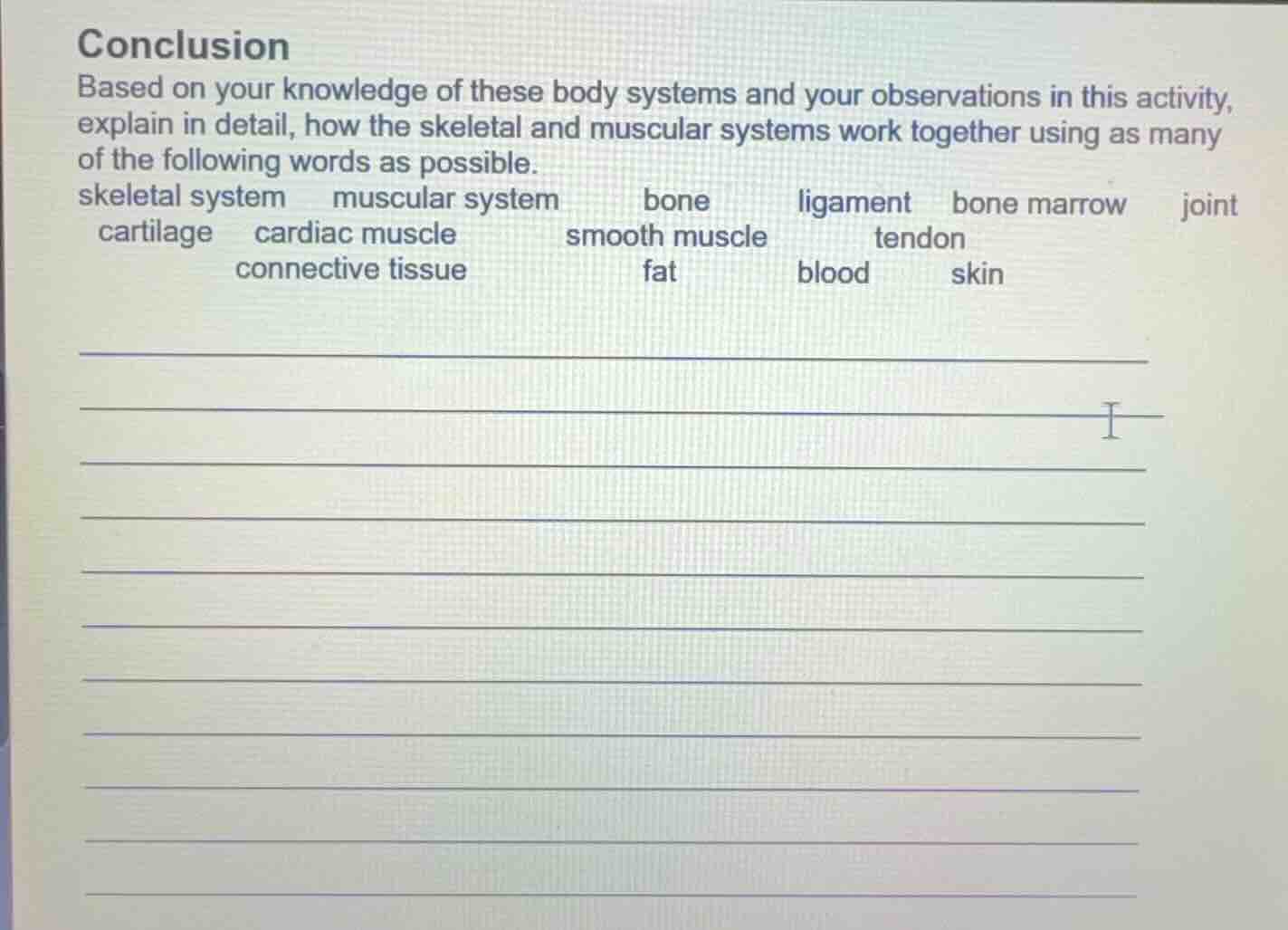
based on your knowledge of these body systems and your observations in this activity,
explain in detail, how the skeletal and muscular systems work together using as many
of the following words as possible.
skeletal system muscular system bone ligament bone marrow joint
cartilage cardiac muscle smooth muscle tendon
connective tissue fat blood skin
_________________________________________________________________________
_________________________________________________________________________
_________________________________________________________________________
_________________________________________________________________________
_________________________________________________________________________
_________________________________________________________________________
_________________________________________________________________________
_________________________________________________________________________
_________________________________________________________________________
_________________________________________________________________________
The skeletal system (made of bone, cartilage, ligaments, joints, and bone marrow) and muscular system work in tandem for movement, support, and protection. Bones provide a rigid framework; joints (cushioned by cartilage, held stable by ligaments) enable movement. Skeletal muscles (distinct from cardiac/smooth muscle, which serve other bodily functions) attach to bones via tendons—both tendons and ligaments are types of connective tissue. When skeletal muscles contract, they pull on bones to create movement at joints. Bone marrow produces blood cells that deliver oxygen and nutrients to working muscles, while fat (a connective tissue) cushions bones and muscles under the skin, adding a protective layer.

Snap & solve any problem in the app
Get step-by-step solutions on Sovi AI
Photo-based solutions with guided steps
Explore more problems and detailed explanations
The skeletal system and muscular system function as an integrated unit to enable movement, provide structural support, and protect bodily tissues:
- The skeletal system forms the body's rigid framework, composed of bone (the hard structural tissue), cartilage (a flexible connective tissue that cushions joints to prevent bone-on-bone friction), and ligaments (tough connective tissue that binds bones together to stabilize joints). Inside bones, bone marrow produces blood cells that carry oxygen and nutrients to fuel working muscles.
- The muscular system’s skeletal muscles (separate from cardiac muscle (heart-specific) and smooth muscle (for internal organs)) attach directly to bones via tendons (thick connective tissue cords). When skeletal muscles contract, they pull on the connected bones, creating movement at joints.
- Additional connective tissue like fat lies beneath the skin, providing a protective, cushioning layer around bones and muscles to absorb impact during movement. Together, these structures allow coordinated, controlled movement while maintaining the body's shape and protecting vital internal structures.