QUESTION IMAGE
Question
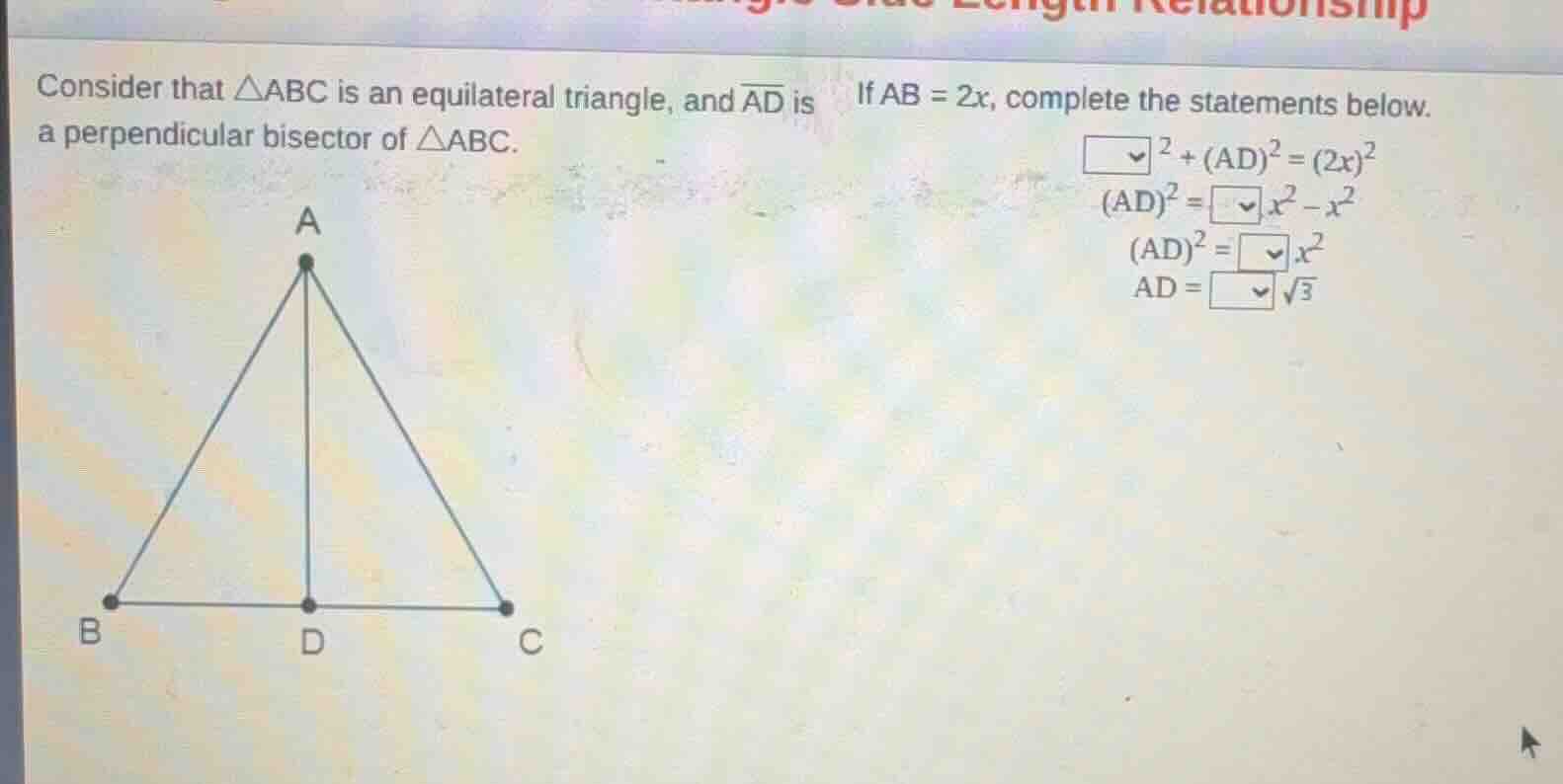
consider that △abc is an equilateral triangle, and \\(\overline{ad}\\) is a perpendicular bisector of △abc. if \\(ab = 2x\\), complete the statements below. \\(\square^2 + (ad)^2 = (2x)^2\\) \\((ad)^2 = \square x^2 - x^2\\) \\((ad)^2 = \square x^2\\) \\(ad = \square \sqrt{3}\\) (and there is a diagram of equilateral triangle abc with ad as the perpendicular bisector from a to bc, with d on bc between b and c)
Step1: Identify BD length
In equilateral triangle \( \triangle ABC \), \( AD \) is perpendicular bisector, so \( BD=\frac{BC}{2} \). Since \( AB = BC = 2x \) (equilateral triangle), \( BD = x \). By Pythagorean theorem in \( \triangle ABD \): \( BD^{2}+(AD)^{2}=AB^{2} \), so \( x^{2}+(AD)^{2}=(2x)^{2} \).
Step2: Solve for \( (AD)^{2} \)
Expand \( (2x)^{2}=4x^{2} \), so \( (AD)^{2}=4x^{2}-x^{2} \).
Step3: Simplify \( (AD)^{2} \)
\( 4x^{2}-x^{2}=3x^{2} \), so \( (AD)^{2}=3x^{2} \).
Step4: Solve for \( AD \)
Take square root: \( AD = \sqrt{3x^{2}}=x\sqrt{3} \).

Snap & solve any problem in the app
Get step-by-step solutions on Sovi AI
Photo-based solutions with guided steps
Explore more problems and detailed explanations
First box: \( x \)
Second box: \( 4 \)
Third box: \( 3 \)
Fourth box: \( x \)