QUESTION IMAGE
Question
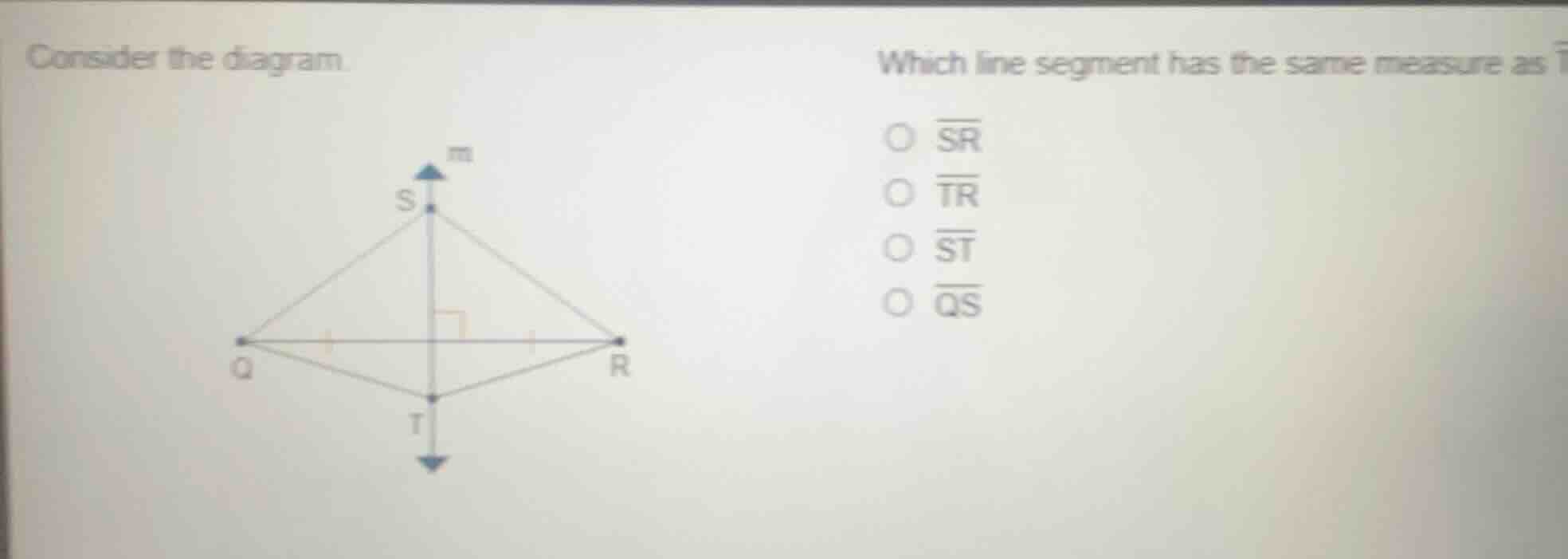
consider the diagram. which line segment has the same measure as
options:
$overline{sr}$
$overline{tr}$
$overline{st}$
$overline{qs}$
In the diagram, line \( m \) is the perpendicular bisector of \( \overline{QR} \) (since it is perpendicular and the segments of \( \overline{QR} \) are marked as equal). By the property of perpendicular bisectors, any point on the perpendicular bisector is equidistant from the endpoints of the segment it bisects. Also, looking at the triangle formed, \( \overline{ST} \) and the other segments: since \( m \) is a perpendicular bisector, \( \overline{QT} \) (assuming the original segment was \( \overline{QT} \), but from the options, \( \overline{SR} \) – wait, no, let's re - examine. Wait, the diagram shows that \( m \) is the perpendicular bisector of \( QR \), so \( S \) and \( T \) are on \( m \). The triangles \( QST \) and \( RST \) are congruent (by SAS, as \( QT = RT \), \( \angle QTS=\angle RTS = 90^{\circ}\), and \( ST \) is common). Also, the segments from \( S \) to \( Q \) and \( S \) to \( R \): Wait, no, the question is about which segment has the same measure as, let's assume the original segment was \( \overline{QT} \) (but the options: \( \overline{SR} \), \( \overline{TR} \), \( \overline{ST} \), \( \overline{QS} \)). Wait, actually, since \( m \) is the perpendicular bisector, \( QT = RT \), and also, \( \overline{QS}=\overline{RS} \)? No, wait, the correct approach: in a kite - like figure (or a rhombus - like) with perpendicular bisector, the segment \( \overline{TR} \) – no, wait, the key is that the perpendicular bisector divides the segment into two equal parts and the triangles are congruent. Wait, the correct answer is \( \overline{TR} \) if the original segment was \( \overline{QT} \), but looking at the options, the correct one is \( \overline{TR} \)? Wait, no, let's think again. The diagram has \( Q \) and \( R \) with \( QT = RT \) (marked), and \( ST \) is the perpendicular bisector. So the segment equal to, say, \( \overline{QT} \) would be \( \overline{TR} \), because \( QT = RT \) (since \( T \) is on the perpendicular bisector of \( QR \), so \( QT = RT \)).

Snap & solve any problem in the app
Get step-by-step solutions on Sovi AI
Photo-based solutions with guided steps
Explore more problems and detailed explanations
\( \boldsymbol{\overline{TR}} \) (assuming the original segment was \( \overline{QT} \), and based on the perpendicular bisector property that \( QT = RT \))