QUESTION IMAGE
Question
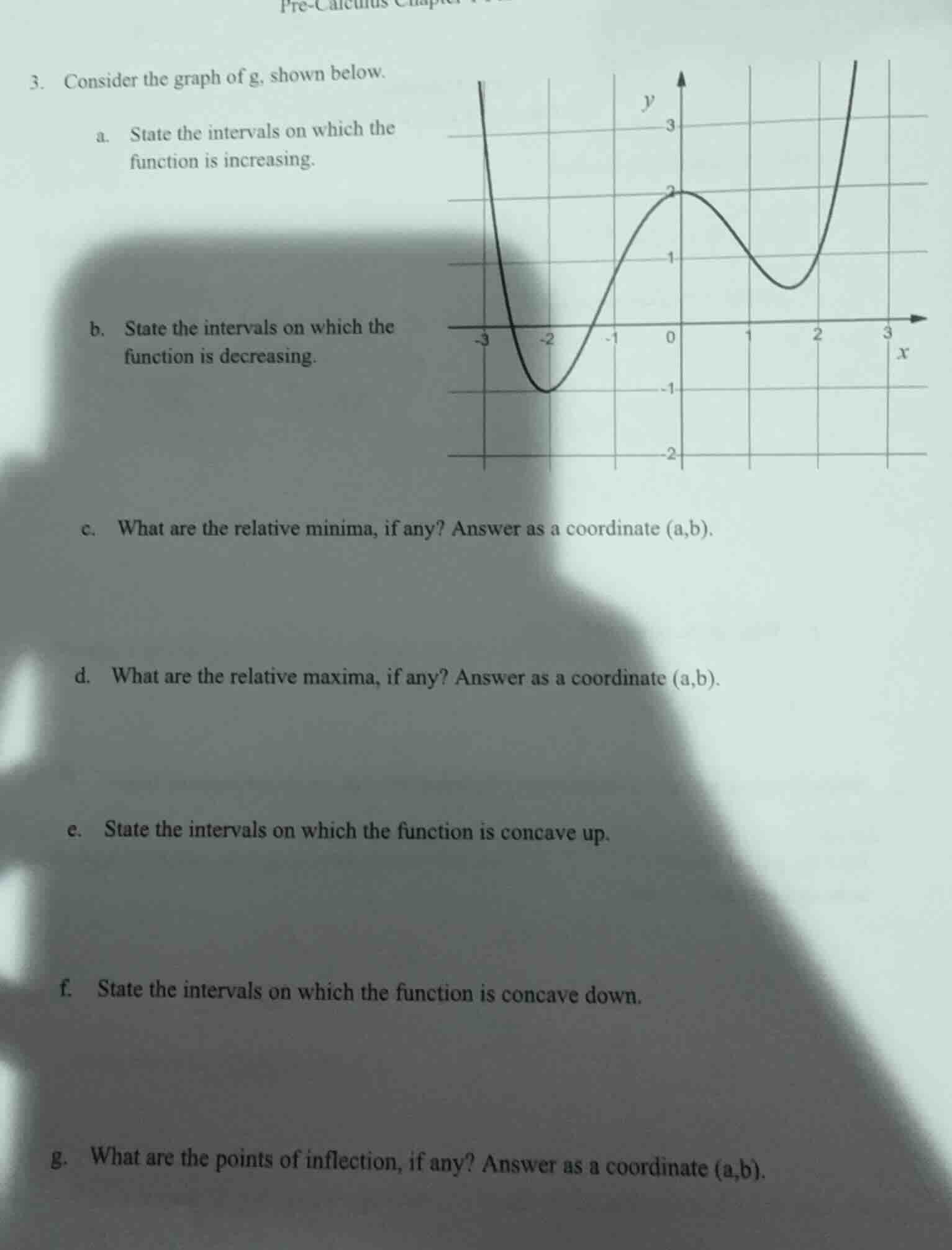
- consider the graph of g, shown below.
a. state the intervals on which the function is increasing.
b. state the intervals on which the function is decreasing.
c. what are the relative minima, if any? answer as a coordinate (a,b).
d. what are the relative maxima, if any? answer as a coordinate (a,b).
e. state the intervals on which the function is concave up.
f. state the intervals on which the function is concave down.
g. what are the points of inflection, if any? answer as a coordinate (a,b).
Step1: Identify increasing intervals
A function increases when its graph rises as $x$ increases. From the graph, this occurs on $(-2, 0)$ and $(2, \infty)$.
Step2: Identify decreasing intervals
A function decreases when its graph falls as $x$ increases. From the graph, this occurs on $(-\infty, -2)$ and $(0, 2)$.
Step3: Locate relative minima
Relative minima are "valley" points on the graph. The points are $(-2, -1)$ and $(2, 0)$.
Step4: Locate relative maxima
Relative maxima are "peak" points on the graph. The point is $(0, 2)$.
Step5: Identify concave up intervals
A function is concave up when its graph curves upward. From the graph, this occurs on $(-\infty, -1)$ and $(1, \infty)$.
Step6: Identify concave down intervals
A function is concave down when its graph curves downward. From the graph, this occurs on $(-1, 1)$.
Step7: Locate inflection points
Inflection points are where concavity changes. The points are $(-1, 0)$ and $(1, 1)$.

Snap & solve any problem in the app
Get step-by-step solutions on Sovi AI
Photo-based solutions with guided steps
Explore more problems and detailed explanations
a. $(-2, 0)$ and $(2, \infty)$
b. $(-\infty, -2)$ and $(0, 2)$
c. $(-2, -1)$ and $(2, 0)$
d. $(0, 2)$
e. $(-\infty, -1)$ and $(1, \infty)$
f. $(-1, 1)$
g. $(-1, 0)$ and $(1, 1)$