QUESTION IMAGE
Question
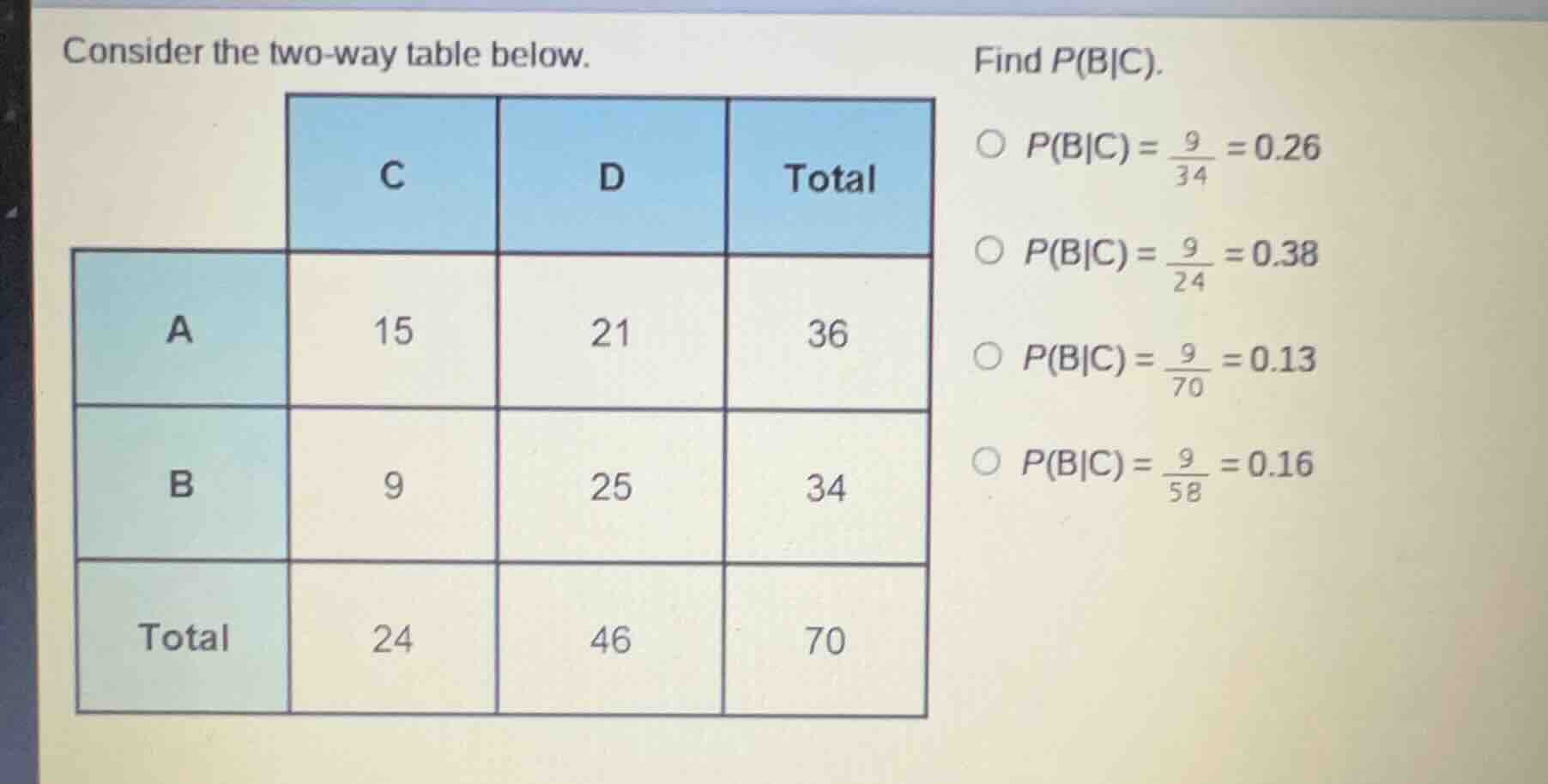
consider the two-way table below. find ( p(b|c) ).
| c | d | total | |
|---|---|---|---|
| b | 9 | 25 | 34 |
| total | 24 | 46 | 70 |
- ( p(b|c)=\frac{9}{34}=0.26 )
- ( p(b|c)=\frac{9}{24}=0.38 )
- ( p(b|c)=\frac{9}{70}=0.13 )
- ( p(b|c)=\frac{9}{58}=0.16 )
Step1: Recall Conditional Probability Formula
The formula for conditional probability is \( P(B|C) = \frac{P(B \cap C)}{P(C)} \). For a two - way table, \( n(B\cap C) \) is the number of outcomes in both \( B \) and \( C \), and \( n(C) \) is the number of outcomes in \( C \). So \( P(B|C)=\frac{n(B\cap C)}{n(C)} \).
Step2: Identify \( n(B\cap C) \) and \( n(C) \) from the table
From the two - way table, the number of elements in the intersection of \( B \) and \( C \) (i.e., \( n(B\cap C) \)) is 9 (the value in the cell where row \( B \) and column \( C \) intersect). The total number of elements in column \( C \) (i.e., \( n(C) \)) is the sum of the values in column \( C \), which is \( 15 + 9=24 \).
Step3: Calculate \( P(B|C) \)
Using the formula \( P(B|C)=\frac{n(B\cap C)}{n(C)} \), we substitute \( n(B\cap C) = 9 \) and \( n(C)=24 \). So \( P(B|C)=\frac{9}{24}\approx0.38 \).

Snap & solve any problem in the app
Get step-by-step solutions on Sovi AI
Photo-based solutions with guided steps
Explore more problems and detailed explanations
\( P(B|C)=\frac{9}{24} = 0.38 \) (the option: \( P(B|C)=\frac{9}{24}=0.38 \))