QUESTION IMAGE
Question
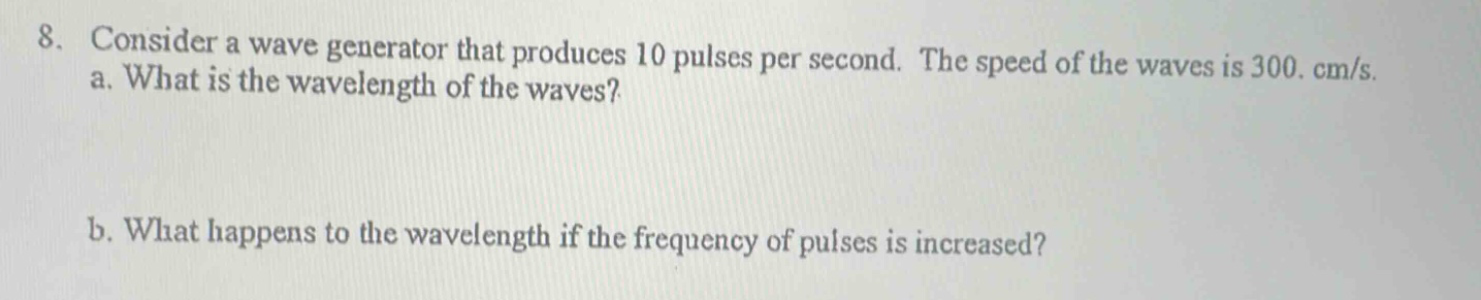
- consider a wave generator that produces 10 pulses per second. the speed of the waves is 300. cm/s.
a. what is the wavelength of the waves?
b. what happens to the wavelength if the frequency of pulses is increased?
Part (a)
Step 1: Recall the wave speed formula
The formula that relates wave speed (\(v\)), frequency (\(f\)), and wavelength (\(\lambda\)) is \(v = f\lambda\). We need to find the wavelength, so we can rearrange this formula to \(\lambda=\frac{v}{f}\).
Step 2: Identify the given values
The frequency \(f\) is the number of pulses per second, so \(f = 10\) Hz (since 1 pulse per second is 1 Hz). The wave speed \(v = 300\) cm/s.
Step 3: Calculate the wavelength
Substitute the values of \(v\) and \(f\) into the formula \(\lambda=\frac{v}{f}\). So, \(\lambda=\frac{300\ \text{cm/s}}{10\ \text{Hz}}\).
Step 4: Perform the division
\(\frac{300}{10}=30\) cm.
We know from the wave speed formula \(v = f\lambda\). If we assume that the wave speed \(v\) remains constant (since the medium through which the wave travels is not changing, which is a common assumption in such cases), and the frequency \(f\) is increased, then from the formula \(\lambda=\frac{v}{f}\), when the numerator (\(v\)) is constant and the denominator (\(f\)) increases, the value of \(\lambda\) (wavelength) will decrease. This is because wavelength is inversely proportional to frequency when speed is constant.

Snap & solve any problem in the app
Get step-by-step solutions on Sovi AI
Photo-based solutions with guided steps
Explore more problems and detailed explanations
The wavelength of the waves is \(\boldsymbol{30}\) centimeters.