QUESTION IMAGE
Question
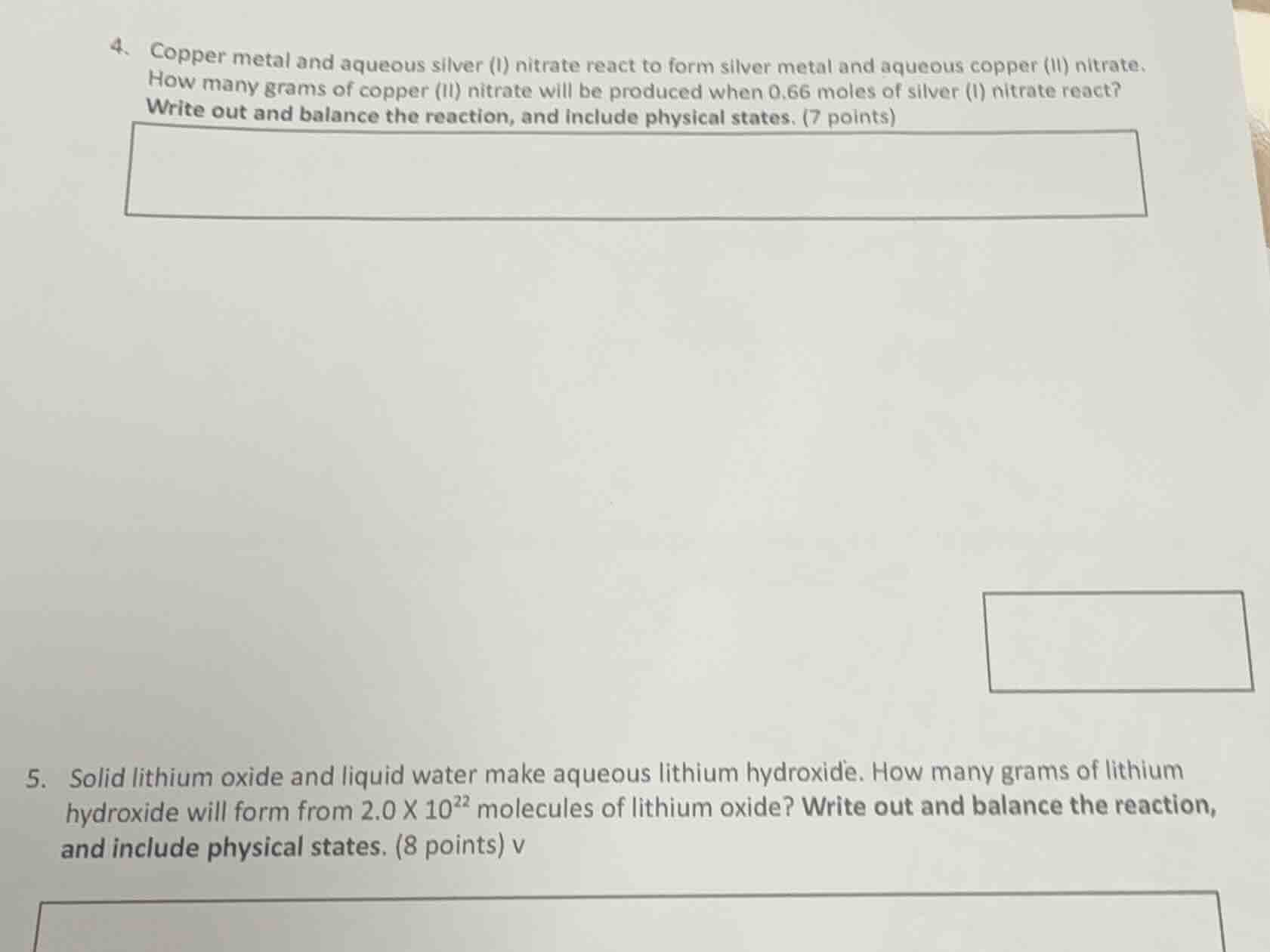
- copper metal and aqueous silver (i) nitrate react to form silver metal and aqueous copper (ii) nitrate. how many grams of copper (ii) nitrate will be produced when 0.66 moles of silver (i) nitrate react? write out and balance the reaction, and include physical states. (7 points)
- solid lithium oxide and liquid water make aqueous lithium hydroxide. how many grams of lithium hydroxide will form from 2.0 × 10²² molecules of lithium oxide? write out and balance the reaction, and include physical states. (8 points) v
Question 4
Step 1: Write the unbalanced reaction
The reactants are copper metal ($\text{Cu}(s)$) and aqueous silver(I) nitrate ($\text{AgNO}_3(aq)$). The products are silver metal ($\text{Ag}(s)$) and aqueous copper(II) nitrate ($\text{Cu(NO}_3\text{)}_2(aq)$). So the unbalanced reaction is:
$\text{Cu}(s) + \text{AgNO}_3(aq)
ightarrow \text{Ag}(s) + \text{Cu(NO}_3\text{)}_2(aq)$
Step 2: Balance the reaction
- For nitrate ions ($\text{NO}_3^-$): There are 2 in $\text{Cu(NO}_3\text{)}_2$, so we put a coefficient of 2 in front of $\text{AgNO}_3$.
- For silver ($\text{Ag}$): Now there are 2 $\text{Ag}$ on the left, so we put a coefficient of 2 in front of $\text{Ag}(s)$.
- Copper ($\text{Cu}$) is already balanced (1 on each side).
The balanced reaction is:
$\text{Cu}(s) + 2\text{AgNO}_3(aq)
ightarrow 2\text{Ag}(s) + \text{Cu(NO}_3\text{)}_2(aq)$
Step 3: Determine mole ratio
From the balanced equation, 2 moles of $\text{AgNO}_3$ produce 1 mole of $\text{Cu(NO}_3\text{)}_2$.
Step 4: Calculate moles of $\text{Cu(NO}_3\text{)}_2$
Given moles of $\text{AgNO}_3 = 0.66$ mol.
Moles of $\text{Cu(NO}_3\text{)}_2 = \frac{1}{2} \times$ moles of $\text{AgNO}_3 = \frac{1}{2} \times 0.66 = 0.33$ mol.
Step 5: Calculate molar mass of $\text{Cu(NO}_3\text{)}_2$
Molar mass of $\text{Cu}$: $63.55$ g/mol, $\text{N}$: $14.01$ g/mol, $\text{O}$: $16.00$ g/mol.
Molar mass = $63.55 + 2 \times (14.01 + 3 \times 16.00) = 63.55 + 2 \times (14.01 + 48.00) = 63.55 + 2 \times 62.01 = 63.55 + 124.02 = 187.57$ g/mol.
Step 6: Calculate mass of $\text{Cu(NO}_3\text{)}_2$
Mass = moles $\times$ molar mass = $0.33$ mol $\times 187.57$ g/mol $\approx 61.90$ g (or 62 g, depending on rounding).
Question 5
Step 1: Write the unbalanced reaction
Reactants: solid lithium oxide ($\text{Li}_2\text{O}(s)$) and liquid water ($\text{H}_2\text{O}(l)$). Product: aqueous lithium hydroxide ($\text{LiOH}(aq)$).
Unbalanced reaction: $\text{Li}_2\text{O}(s) + \text{H}_2\text{O}(l)
ightarrow \text{LiOH}(aq)$
Step 2: Balance the reaction
- Lithium ($\text{Li}$): 2 on left, so put 2 in front of $\text{LiOH}$.
- Hydrogen ($\text{H}$) and oxygen ($\text{O}$): Now 2 $\text{LiOH}$ has 2 $\text{H}$ and 2 $\text{O}$, which matches 1 $\text{H}_2\text{O}$ (2 $\text{H}$, 1 $\text{O}$) and 1 $\text{Li}_2\text{O}$ (1 $\text{O}$). So the equation is balanced as:
$\text{Li}_2\text{O}(s) + \text{H}_2\text{O}(l)
ightarrow 2\text{LiOH}(aq)$
Step 3: Convert molecules to moles
Avogadro’s number: $6.022 \times 10^{23}$ molecules/mol.
Moles of $\text{Li}_2\text{O} = \frac{2.0 \times 10^{22}\ \text{molecules}}{6.022 \times 10^{23}\ \text{molecules/mol}} \approx 0.0332$ mol.
Step 4: Determine mole ratio
From the balanced equation, 1 mole of $\text{Li}_2\text{O}$ produces 2 moles of $\text{LiOH}$.
Step 5: Calculate moles of $\text{LiOH}$
Moles of $\text{LiOH} = 2 \times$ moles of $\text{Li}_2\text{O} = 2 \times 0.0332 \approx 0.0664$ mol.
Step 6: Calculate molar mass of $\text{LiOH}$
Molar mass of $\text{Li}$: $6.94$ g/mol, $\text{O}$: $16.00$ g/mol, $\text{H}$: $1.01$ g/mol.
Molar mass = $6.94 + 16.00 + 1.01 = 23.95$ g/mol.
Step 7: Calculate mass of $\text{LiOH}$
Mass = moles $\times$ molar mass = $0.0664$ mol $\times 23.95$ g/mol $\approx 1.59$ g (or ~1.6 g).
Question 4 Answer:
Balanced reaction: $\boldsymbol{\text{Cu}(s) + 2\text{AgNO}_3(aq)
ightarrow 2\text{Ag}(s) + \text{Cu(NO}_3\text{)}_2(aq)}$
Mass of $\text{Cu(NO}_3\text{)}_2$: $\boldsymbol{\approx 62\ \text{g}}$ (or $61.9\ \text{g}$)
Question 5 Answer:
Balanced reaction: $\boldsymbol{\text{Li}_2\text{O}(s) + \text{H}_2\text{O}(l)
ightarrow 2\text{LiOH}(aq)}$
Mass of $\text{LiOH}$: $\boldsymbol{\approx 1.6\ \text{g}}$ (or $1.59\ \text{g}$)

Snap & solve any problem in the app
Get step-by-step solutions on Sovi AI
Photo-based solutions with guided steps
Explore more problems and detailed explanations
Step 1: Write the unbalanced reaction
Reactants: solid lithium oxide ($\text{Li}_2\text{O}(s)$) and liquid water ($\text{H}_2\text{O}(l)$). Product: aqueous lithium hydroxide ($\text{LiOH}(aq)$).
Unbalanced reaction: $\text{Li}_2\text{O}(s) + \text{H}_2\text{O}(l)
ightarrow \text{LiOH}(aq)$
Step 2: Balance the reaction
- Lithium ($\text{Li}$): 2 on left, so put 2 in front of $\text{LiOH}$.
- Hydrogen ($\text{H}$) and oxygen ($\text{O}$): Now 2 $\text{LiOH}$ has 2 $\text{H}$ and 2 $\text{O}$, which matches 1 $\text{H}_2\text{O}$ (2 $\text{H}$, 1 $\text{O}$) and 1 $\text{Li}_2\text{O}$ (1 $\text{O}$). So the equation is balanced as:
$\text{Li}_2\text{O}(s) + \text{H}_2\text{O}(l)
ightarrow 2\text{LiOH}(aq)$
Step 3: Convert molecules to moles
Avogadro’s number: $6.022 \times 10^{23}$ molecules/mol.
Moles of $\text{Li}_2\text{O} = \frac{2.0 \times 10^{22}\ \text{molecules}}{6.022 \times 10^{23}\ \text{molecules/mol}} \approx 0.0332$ mol.
Step 4: Determine mole ratio
From the balanced equation, 1 mole of $\text{Li}_2\text{O}$ produces 2 moles of $\text{LiOH}$.
Step 5: Calculate moles of $\text{LiOH}$
Moles of $\text{LiOH} = 2 \times$ moles of $\text{Li}_2\text{O} = 2 \times 0.0332 \approx 0.0664$ mol.
Step 6: Calculate molar mass of $\text{LiOH}$
Molar mass of $\text{Li}$: $6.94$ g/mol, $\text{O}$: $16.00$ g/mol, $\text{H}$: $1.01$ g/mol.
Molar mass = $6.94 + 16.00 + 1.01 = 23.95$ g/mol.
Step 7: Calculate mass of $\text{LiOH}$
Mass = moles $\times$ molar mass = $0.0664$ mol $\times 23.95$ g/mol $\approx 1.59$ g (or ~1.6 g).
Question 4 Answer:
Balanced reaction: $\boldsymbol{\text{Cu}(s) + 2\text{AgNO}_3(aq)
ightarrow 2\text{Ag}(s) + \text{Cu(NO}_3\text{)}_2(aq)}$
Mass of $\text{Cu(NO}_3\text{)}_2$: $\boldsymbol{\approx 62\ \text{g}}$ (or $61.9\ \text{g}$)
Question 5 Answer:
Balanced reaction: $\boldsymbol{\text{Li}_2\text{O}(s) + \text{H}_2\text{O}(l)
ightarrow 2\text{LiOH}(aq)}$
Mass of $\text{LiOH}$: $\boldsymbol{\approx 1.6\ \text{g}}$ (or $1.59\ \text{g}$)