QUESTION IMAGE
Question
cru
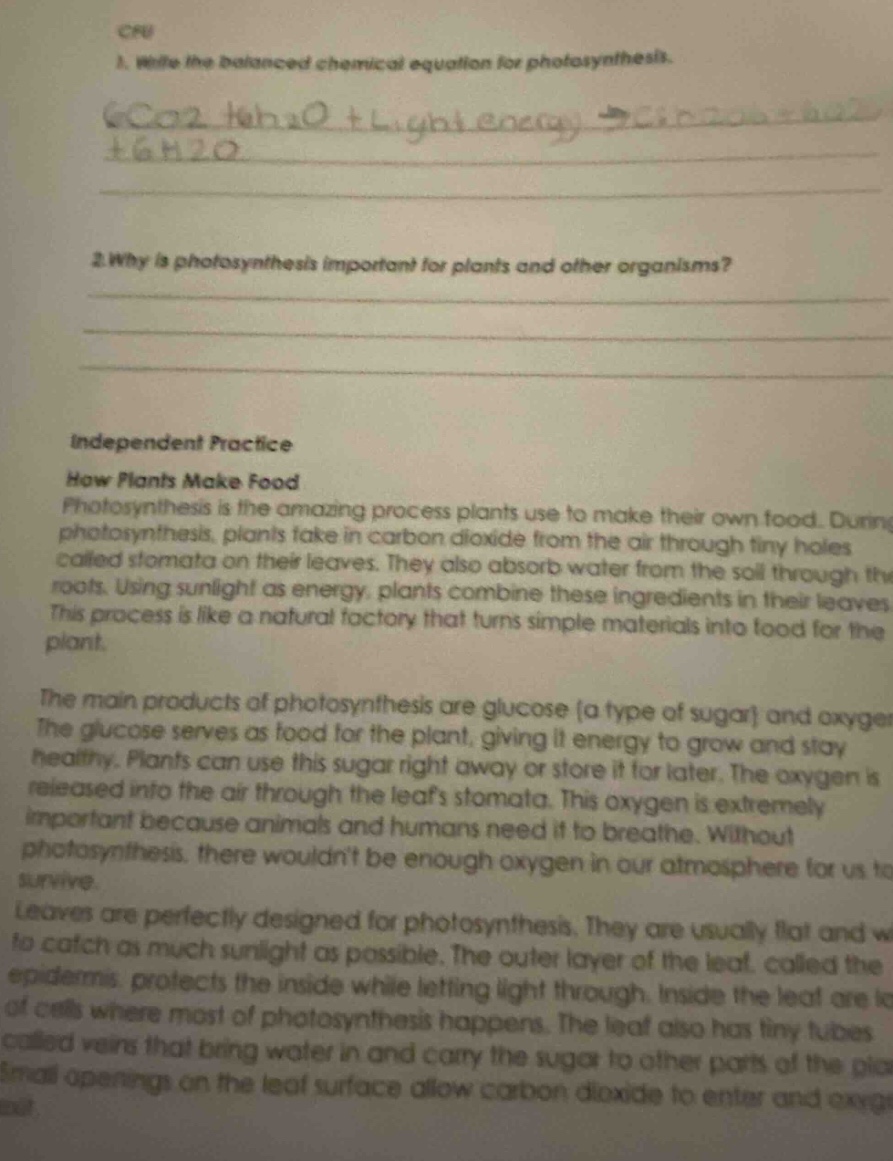
- write the balanced chemical equation for photosynthesis.
- why is photosynthesis important for plants and other organisms?
independent practice
how plants make food
photosynthesis is the amazing process plants use to make their own food. during photosynthesis, plants take in carbon dioxide from the air through tiny holes called stomata on their leaves. they also absorb water from the soil through the roots. using sunlight as energy, plants combine these ingredients in their leaves. this process is like a natural factory that turns simple materials into food for the plant.
the main products of photosynthesis are glucose (a type of sugar) and oxygen. the glucose serves as food for the plant, giving it energy to grow and stay healthy. plants can use this sugar right away or store it for later. the oxygen is released into the air through the leaf’s stomata. this oxygen is extremely important because animals and humans need it to breathe. without photosynthesis, there wouldn’t be enough oxygen in our atmosphere for us to survive.
leaves are perfectly designed for photosynthesis. they are usually flat and wide to catch as much sunlight as possible. the outer layer of the leaf, called the epidermis, protects the inside while letting light through. inside the leaf are lots of cells where most of photosynthesis happens. the leaf also has tiny tubes called veins that bring water in and carry the sugar to other parts of the plant. small openings on the leaf surface allow carbon dioxide to enter and oxygen to exit.
Question 1: Write the balanced chemical equation for photosynthesis.
Step 1: Recall the reactants and products of photosynthesis.
The reactants are carbon dioxide ($\ce{CO_2}$), water ($\ce{H_2O}$), and light energy. The products are glucose ($\ce{C_6H_{12}O_6}$) and oxygen ($\ce{O_2}$).
Step 2: Balance the carbon atoms.
There are 6 carbon atoms in glucose, so we need 6 $\ce{CO_2}$ molecules: $6\ce{CO_2}$.
Step 3: Balance the hydrogen atoms.
There are 12 hydrogen atoms in glucose, so we need 6 $\ce{H_2O}$ molecules (since each $\ce{H_2O}$ has 2 hydrogen atoms: $6\times2 = 12$): $6\ce{H_2O}$.
Step 4: Balance the oxygen atoms.
On the reactant side, from $6\ce{CO_2}$ we have $6\times2 = 12$ oxygen atoms, and from $6\ce{H_2O}$ we have $6\times1 = 6$ oxygen atoms, so total reactant oxygen is $12 + 6 = 18$. On the product side, glucose has 6 oxygen atoms, so the oxygen gas ($\ce{O_2}$) must provide $18 - 6 = 12$ oxygen atoms. Since each $\ce{O_2}$ molecule has 2 oxygen atoms, we need $\frac{12}{2}=6$ $\ce{O_2}$ molecules.
Step 5: Write the balanced equation.
Putting it all together with light energy as the energy source: $6\ce{CO_2} + 6\ce{H_2O} \xrightarrow{\text{Light Energy}} \ce{C_6H_{12}O_6} + 6\ce{O_2}$
- For plants: Photosynthesis produces glucose, which acts as food. This glucose provides the energy plants need to grow, develop, and maintain their health. Plants can use the glucose immediately for energy or store it for later use.
- For other organisms (like animals and humans): Photosynthesis releases oxygen into the atmosphere. Most aerobic organisms (including animals and humans) require oxygen to breathe and perform cellular respiration to obtain energy. Additionally, the glucose produced by plants (and the energy stored in it) is passed up the food chain when plants are consumed by other organisms, providing energy for those organisms as well. Without photosynthesis, there would not be enough oxygen in the atmosphere to support aerobic life, and the base of the food chain (plants as producers) would not exist, disrupting the entire ecosystem.

Snap & solve any problem in the app
Get step-by-step solutions on Sovi AI
Photo-based solutions with guided steps
Explore more problems and detailed explanations
$6\ce{CO_2} + 6\ce{H_2O} \xrightarrow{\text{Light Energy}} \ce{C_6H_{12}O_6} + 6\ce{O_2}$