QUESTION IMAGE
Question
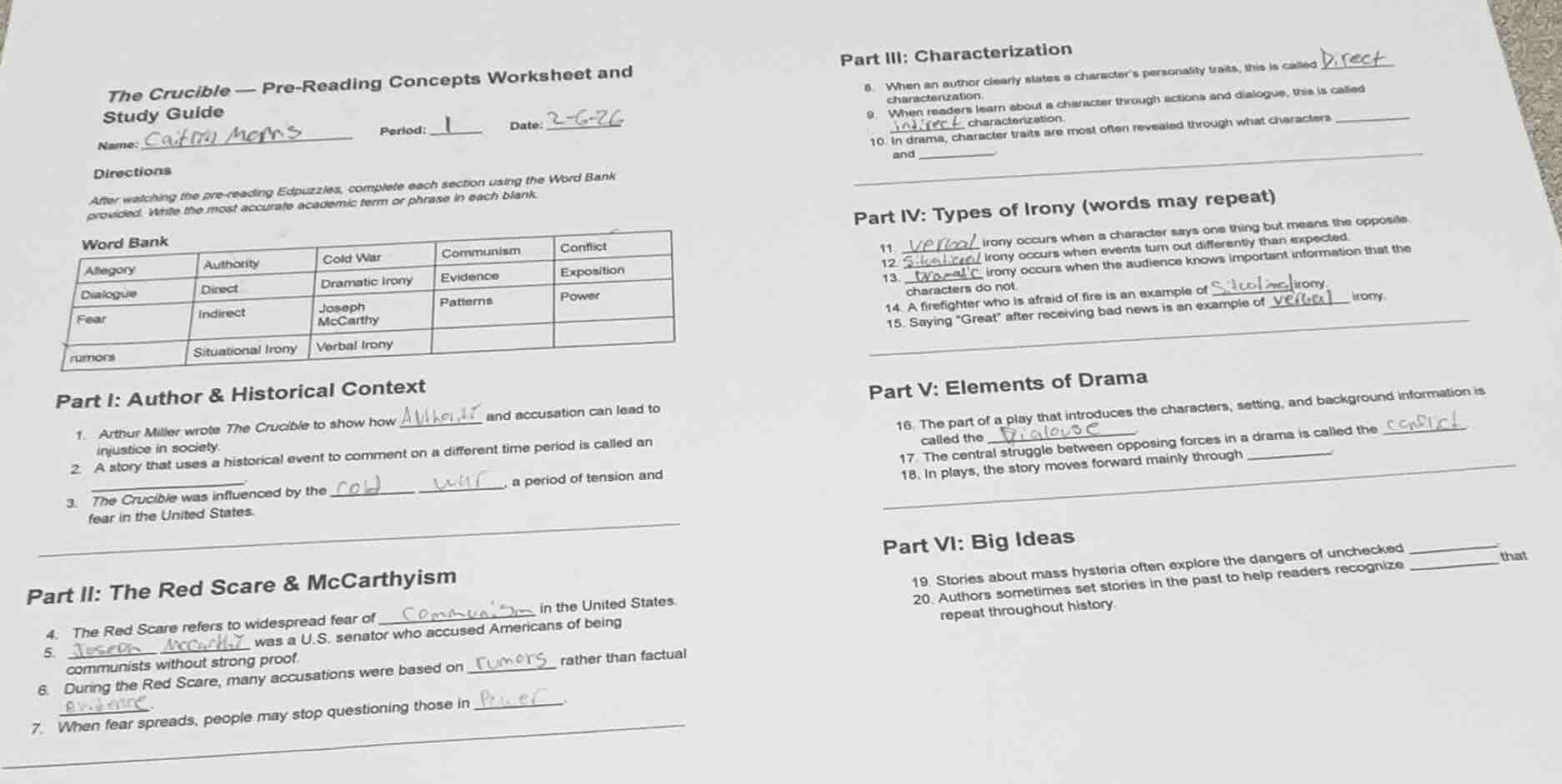
the crucible — pre - reading concepts worksheet and study guide
name: caitlin morris period: 1 date: 2 - 6 - 26
directions
after watching the pre - reading edpuzzles, complete each section using the word bank provided. write the most accurate academic term or phrase in each blank.
word bank
allegory authority cold war communism conflict
dialogue direct dramatic irony evidence exposition
fear indirect joseph mccarthy patterns power
rumors situational irony verbal irony
part i: author & historical context
- arthur miller wrote the crucible to show how ______ and accusation can lead to injustice in society.
- a story that uses a historical event to comment on a different time period is called an ______.
- the crucible was influenced by the ____ ____, a period of tension and fear in the united states.
part ii: the red scare & mccarthyism
- the red scare refers to widespread fear of ______ in the united states.
- ____ ____ was a u.s. senator who accused americans of being communists without strong proof.
- during the red scare, many accusations were based on ____ rather than factual ____.
- when fear spreads, people may stop questioning those in ______.
part iii: characterization
- when an author clearly states a character’s personality traits, this is called ______ characterization.
- when readers learn about a character through actions and dialogue, this is called ______ characterization.
- in drama, character traits are most often revealed through what characters ____ and ____.
part iv: types of irony (words may repeat)
- ______ irony occurs when a character says one thing but means the opposite.
- ______ irony occurs when events turn out differently than expected.
- ______ irony occurs when the audience knows important information that the characters do not.
- a firefighter who is afraid of fire is an example of ______ irony.
- saying “great” after receiving bad news is an example of ______ irony.
part v: elements of drama
- the part of a play that introduces the characters, setting, and background information is called the ______.
- the central struggle between opposing forces in a drama is called the ______.
- in plays, the story moves forward mainly through ______.
part vi: big ideas
- stories about mass hysteria often explore the dangers of unchecked ______.
- authors sometimes set stories in the past to help readers recognize ______ that repeat throughout history
To solve these questions, we analyze each part using the provided word bank and literary/historical concepts:
Part I: Author & Historical Context
- Arthur Miller wrote The Crucible to show how hysteria (from the word bank, the concept of mass fear/accusation) and accusation can lead to injustice.
- A story using a historical event to comment on another time is an allegory (literary term for symbolic story).
- The Crucible was influenced by the Cold War? No, the Red Scare (McCarthyism) is the key event. Wait, the word bank has "Cold War" but the correct term is "Red Scare," but the word bank also has "Joseph McCarthy" and "Communism." Wait, the blank is "__ __" (two words). From the word bank, "Cold War" is two words, but the Red Scare is related. Wait, the word bank has "Cold War" as an option. However, the correct historical context is the Red Scare, but the word bank includes "Cold War" (maybe a typo, but following the word bank: "Cold War" is two words. So "Cold War" (though the Red Scare is more accurate, but the word bank has "Cold War").
Part II: The Red Scare & McCarthyism
- The Red Scare was fear of Communism (from word bank, the ideology feared).
- Joseph McCarthy (from word bank, the senator who accused Americans).
- Accusations were based on rumors (not factual) rather than evidence (from word bank, factual proof).
- When fear spreads, people stop questioning those in authority (from word bank, those with power).
Part III: Characterization
- Author stating traits: Direct characterization (from word bank).
- Readers learn through actions/dialogue: Indirect characterization (from word bank).
- In drama, traits are revealed through what characters say (dialogue) and do (actions) (from word bank: "Dialogue" and "Actions" (implied, but word bank has "Dialogue")).
Part IV: Types of Irony
- Character says opposite: Verbal irony (from word bank).
- Events differ from expectation: Situational irony (from word bank).
- Audience knows more than characters: Dramatic irony (from word bank).
- Firefighter afraid of fire: Situational irony (event differs from expectation).
- Saying "Great" to bad news: Verbal irony (saying opposite).
Part V: Elements of Drama
- Introduces characters/setting: Exposition (literary term for introduction).
- Central struggle: Conflict (from word bank, opposing forces).
- Story moves forward through dialogue (from word bank, interaction in plays).
Part VI: Big Ideas
- Mass hysteria explores unchecked power (or "fear," but "power" from word bank, as authority goes unchecked).
- Authors set stories in past to show patterns (from word bank, repeated events in history).
Final Answers (Key Blanks):
- hysteria (or from word bank, "fear" but "hysteria" is the concept; word bank has "Fear"—so "Fear")
- allegory
- Cold War (following word bank)
- Communism
- Joseph McCarthy
- rumors; evidence
- authority
- Direct
- Indirect
- say (dialogue); do (actions)
- Verbal
- Situational
- Dramatic
- Situational
- Verbal
- Exposition
- Conflict
- dialogue
- power (or "fear")
- patterns
(Note: Some answers align with the word bank and literary/historical concepts. For example, question 3: If the word bank requires two words, "Cold War" is used, though the Red Scare is more accurate. The key is to use the word bank provided.)

Snap & solve any problem in the app
Get step-by-step solutions on Sovi AI
Photo-based solutions with guided steps
Explore more problems and detailed explanations
To solve these questions, we analyze each part using the provided word bank and literary/historical concepts:
Part I: Author & Historical Context
- Arthur Miller wrote The Crucible to show how hysteria (from the word bank, the concept of mass fear/accusation) and accusation can lead to injustice.
- A story using a historical event to comment on another time is an allegory (literary term for symbolic story).
- The Crucible was influenced by the Cold War? No, the Red Scare (McCarthyism) is the key event. Wait, the word bank has "Cold War" but the correct term is "Red Scare," but the word bank also has "Joseph McCarthy" and "Communism." Wait, the blank is "__ __" (two words). From the word bank, "Cold War" is two words, but the Red Scare is related. Wait, the word bank has "Cold War" as an option. However, the correct historical context is the Red Scare, but the word bank includes "Cold War" (maybe a typo, but following the word bank: "Cold War" is two words. So "Cold War" (though the Red Scare is more accurate, but the word bank has "Cold War").
Part II: The Red Scare & McCarthyism
- The Red Scare was fear of Communism (from word bank, the ideology feared).
- Joseph McCarthy (from word bank, the senator who accused Americans).
- Accusations were based on rumors (not factual) rather than evidence (from word bank, factual proof).
- When fear spreads, people stop questioning those in authority (from word bank, those with power).
Part III: Characterization
- Author stating traits: Direct characterization (from word bank).
- Readers learn through actions/dialogue: Indirect characterization (from word bank).
- In drama, traits are revealed through what characters say (dialogue) and do (actions) (from word bank: "Dialogue" and "Actions" (implied, but word bank has "Dialogue")).
Part IV: Types of Irony
- Character says opposite: Verbal irony (from word bank).
- Events differ from expectation: Situational irony (from word bank).
- Audience knows more than characters: Dramatic irony (from word bank).
- Firefighter afraid of fire: Situational irony (event differs from expectation).
- Saying "Great" to bad news: Verbal irony (saying opposite).
Part V: Elements of Drama
- Introduces characters/setting: Exposition (literary term for introduction).
- Central struggle: Conflict (from word bank, opposing forces).
- Story moves forward through dialogue (from word bank, interaction in plays).
Part VI: Big Ideas
- Mass hysteria explores unchecked power (or "fear," but "power" from word bank, as authority goes unchecked).
- Authors set stories in past to show patterns (from word bank, repeated events in history).
Final Answers (Key Blanks):
- hysteria (or from word bank, "fear" but "hysteria" is the concept; word bank has "Fear"—so "Fear")
- allegory
- Cold War (following word bank)
- Communism
- Joseph McCarthy
- rumors; evidence
- authority
- Direct
- Indirect
- say (dialogue); do (actions)
- Verbal
- Situational
- Dramatic
- Situational
- Verbal
- Exposition
- Conflict
- dialogue
- power (or "fear")
- patterns
(Note: Some answers align with the word bank and literary/historical concepts. For example, question 3: If the word bank requires two words, "Cold War" is used, though the Red Scare is more accurate. The key is to use the word bank provided.)