QUESTION IMAGE
Question
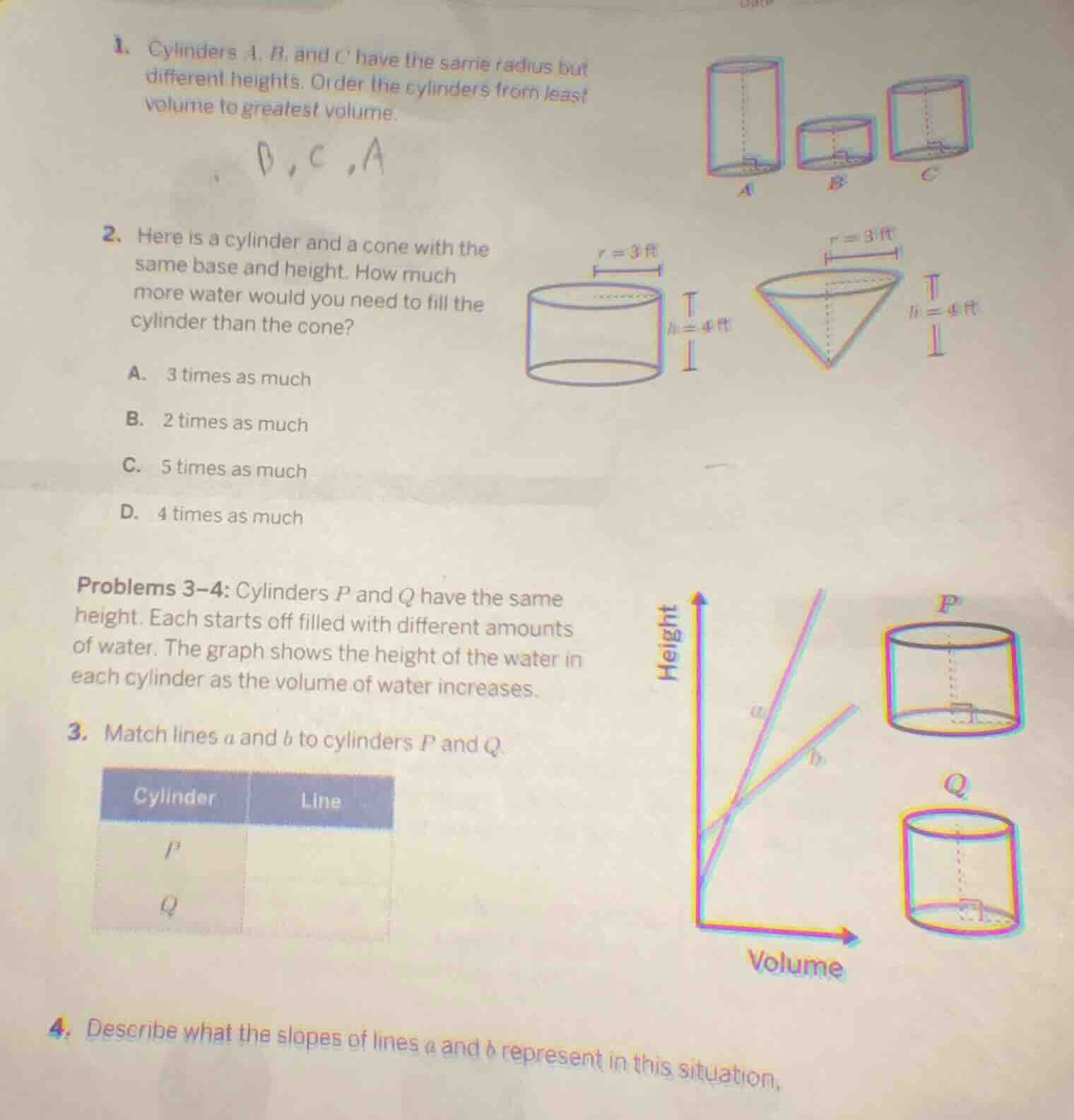
- cylinders a, b, and c have the same radius but different heights. order the cylinders from least volume to greatest volume.
- here is a cylinder and a cone with the same base and height. how much more water would you need to fill the cylinder than the cone?
a. 3 times as much
b. 2 times as much
c. 5 times as much
d. 4 times as much
problems 3–4: cylinders p and q have the same height. each starts off filled with different amounts of water. the graph shows the height of the water in each cylinder as the volume of water increases.
- match lines a and b to cylinders p and q.
| cylinder | line |
|---|---|
| q |
- describe what the slopes of lines a and b represent in this situation,
Step1: Recall cylinder volume formula
Volume of cylinder: $V_{cyl} = \pi r^2 h$
Step2: Recall cone volume formula
Volume of cone: $V_{cone} = \frac{1}{3}\pi r^2 h$
Step3: Calculate volume difference
Difference: $V_{cyl} - V_{cone} = \pi r^2 h - \frac{1}{3}\pi r^2 h = \frac{2}{3}\pi r^2 h$
Step4: Compare difference to cone volume
$\frac{V_{cyl}-V_{cone}}{V_{cone}} = \frac{\frac{2}{3}\pi r^2 h}{\frac{1}{3}\pi r^2 h} = 2$
Brief Explanations
- For cylinders with equal radius, volume is directly proportional to height. From the diagram, height of B < C < A, so volume follows the same order.
- For cylinders of equal height, a wider radius means more volume is needed to increase height. Cylinder P has a larger radius, so height increases more slowly with volume (matches line b). Cylinder Q has a smaller radius, so height increases more quickly with volume (matches line a).
- Slope is height per unit volume, so it represents the inverse of the cylinder's base area: how much the water height rises for each unit of added volume.

Snap & solve any problem in the app
Get step-by-step solutions on Sovi AI
Photo-based solutions with guided steps
Explore more problems and detailed explanations
B. 2 times as much
---