QUESTION IMAGE
Question
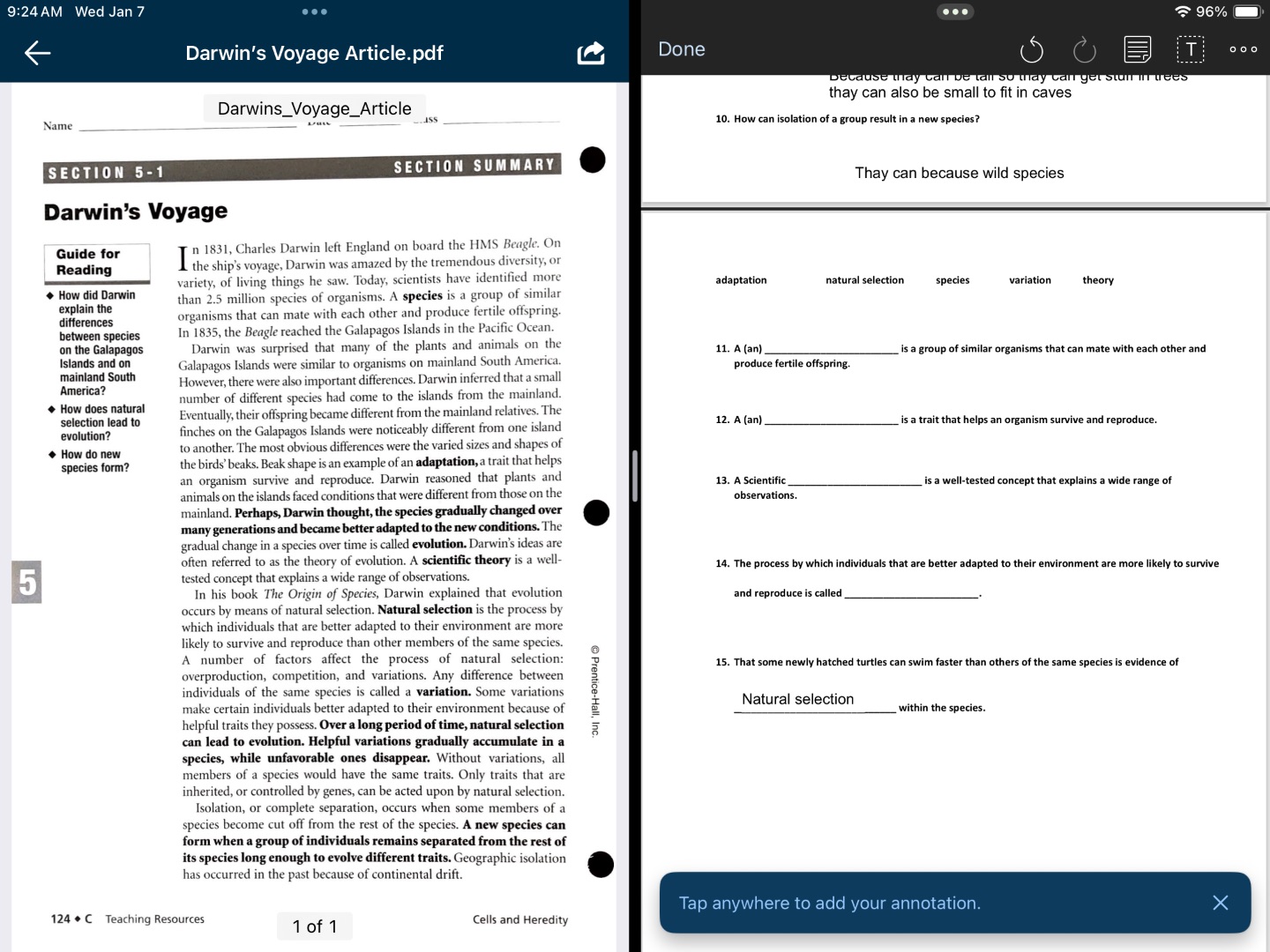
darwins voyage
guide for reading
- how did darwin explain the differences between species on the galapagos islands and on mainland south america?
- how does natural selection lead to evolution?
- how do new species form?
in 1831, charles darwin left england on board the hms beagle. on the ships voyage, darwin was amazed by the tremendous diversity, or variety, of living things he saw. today, scientists have identified more than 2.5 million species of organisms. a species is a group of similar organisms that can mate with each other and produce fertile offspring. in 1835, the beagle reached the galapagos islands in the pacific ocean.
darwin was surprised that many of the plants and animals on the galapagos islands were similar to organisms on mainland south america. however, there were also important differences. darwin inferred that a small number of different species had come to the islands from the mainland. eventually, their offspring became different from the mainland relatives. the finches on the galapagos islands were noticeably different from one island to another. the most obvious differences were the varied sizes and shapes of the birds beaks. beak shape is an example of an adaptation, a trait that helps an organism survive and reproduce. darwin reasoned that plants and animals on the islands faced conditions that were different from those on the mainland. perhaps, darwin thought, the species gradually changed over many generations and became better adapted to the new conditions. the gradual change in a species over time is called evolution. darwins ideas are often referred to as the theory of evolution. a scientific theory is a well - tested concept that explains a wide range of observations.
in his book the origin of species, darwin explained that evolution occurs by means of natural selection. natural selection is the process by which individuals that are better adapted to their environment are more likely to survive and reproduce than other members of the same species. a number of factors affect the process of natural selection: overproduction, competition, and variations. any difference between individuals of the same species is called a variation. some variations make certain individuals better adapted to their environment because of helpful traits they possess. over a long period of time, natural selection can lead to evolution. helpful variations gradually accumulate in a species, while unfavorable ones disappear. without variations, all members of a species would have the same traits. only traits that are inherited, or controlled by genes, can be acted upon by natural selection.
isolation, or complete separation, occurs when some members of a species become cut off from the rest of the species. a new species can form when a group of individuals remains separated from the rest of its species long enough to evolve different traits. geographic isolation has occurred in the past because of continental drift.
- how can isolation of a group result in a new species?
thay can because wild species
adaptation natural selection species variation theory
- a (an) ________ is a group of similar organisms that can mate with each other and produce fertile offspring.
- a (an) ________ is a trait that helps an organism survive and reproduce.
- a scientific ________ is a well - tested concept that explains a wide range of observations.
- the process by which individuals that are better adapted to their environment are more likely to survive and reproduce is called ________.
- that some newly hatched turtles can swim faster than others of the same species is evidence of natural selection ________ within the species.
- Isolation splits a species into groups with no genetic exchange. Each group adapts to its unique environment, leading to reproductive isolation and new species.
- The definition of "species" matches the description of organisms that mate to produce fertile offspring.
- An "adaptation" is a trait enhancing survival/reproduction, as stated in the text.
- A scientific "theory" is a well-tested explanation for broad observations, per the article.
- "Natural selection" is the process where better-adapted individuals survive and reproduce more.
- Differences between individuals of the same species (like swimming speed in turtles) are defined as "variation" in the text.

Snap & solve any problem in the app
Get step-by-step solutions on Sovi AI
Photo-based solutions with guided steps
Explore more problems and detailed explanations
- Isolation prevents gene flow, so separated groups accumulate unique adaptations over time until they can no longer interbreed.
- species
- adaptation
- theory
- natural selection
- variation