QUESTION IMAGE
Question
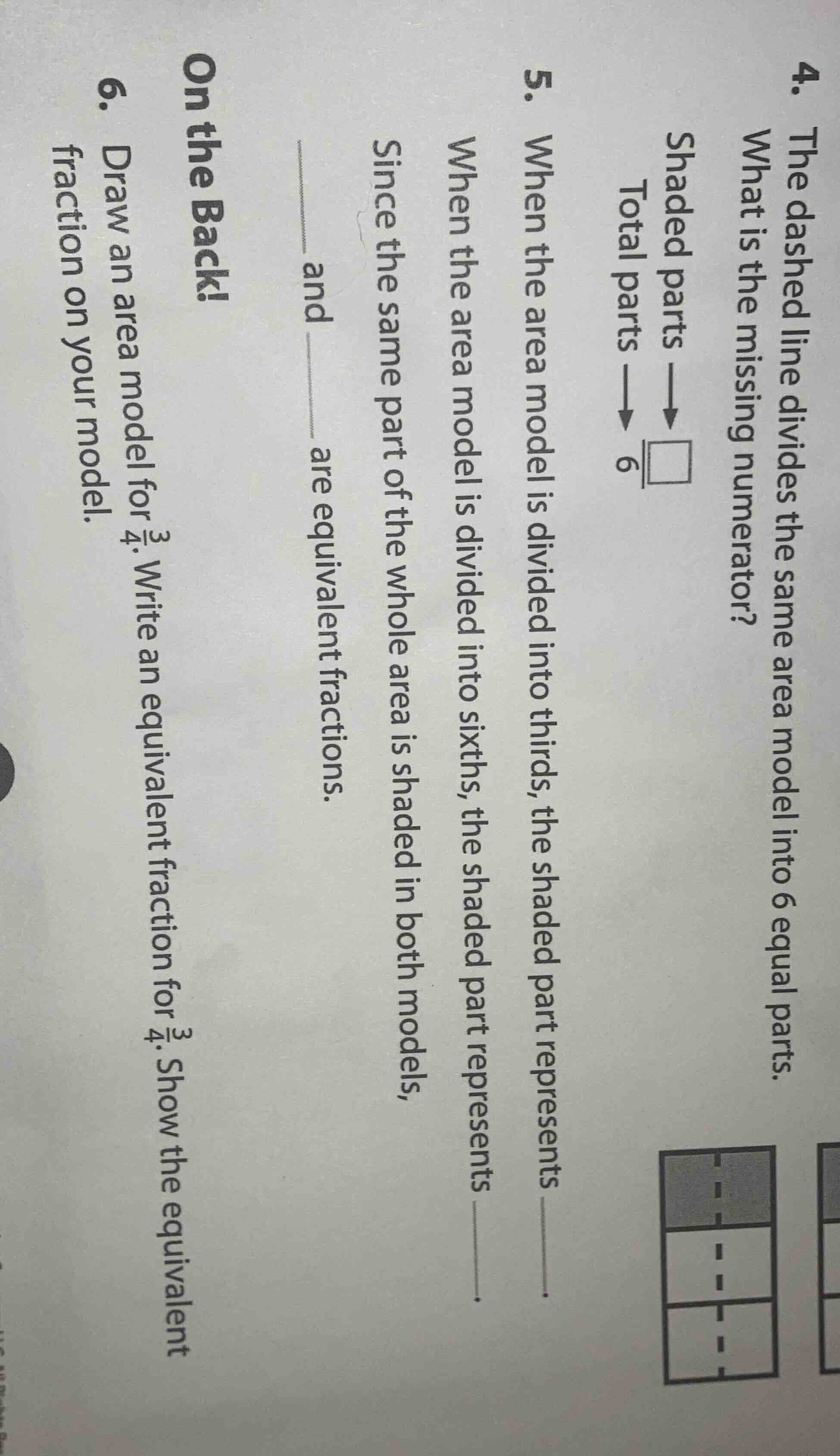
- the dashed line divides the same area model into 6 equal parts. what is the missing numerator?
shaded parts
total parts (\frac{square}{6})
- when the area model is divided into thirds, the shaded part represents ______.
when the area model is divided into sixths, the shaded part represents ______.
since the same part of the whole area is shaded in both models,
____ and ____ are equivalent fractions.
on the back!
- draw an area model for (\frac{3}{4}). write an equivalent fraction for (\frac{3}{4}). show the equivalent fraction on your model.
Response
Question 4:
Step1: Analyze the diagram (assuming the shaded parts: from the image, the shaded part is 2 out of 3 parts when divided into thirds? Wait, no, the total parts are 6. Wait, maybe the original model (before dashed line) was divided into 3 parts, shaded 1? Wait, no, let's re-express. Wait, the dashed line divides into 6 equal parts. Let's see, if originally, maybe the shaded part was 2 when divided into 3? Wait, no, the problem says "the dashed line divides the same area model into 6 equal parts. What is the missing numerator? Shaded parts, Total parts $\frac{\square}{6}$". Wait, maybe the original shaded part was 1 when total was 3? Wait, no, let's think of equivalent fractions. If the original was $\frac{1}{3}$, then to get denominator 6, multiply numerator and denominator by 2: $\frac{1\times2}{3\times2}=\frac{2}{6}$. Wait, or maybe the shaded part in the original (before dashed) was 2 out of 3? No, maybe the diagram shows that when divided into 3 parts, shaded is 1, so when divided into 6, shaded is 2. Wait, let's check: $\frac{1}{3}=\frac{2}{6}$. So the missing numerator is 2.
Step1: Identify original fraction (assume original was $\frac{1}{3}$ from context, since dividing into 3 and then 6).
Step2: Find equivalent fraction with denominator 6. Multiply numerator and denominator of $\frac{1}{3}$ by 2: $\frac{1\times2}{3\times2}=\frac{2}{6}$.
Step1: When divided into thirds, the shaded part: let's assume the shaded part is 1 (if original was $\frac{1}{3}$). So when divided into thirds, the shaded part represents $\frac{1}{3}$.
Step2: When divided into sixths, the shaded part (equivalent) is $\frac{2}{6}$, so represents $\frac{2}{6}$ (or simplified $\frac{1}{3}$, but as a fraction with denominator 6, it's $\frac{2}{6}$). Then, since the same part is shaded, $\frac{1}{3}$ and $\frac{2}{6}$ are equivalent fractions.
Step1: Determine fraction for thirds: If shaded is 1 out of 3, it's $\frac{1}{3}$.
Step2: Determine fraction for sixths: Equivalent to $\frac{1}{3}$ is $\frac{2}{6}$.
Step3: State equivalent fractions: $\frac{1}{3}$ and $\frac{2}{6}$ (or whatever the actual shaded was, but based on equivalent, if original shaded was 1/3, then sixths is 2/6).
Step1: Draw a rectangle (area model) and divide it into 4 equal parts. Shade 3 of them (for $\frac{3}{4}$).
Step2: To find an equivalent fraction, multiply numerator and denominator by 2: $\frac{3\times2}{4\times2}=\frac{6}{8}$. So draw another rectangle, divide into 8 equal parts, shade 6.
Step1: Draw for $\frac{3}{4}$: Rectangle with 4 columns, shade 3.
Step2: Equivalent fraction: $\frac{3}{4}=\frac{6}{8}$ (multiply numerator and denominator by 2). Draw rectangle with 8 columns, shade 6.

Snap & solve any problem in the app
Get step-by-step solutions on Sovi AI
Photo-based solutions with guided steps
Explore more problems and detailed explanations
2