QUESTION IMAGE
Question
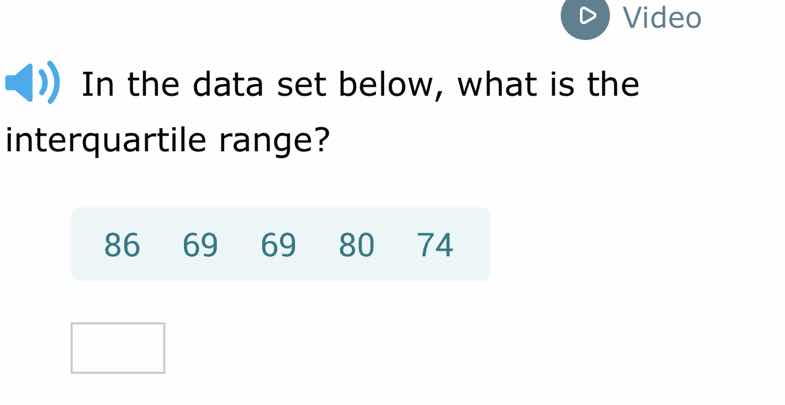
in the data set below, what is the interquartile range? 86 69 69 80 74
Step1: Order the data set
First, we need to order the given data set from smallest to largest. The data set is \( 86, 69, 69, 80, 74 \). After ordering, we get \( 69, 69, 74, 80, 86 \).
Step2: Find the median (Q2)
The median (second quartile, \( Q_2 \)) of a data set with \( n \) values is the middle value when \( n \) is odd. Here, \( n = 5 \), so the median is the 3rd value. The 3rd value in the ordered data set \( 69, 69, 74, 80, 86 \) is \( 74 \). So, \( Q_2=74 \).
Step3: Find Q1 (first quartile)
The first quartile (\( Q_1 \)) is the median of the lower half of the data set. The lower half of the data set (values below \( Q_2 \)) is \( 69, 69 \). The median of this two - value data set is the average of the two values. So, \( Q_1=\frac{69 + 69}{2}=69 \).
Step4: Find Q3 (third quartile)
The third quartile (\( Q_3 \)) is the median of the upper half of the data set. The upper half of the data set (values above \( Q_2 \)) is \( 80, 86 \). The median of this two - value data set is the average of the two values. So, \( Q_3=\frac{80+86}{2}=\frac{166}{2} = 83 \).
Step5: Calculate the interquartile range (IQR)
The interquartile range is calculated as \( IQR=Q_3 - Q_1 \). Substituting the values of \( Q_3 = 83 \) and \( Q_1 = 69 \), we get \( IQR=83 - 69=14 \).

Snap & solve any problem in the app
Get step-by-step solutions on Sovi AI
Photo-based solutions with guided steps
Explore more problems and detailed explanations
\( 14 \)