QUESTION IMAGE
Question
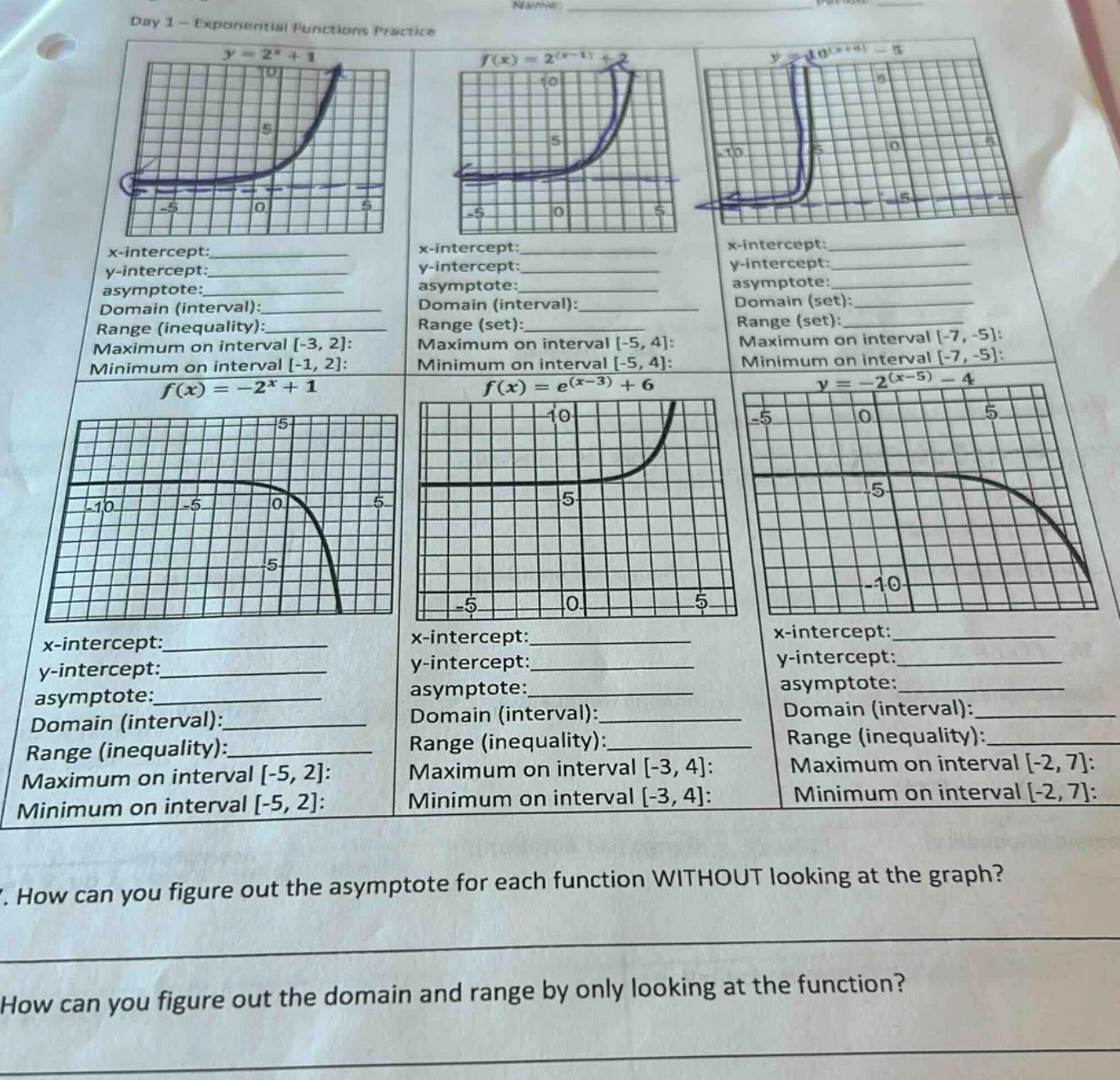
day 1 - exponential functions practice
for ( y = 2^x + 1 ):
x - intercept:
y - intercept:
asymptote:
domain (interval):
range (inequality):
maximum on interval (-3, 2):
minimum on interval (-1, 2):
for ( f(x) = 2^{(x - 1)} + 2 ):
x - intercept:
y - intercept:
asymptote:
domain (interval):
range (set):
maximum on interval (-5, 4):
minimum on interval (-5, 4):
for ( y = 10^{(x + 6)} - 5 ):
x - intercept:
y - intercept:
asymptote:
domain (set):
range (set):
maximum on interval (-7, -5):
minimum on interval (-7, -5):
for ( f(x) = -2^x + 1 ):
x - intercept:
y - intercept:
asymptote:
domain (interval):
range (inequality):
maximum on interval (-5, 2):
minimum on interval (-5, 2):
for ( f(x) = e^{(x - 3)} + 6 ):
x - intercept:
y - intercept:
asymptote:
domain (interval):
range (inequality):
maximum on interval (-3, 4):
minimum on interval (-3, 4):
for ( y = -2^{(x - 5)} - 4 ):
x - intercept:
y - intercept:
asymptote:
domain (interval):
range (inequality):
maximum on interval (-2, 7):
minimum on interval (-2, 7):
- how can you figure out the asymptote for each function without looking at the graph?
how can you figure out the domain and range by only looking at the function?
Let's tackle the first function \( y = 2^x + 1 \) step by step:
x - intercept:
To find the x - intercept, we set \( y = 0 \) and solve for \( x \).
So, \( 0=2^x + 1 \)
\( 2^x=- 1 \)
But the exponential function \( 2^x>0 \) for all real \( x \), so there is no x - intercept.
y - intercept:
To find the y - intercept, we set \( x = 0 \) and solve for \( y \).
\( y=2^0 + 1=1 + 1 = 2 \)
Asymptote:
For the exponential function of the form \( y = a^x + k \) (where \( a>0,a
eq1 \)), the horizontal asymptote is \( y = k \).
In the function \( y = 2^x+1 \), \( k = 1 \), so the horizontal asymptote is \( y = 1 \)
Domain (interval):
The domain of an exponential function \( y = a^x + k \) ( \( a>0,a
eq1 \)) is all real numbers. So the domain is \( (-\infty,\infty) \)
Range (inequality):
Since \( 2^x>0 \) for all real \( x \), then \( 2^x + 1>0 + 1=1 \). So the range is \( y>1 \)
Maximum on interval \([- 3,2]\):
The function \( y = 2^x+1 \) is an increasing function (because the base \( 2>1 \)). So on the interval \([-3,2]\), the maximum value occurs at \( x = 2 \)
\( y(2)=2^2 + 1=4 + 1=5 \)
Minimum on interval \([-1,2]\):
Since the function is increasing, on the interval \([-1,2]\), the minimum value occurs at \( x=-1 \)
\( y(-1)=2^{-1}+1=\frac{1}{2}+1=\frac{3}{2} = 1.5 \)
Now for the function \( f(x)=2^{(x - 1)}+2 \):
x - intercept:
Set \( f(x)=0 \), so \( 0 = 2^{(x - 1)}+2 \)
\( 2^{(x - 1)}=-2 \)
Since \( 2^{(x - 1)}>0 \) for all real \( x \), there is no x - intercept.
y - intercept:
Set \( x = 0 \), \( f(0)=2^{(0 - 1)}+2=\frac{1}{2}+2=\frac{1 + 4}{2}=\frac{5}{2}=2.5 \)
Asymptote:
For the function \( f(x)=a^{(x - h)}+k \) ( \( a>0,a
eq1 \) ), the horizontal asymptote is \( y = k \). Here \( k = 2 \), so the horizontal asymptote is \( y = 2 \)
Domain (interval):
The domain of an exponential function \( f(x)=2^{(x - 1)}+2 \) is all real numbers. So the domain is \( (-\infty,\infty) \)
Range (set):
Since \( 2^{(x - 1)}>0 \) for all real \( x \), then \( 2^{(x - 1)}+2>0 + 2 = 2 \). So the range is \( \{y\in\mathbb{R}:y > 2\} \)
Maximum on interval \([-5,4]\):
The function \( f(x)=2^{(x - 1)}+2 \) is increasing (base \( 2>1 \)). So on the interval \([-5,4]\), the maximum occurs at \( x = 4 \)
\( f(4)=2^{(4 - 1)}+2=8 + 2 = 10 \)
Minimum on interval \([-5,4]\):
Since the function is increasing, on the interval \([-5,4]\), the minimum occurs at \( x=-5 \)
\( f(-5)=2^{(-5 - 1)}+2=2^{-6}+2=\frac{1}{64}+2=\frac{1 + 128}{64}=\frac{129}{64}\approx2.015625 \)
For the function \( y = 10^{(x + 6)}-5 \):
x - intercept:
Set \( y = 0 \), so \( 0=10^{(x + 6)}-5 \)
\( 10^{(x + 6)}=5 \)
Take the common logarithm of both sides: \( \log_{10}(10^{(x + 6)})=\log_{10}(5) \)
\( x + 6=\log_{10}(5)\approx0.69897 \)
\( x=\log_{10}(5)-6\approx0.69897 - 6=-5.30103 \)
y - intercept:
Set \( x = 0 \), \( y = 10^{(0 + 6)}-5=10^6-5 = 999995 \)
Asymptote:
For the function \( y = a^{(x + h)}-k \) ( \( a>0,a
eq1 \) ), the horizontal asymptote is \( y=-k \) (wait, no, for \( y = a^{(x + h)}+k \), asymptote is \( y = k \)). Here the function is \( y = 10^{(x + 6)}-5 \), so the horizontal asymptote is \( y=-5 \)
Domain (set):
The domain of an exponential function \( y = 10^{(x + 6)}-5 \) is all real numbers. So the domain is \( \{x\in\mathbb{R}\} \)
Range (set):
Since \( 10^{(x + 6)}>0 \) for all real \( x \), then \( 10^{(x + 6)}-5>0 - 5=-5 \). So the range is \( \{y\in\mathbb{R}:y > - 5\} \)
Maximum on interval \([-7,-5]\):
The function \( y = 10^{(x + 6)}-5 \) is increasing (base…

Snap & solve any problem in the app
Get step-by-step solutions on Sovi AI
Photo-based solutions with guided steps
Explore more problems and detailed explanations
Let's tackle the first function \( y = 2^x + 1 \) step by step:
x - intercept:
To find the x - intercept, we set \( y = 0 \) and solve for \( x \).
So, \( 0=2^x + 1 \)
\( 2^x=- 1 \)
But the exponential function \( 2^x>0 \) for all real \( x \), so there is no x - intercept.
y - intercept:
To find the y - intercept, we set \( x = 0 \) and solve for \( y \).
\( y=2^0 + 1=1 + 1 = 2 \)
Asymptote:
For the exponential function of the form \( y = a^x + k \) (where \( a>0,a
eq1 \)), the horizontal asymptote is \( y = k \).
In the function \( y = 2^x+1 \), \( k = 1 \), so the horizontal asymptote is \( y = 1 \)
Domain (interval):
The domain of an exponential function \( y = a^x + k \) ( \( a>0,a
eq1 \)) is all real numbers. So the domain is \( (-\infty,\infty) \)
Range (inequality):
Since \( 2^x>0 \) for all real \( x \), then \( 2^x + 1>0 + 1=1 \). So the range is \( y>1 \)
Maximum on interval \([- 3,2]\):
The function \( y = 2^x+1 \) is an increasing function (because the base \( 2>1 \)). So on the interval \([-3,2]\), the maximum value occurs at \( x = 2 \)
\( y(2)=2^2 + 1=4 + 1=5 \)
Minimum on interval \([-1,2]\):
Since the function is increasing, on the interval \([-1,2]\), the minimum value occurs at \( x=-1 \)
\( y(-1)=2^{-1}+1=\frac{1}{2}+1=\frac{3}{2} = 1.5 \)
Now for the function \( f(x)=2^{(x - 1)}+2 \):
x - intercept:
Set \( f(x)=0 \), so \( 0 = 2^{(x - 1)}+2 \)
\( 2^{(x - 1)}=-2 \)
Since \( 2^{(x - 1)}>0 \) for all real \( x \), there is no x - intercept.
y - intercept:
Set \( x = 0 \), \( f(0)=2^{(0 - 1)}+2=\frac{1}{2}+2=\frac{1 + 4}{2}=\frac{5}{2}=2.5 \)
Asymptote:
For the function \( f(x)=a^{(x - h)}+k \) ( \( a>0,a
eq1 \) ), the horizontal asymptote is \( y = k \). Here \( k = 2 \), so the horizontal asymptote is \( y = 2 \)
Domain (interval):
The domain of an exponential function \( f(x)=2^{(x - 1)}+2 \) is all real numbers. So the domain is \( (-\infty,\infty) \)
Range (set):
Since \( 2^{(x - 1)}>0 \) for all real \( x \), then \( 2^{(x - 1)}+2>0 + 2 = 2 \). So the range is \( \{y\in\mathbb{R}:y > 2\} \)
Maximum on interval \([-5,4]\):
The function \( f(x)=2^{(x - 1)}+2 \) is increasing (base \( 2>1 \)). So on the interval \([-5,4]\), the maximum occurs at \( x = 4 \)
\( f(4)=2^{(4 - 1)}+2=8 + 2 = 10 \)
Minimum on interval \([-5,4]\):
Since the function is increasing, on the interval \([-5,4]\), the minimum occurs at \( x=-5 \)
\( f(-5)=2^{(-5 - 1)}+2=2^{-6}+2=\frac{1}{64}+2=\frac{1 + 128}{64}=\frac{129}{64}\approx2.015625 \)
For the function \( y = 10^{(x + 6)}-5 \):
x - intercept:
Set \( y = 0 \), so \( 0=10^{(x + 6)}-5 \)
\( 10^{(x + 6)}=5 \)
Take the common logarithm of both sides: \( \log_{10}(10^{(x + 6)})=\log_{10}(5) \)
\( x + 6=\log_{10}(5)\approx0.69897 \)
\( x=\log_{10}(5)-6\approx0.69897 - 6=-5.30103 \)
y - intercept:
Set \( x = 0 \), \( y = 10^{(0 + 6)}-5=10^6-5 = 999995 \)
Asymptote:
For the function \( y = a^{(x + h)}-k \) ( \( a>0,a
eq1 \) ), the horizontal asymptote is \( y=-k \) (wait, no, for \( y = a^{(x + h)}+k \), asymptote is \( y = k \)). Here the function is \( y = 10^{(x + 6)}-5 \), so the horizontal asymptote is \( y=-5 \)
Domain (set):
The domain of an exponential function \( y = 10^{(x + 6)}-5 \) is all real numbers. So the domain is \( \{x\in\mathbb{R}\} \)
Range (set):
Since \( 10^{(x + 6)}>0 \) for all real \( x \), then \( 10^{(x + 6)}-5>0 - 5=-5 \). So the range is \( \{y\in\mathbb{R}:y > - 5\} \)
Maximum on interval \([-7,-5]\):
The function \( y = 10^{(x + 6)}-5 \) is increasing (base \( 10>1 \)). On the interval \([-7,-5]\), the maximum occurs at \( x=-5 \)
\( y(-5)=10^{(-5 + 6)}-5=10^{1}-5 = 5 \)
Minimum on interval \([-7,-5]\):
Since the function is increasing, on the interval \([-7,-5]\), the minimum occurs at \( x=-7 \)
\( y(-7)=10^{(-7 + 6)}-5=10^{-1}-5=\frac{1}{10}-5=-4.9 \)
For the function \( f(x)=-2^x + 1 \):
x - intercept:
Set \( f(x)=0 \), so \( 0=-2^x + 1 \)
\( 2^x=1 \)
\( x = 0 \) (since \( 2^0 = 1 \))
y - intercept:
Set \( x = 0 \), \( f(0)=-2^0 + 1=-1 + 1 = 0 \)
Asymptote:
For the function \( f(x)=-a^x + k \) ( \( a>0,a
eq1 \) ), the horizontal asymptote is \( y = k \). Here \( k = 1 \), so the horizontal asymptote is \( y = 1 \)
Domain (interval):
The domain of \( f(x)=-2^x + 1 \) is all real numbers. So the domain is \( (-\infty,\infty) \)
Range (inequality):
Since \( 2^x>0 \), then \( - 2^x<0 \), and \( -2^x + 1<0 + 1 = 1 \). So the range is \( y<1 \)
Maximum on interval \([-5,2]\):
The function \( f(x)=-2^x + 1 \) is decreasing (because the coefficient of \( 2^x \) is negative). So on the interval \([-5,2]\), the maximum occurs at \( x=-5 \)
\( f(-5)=-2^{-5}+1=-\frac{1}{32}+1=\frac{31}{32}\approx0.96875 \)
Minimum on interval \([-5,2]\):
Since the function is decreasing, on the interval \([-5,2]\), the minimum occurs at \( x = 2 \)
\( f(2)=-2^2 + 1=-4 + 1=-3 \)
For the function \( f(x)=e^{(x - 3)}+6 \):
x - intercept:
Set \( f(x)=0 \), so \( 0=e^{(x - 3)}+6 \)
\( e^{(x - 3)}=-6 \)
Since \( e^{(x - 3)}>0 \) for all real \( x \), there is no x - intercept.
y - intercept:
Set \( x = 0 \), \( f(0)=e^{(0 - 3)}+6=e^{-3}+6=\frac{1}{e^3}+6\approx\frac{1}{20.0855}+6\approx0.0498+6 = 6.0498 \)
Asymptote:
For the function \( f(x)=e^{(x - h)}+k \), the horizontal asymptote is \( y = k \). Here \( k = 6 \), so the horizontal asymptote is \( y = 6 \)
Domain (interval):
The domain of \( f(x)=e^{(x - 3)}+6 \) is all real numbers. So the domain is \( (-\infty,\infty) \)
Range (inequality):
Since \( e^{(x - 3)}>0 \) for all real \( x \), then \( e^{(x - 3)}+6>0 + 6 = 6 \). So the range is \( y>6 \)
Maximum on interval \([-3,4]\):
The function \( f(x)=e^{(x - 3)}+6 \) is increasing (since the base \( e>1 \)). So on the interval \([-3,4]\), the maximum occurs at \( x = 4 \)
\( f(4)=e^{(4 - 3)}+6=e + 6\approx2.71828+6 = 8.71828 \)
Minimum on interval \([-3,4]\):
Since the function is increasing, on the interval \([-3,4]\), the minimum occurs at \( x=-3 \)
\( f(-3)=e^{(-3 - 3)}+6=e^{-6}+6=\frac{1}{e^6}+6\approx\frac{1}{403.4288}+6\approx0.00248+6 = 6.00248 \)
For the function \( y=-2^{(x - 5)}-4 \):
x - intercept:
Set \( y = 0 \), so \( 0=-2^{(x - 5)}-4 \)
\( 2^{(x - 5)}=-4 \)
Since \( 2^{(x - 5)}>0 \) for all real \( x \), there is no x - intercept.
y - intercept:
Set \( x = 0 \), \( y=-2^{(0 - 5)}-4=-2^{-5}-4=-\frac{1}{32}-4=-\frac{1 + 128}{32}=-\frac{129}{32}\approx - 4.03125 \)
Asymptote:
For the function \( y=-a^{(x - h)}-k \) ( \( a>0,a
eq1 \) ), the horizontal asymptote is \( y=-k \). Here \( k = 4 \), so the horizontal asymptote is \( y=-4 \)
Domain (interval):
The domain of \( y=-2^{(x - 5)}-4 \) is all real numbers. So the domain is \( (-\infty,\infty) \)
Range (inequality):
Since \( 2^{(x - 5)}>0 \), then \( -2^{(x - 5)}<0 \), and \( -2^{(x - 5)}-4<0 - 4=-4 \). So the range is \( y<-4 \)
Maximum on interval \([-2,7]\):
The function \( y=-2^{(x - 5)}-4 \) is decreasing (because the coefficient of \( 2^{(x - 5)} \) is negative). So on the interval \([-2,7]\), the maximum occurs at \( x=-2 \)
\( y(-2)=-2^{(-2 - 5)}-4=-2^{-7}-4=-\frac{1}{128}-4=-\frac{1 + 512}{128}=-\frac{513}{128}\approx - 3.99219 \)
Minimum on interval \([-2,7]\):
Since the function is decreasing, on the interval \([-2,7]\), the minimum occurs at \( x = 7 \)
\( y(7)=-2^{(7 - 5)}-4=-2^{2}-4=-4 - 4=-8 \)
How to find the asymptote without looking at the graph:
For an exponential function of the form \( y = a^x + k \) (or \( y=a^{(x - h)}+k \), \( y=-a^x + k \), \( y=-a^{(x - h)}-k \) etc.), the horizontal asymptote is determined by the constant term added or subtracted after the exponential part.
- For \( y = a^x + k \) ( \( a>0,a
eq1 \) ), as \( x
ightarrow-\infty \), \( a^x
ightarrow0 \) (if \( a > 1 \)) or \( a^x
ightarrow\infty \) (if \( 0 < a<1 \)), but in general, the horizontal asymptote is \( y = k \) when we have \( y=a^x + k \).
- For \( y=-a^x + k \), as \( x
ightarrow\infty \) (if \( a > 1 \)) or \( x
ightarrow-\infty \) (if \( 0 < a<1 \)), \( -a^x
ightarrow0 \) and the asymptote is \( y = k \)
- For \( y=a^x - k \), the asymptote is \( y=-k \) (since \( a^x
ightarrow0 \) and \( y
ightarrow - k \))
- For \( y=-a^x - k \), the asymptote is \( y=-k \) (since \( -a^x
ightarrow0 \) and \( y
ightarrow - k \))
How to find the domain and range by only looking at the function:
Domain:
- For exponential functions of the form \( y = a^x + k \), \( y=a^{(x - h)}+k \), \( y=-a^x + k \), \( y=-a^{(x - h)}-k \) (where \( a>0,a
eq1 \)) the domain is all real numbers. This is because we can plug in any real number for \( x \) into the exponential function and get a real - valued output. There are no restrictions on the input \( x \) (no square roots of negative numbers, no division by zero issues etc.)
Range:
- For \( y = a^x + k \) ( \( a>0,a
eq1 \)):
- Since \( a^x>0 \) for all real \( x \), then \( y=a^x + k>k \). So the range is \( y > k \)
- For \( y=-a^x + k \) ( \( a>0,a
eq1 \)):
- Since \( a^x>0 \), then \( -a^x<0 \), and \( y=-a^x + k
- For \( y=a^x - k \) ( \( a>0,a
eq1 \)):
- Since \( a^x>0 \), then \( y=a^x - k>-k \). So the range is \( y > - k \)
- For \( y=-a^x - k \) ( \( a>0,a
eq1 \)):
- Since \( a^x>0 \), then \( -a^x<0 \), and \( y=-a^x - k<-k \). So the range is \( y < - k \)
If you want to solve for other functions, you can follow similar steps based on the form of the exponential function.